
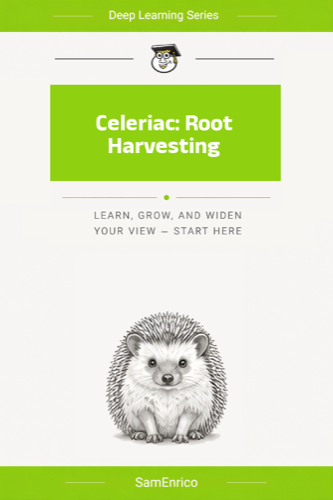
Non-FictionInformativeEducational
Celeriac: Root Harvesting eBook
This harvesting publication, published by SamEnric
by Sosa Lorrie
This harvesting publication, published by SamEnrico, covers Celeriac: Root Harvesting
Formats
Free sample
Chapter 1: The Forgotten Harvest--–- You have probably walked past celeriac a hundred times without noticing it. In the grocery store, it sits ignored next to the parsnips, a knobby, mud-colored orb that looks like something a gardener dug up by accident and decided to sell anyway. In seed catalogs, it occupies a single paragraph at the bottom of the celery page, described in language that ranges from apologetic ("requires patience") to outright discouraging ("challenging for beginners"). And yet, this unassuming vegetable—this lumpy, overlooked, botanically misunderstood root—may be one of the most valuable crops you can grow. It stores for six months without canning, freezing, or electricity.
It replaces potatoes in almost any recipe with a fraction of the carbohydrates. It thrives in conditions that would send tomatoes into fungal despair. And somewhere along the way, we forgot it existed.This book exists because celeriac deserves a second chance. Not as a curiosity for eccentric gardeners, but as a cornerstone of the resilient kitchen garden. Over the next twelve chapters, you will learn everything required to take this crop from seed to storage to supper.
But before we talk about planting schedules or pest management, you need to understand what celeriac actually is—because most people, including many experienced gardeners, get this wrong. And getting it wrong leads directly to the most common failures: roots the size of golf balls, bulbs that rot in storage, and the frustrated conviction that celeriac just isn't worth the trouble.It is worth the trouble. You just need to understand the bulb.What Celeriac Actually Is (And Why It Matters)Let us start with a fundamental truth that will save you years of frustration: celeriac is not a root. At least, not entirely. The part you eat is a swollen hypocotyl—that is botanical language for the lower part of the stem that connects the seedling's first leaves to the true root system.
If you cut a celeriac bulb in half, you will see a pattern of vascular rings that looks more like a kohlrabi or a turnip than a carrot or a parsnip. Those rings are modified stem tissue, engineered by evolution to store water and carbohydrates for the plant's second year of life.Why does this matter for the grower? Because stem tissue behaves differently than root tissue. It grows above the soil line, not below it. It responds to light exposure.
It splits when subjected to uneven watering because the cells are designed for steady expansion, not emergency inflation. And most critically, the swollen hypocotyl has a hard limit to its growth that is determined by the plant's genetics, not by how much space you give it underground. You cannot force a celeriac to become giant by piling soil around it the way you would with a potato. In fact, as you will learn in Chapter 5, burying the crown is a guaranteed path to rot.The scientific name tells the story: Apium graveolens var. rapaceum.
Apium graveolens is wild celery, the same species that gives us stalk celery, leaf celery, and the familiar garden herb. The rapaceum variety designation comes from the Latin rapum, meaning turnip-like. So celeriac is, literally, the turnip-shaped version of celery. It shares the same sharp, herbaceous flavor as celery stalks, but instead of investing its energy in long, fibrous petioles, it pours everything into that swollen stem base. This trade-off is the plant's evolutionary strategy for surviving lean winters in its native habitats.The Marsh Origins: Why Celeriac Drinks Like a Fish Celeriac did not evolve in a well-drained garden bed.
It evolved in the brackish marshes of southern Europe and western Asia, where the water table sits inches below the soil surface year-round. In those environments, drought is essentially impossible. The ground stays damp, cool, and consistently moist from autumn through spring. That is the environmental template that shaped every aspect of celeriac's physiology.This explains the single most common mistake new growers make: treating celeriac like a carrot. Carrots are adapted to well-drained, sandy soils that dry out between waterings.
They develop long taproots to chase water deeper into the profile. Celeriac does the opposite. It develops a shallow, fibrous root system that sits in the top six inches of soil, expecting constant moisture at that depth. When the soil dries out, even briefly, the plant experiences genuine physiological stress. Its leaves wilt.
Its stem growth stalls. And when water returns suddenly, the hypocotyl swells too quickly, splitting open like an overfilled water balloon.Here is the critical distinction that resolves one of the most persistent contradictions in celeriac cultivation: constant moisture does not mean waterlogged soil. In its native marshes, celeriac grew in soil that was damp but not submerged. The water table was high, but the top few inches of soil remained aerated. If you flood celeriac roots in stagnant water, they rot.
If you let them dry out completely, they crack. The goal—and you will hear this repeated throughout this book—is steady, never-fluctuating moisture in well-aerated soil. Think of a wrung-out sponge: damp to the touch, but no water drips when you squeeze it. That is the moisture level you are chasing.Throughout this book, you will encounter sidebars called The Grower's Calculus. These are short, memorable rules derived from actual crop failures.
Here is the first one:The Grower's Calculus – Water Wisdom: "If you can squeeze water from a handful of soil, you have overwatered. If the soil crumbles like dust, you have underwatered. Aim for a wrung-sponge feel—always. And never, under any circumstances, allow a complete dry-down followed by a heavy soak. That sequence is the fastest path to cracked roots."The Biennial Lie (And Why It Confuses Gardeners)Every gardening book will tell you that celeriac is a biennial.
In its first year, it grows vegetative mass—leaves and the swollen hypocotyl. In its second year, after exposure to winter cold, it flowers, produces seed, and dies. This is botanically accurate. But it is also misleading for the home grower, because it implies that the plant will naturally produce a harvestable bulb in year one and then flower in year two if left in the ground.Here is what actually happens: celeriac will bolt (send up a flower stalk) in its first year if exposed to certain environmental triggers, most notably a prolonged period of cold temperatures followed by warming. This is called vernalization, and it is the plant's way of saying, "I have experienced winter, so now I must reproduce before summer ends." A first-year bolting event is a disaster for the root grower.
Once the plant shifts its energy from stem storage to flower production, the hypocotyl stops swelling and actually begins to shrink as its reserves are mobilized for seed production. The root becomes woody, bitter, and essentially worthless.Understanding this explains why timing matters so much. You are not waiting patiently for a biennial plant to complete its natural two-year cycle. You are racing to keep the plant in its vegetative state for as long as possible, harvesting it before it receives the signal to reproduce. This is why the varieties introduced in Chapter 2 have different bolting resistances.
It is why the seedling management practices in Chapter 3 (avoiding cold shock during hardening off) are not optional. And…
This is the end of the free sample. Get the eBook to keep going. Buy now
About this book
Details
- Author
- Sosa Lorrie
- Publisher
- SamEnrico
- Language
- English
- Genre
- Non-Fiction, Informative, Educational
- Released
- 2026-05-18
- Pages (approx.)
- 143
- Available as
- eBook, Audiobook

Read better in the ZLOADR app
Your eBooks on your phone or tablet. Sign in with your SamEnrico account and start reading.
More by Sosa Lorrie
 Crime Scene Documentation GuideSosa Lorrie$11.99
 The Startup Bookkeeping DIY GuideSosa Lorrie$11.99
 Focus For Operations ManagersSosa Lorrie$11.99
 Failure Reframing ImposterSosa Lorrie$11.99
 ADA Section 504 Occupation StorySosa Lorrie$11.99
 Mobile Apps for Hypnosis RecordingSosa Lorrie$11.99
 Journey Method For Daily TasksSosa Lorrie$11.99
 Entrepreneur Time BlockingSosa Lorrie$11.99
 The Radiant Court of Queen Amina: Warrior Queen of ZazzauSosa Lorrie$11.99
 How to Produce a DrainSosa Lorrie$11.99
 How to Produce Popcorn and French Fry ScoopsSosa Lorrie$11.99
 Exploring Still Life Painting: Objects, Arrangement & SymbolismSosa Lorrie$11.99
You may also like
 Hong Kong Handover 1997Dunn Johnnie$11.99
 Zumba For Postnatal Recovery CourseNeal Christian$11.99
 Zumba for BeginnersLadner Nikia$11.99
 YouTube Comment Mining GuideHumes Pandora$12.99
 Worry Box MeditationCarlin Rudy$11.99
 Workplace Stress MeditationNguyen Lynn$11.99
 Workplace Stress and Sleep RepairHawley Ivory$11.99
 Workplace Perfectionism CureDelaney Jeffry$11.99
 Workplace Injustice Anger GuideWallen Isabelle$11.99
 Work Addiction and Burnout LinkGreenwood Ester$11.99
 Women in Yoga and WellnessBeattie Galina$11.99
 Women in Stand Up ComedyChun Evangeline$11.99