
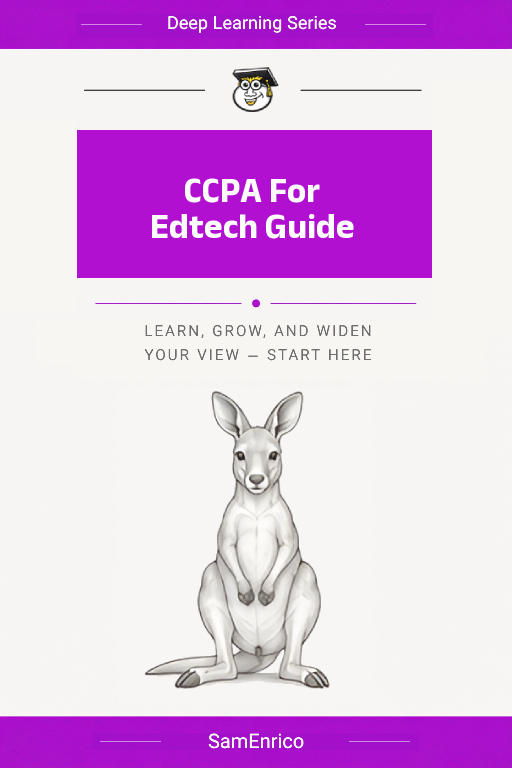
Non-FictionAnnual CheckupEdtechCCPA
CCPA For Edtech Guide eBook
Comply with California Consumer Privacy Act for ed
Comply with California Consumer Privacy Act for edtech platforms collecting student and parent personal information.
Formats
Free sample
Chapter 1: The Dual Mandate--The first time an Edtech founder told me they were "CCPA compliant" because their lawyer added a privacy policy link to the footer, I laughed. Then I realized they were serious. Then I realized they were about to be sued.That founder had built a beautiful learning platform used by twelve school districts across California. Students loved the gamified math exercises. Parents appreciated the real-time progress reports.
The company had raised seven million dollars. And somewhere in the parent portal code, buried deep in a third-party analytics script, a single line of Java Script was quietly sending student email hashes to an advertising network. Not for money. Not intentionally. Just because the founder had copied a boilerplate tracking snippet from a previous e-commerce project.That single line of code created a legal exposure of approximately four million dollars in potential statutory damages.This is the reality of CCPA compliance for Edtech.
It is not about checklists. It is not about privacy policies. It is about understanding that your platform serves two masters with diametrically opposed demands, and the law expects you to serve both perfectly.The first master is the school district. Under the Family Educational Rights and Privacy Act, under state education codes like California's Education Code Section 49073, under the contractual agreements you signed to get your product into classrooms, the school demands that you retain student data. Grades must be preserved for years.
Attendance records must be auditable. Special education classifications must follow the student from grade to grade. Delete a student's record too early, and you breach your contract with the district. Delete it too late, and you violate the parent's right to deletion under CCPA.The second master is the parent or student consumer. Under the California Consumer Privacy Act as amended by the California Privacy Rights Act of 2023, that consumer has the right to know what data you have collected about them, the right to delete that data, the right to opt out of the sale or sharing of that data, and the right to correct inaccurate information.
A parent can wake up on a Tuesday morning, decide they no longer want their child's data on your platform, submit a deletion request, and expect you to erase everything within forty-five days. Not ninety days. Not "when you get around to it." Forty-five calendar days.These two masters are not merely different. They are fundamentally opposed. The school wants retention.
The parent wants deletion. The school wants data to be shareable with other authorized educational vendors. The parent wants to know exactly who has their child's information and to stop any sharing they did not explicitly approve. And you, the Edtech vendor, are standing in the middle holding a platform that cannot simultaneously satisfy both without operational precision that most technology companies never develop.This chapter establishes the foundational framework that every subsequent chapter in this book builds upon. We will answer three questions with brutal honesty.
First, what exactly is CCPA and why does it apply to your Edtech platform? Second, are you a Business or a Service Provider under the law, because that distinction determines everything from your liability to your contractual obligations? Third, what is the specific scope of this book and how should you read it to get the maximum value in the minimum time?If you read only one chapter of this book, make it this one. The rest of the chapters provide the how. This chapter provides the what and the why.
And without the what and the why, the how will lead you to disaster.The Threshold Question Nobody Answers Correctly Let us start with the most basic question. Does the California Consumer Privacy Act even apply to your Edtech platform? The answer is almost certainly yes, but the path to that answer requires walking through three thresholds.The first threshold is revenue. CCPA applies to any for-profit entity that does business in California and has annual gross revenues exceeding twenty-five million dollars. If your Edtech platform generates more than twenty-five million dollars in revenue, you are a Business under CCPA.
Full stop. No exceptions. No educational exemptions. No school district loopholes.But here is where most Edtech founders get it wrong. The twenty-five million dollar threshold is not the only path to coverage.
It is not even the most common path for early-stage and mid-stage Edtech companies. The second threshold is data volume. CCPA applies to any entity that alone or in combination annually buys, receives, sells, or shares the personal information of fifty thousand or more consumers, households, or devices. Notice that this threshold does not require revenue. A free Edtech platform with zero revenue becomes subject to CCPA the moment it collects personal information from fifty thousand students or parents.
Fifty thousand is not a large number. A single medium-sized school district can have twenty thousand students. Add their parents, and you cross the threshold with two districts.The third threshold is revenue source. CCPA applies to any entity that derives fifty percent or more of its annual revenue from selling or sharing consumers' personal information. For most legitimate Edtech platforms, this threshold does not apply because you are not in the business of selling student data.
But be careful. Under CCPA, the definition of "sell" is broader than cash-for-data transactions. We will explore that definition thoroughly in Chapter Six. For now, understand that if any meaningful portion of your revenue comes from advertising based on student or parent data, you likely cross this threshold as well.Here is the critical insight that most compliance guides obscure. These thresholds are evaluated annually.
You do not get to ignore CCPA because you had forty-nine thousand consumers last year. The moment you cross fifty thousand, you are a Business. The moment your revenue hits twenty-five million and one dollars, you are a Business. There is no grace period. There is no safe harbor for the week before you cross the line.But wait, you might be thinking.
What about the educational institution exemption? Does that apply to Edtech vendors?The Educational Institution Trap This is where the confusion becomes dangerous. Under the California Consumer Privacy Act, there is a specific provision that exempts "educational institutions" from certain requirements. This exemption is derived from the Family Educational Rights and Privacy Act, which treats schools as the stewards of student data rather than commercial enterprises. Many Edtech vendors hear about this exemption and assume it applies to them.
It does not.Let me be absolutely clear. The educational institution exemption applies to the school district. It applies to the public school. It applies to the private school that meets specific criteria. It does not apply to the vendor that provides software to that school.
You are not an educational institution. You are a commercial entity that happens to sell into the education market. The law treats you accordingly.Consider a specific example. The Los Angeles Unified School District, with six hundred thousand students, is an educational institution. When LAUSD collects student data directly through its own systems, it may be exempt from certain CCPA provisions.
But an Edtech vendor that provides a reading assessment platform to LAUSD is not the school. That vendor is a…
This is the end of the free sample. Get the eBook to keep going. Buy now
About this book
Details
- Author
- Edmonds Donnette
- Publisher
- SamEnrico
- Language
- English
- Genre
- Non-Fiction, Annual Checkup, Edtech, CCPA
- Released
- 2026-06-01
- Pages (approx.)
- 149
- Available as
- eBook, Audiobook

Read better in the ZLOADR app
Your eBooks on your phone or tablet. Sign in with your SamEnrico account and start reading.
More by Edmonds Donnette
 Affirmations for High SensitivityEdmonds Donnette$11.99
 Walking Program For LongevityEdmonds Donnette$11.99
 Metta for Trauma Survivors GuideEdmonds Donnette$11.99
 Addiction Recovery Relationship GuideEdmonds Donnette$11.99
 Beginner Mindfulness for Financial StressEdmonds Donnette$11.99
 The Last Great Solo: The Psychological Battle of the PacificEdmonds Donnette$11.99
 The Silent Bidding War: How a $100M Free Agent Almost Broke the NBAEdmonds Donnette$11.99
 Turkish Student Safety GuideEdmonds Donnette$12.99
 Understanding Delirium TremensEdmonds Donnette$17.99
 Montessori TeacherEdmonds Donnette$11.99
 How to Become a School-plant ConsultantEdmonds Donnette$11.99
You may also like
 Hong Kong Handover 1997Dunn Johnnie$11.99
 Zumba For Postnatal Recovery CourseNeal Christian$11.99
 Zumba for BeginnersLadner Nikia$11.99
 YouTube Comment Mining GuideHumes Pandora$12.99
 Worry Box MeditationCarlin Rudy$11.99
 Workplace Stress MeditationNguyen Lynn$11.99
 Workplace Stress and Sleep RepairHawley Ivory$11.99
 Workplace Perfectionism CureDelaney Jeffry$11.99
 Workplace Injustice Anger GuideWallen Isabelle$11.99
 Work Addiction and Burnout LinkGreenwood Ester$11.99
 Women in Yoga and WellnessBeattie Galina$11.99
 Women in Stand Up ComedyChun Evangeline$11.99