
Non-FictionHealth & WellnessCBT
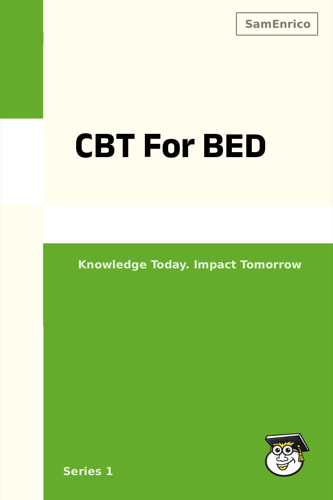
CBT For BED eBook
Teaches cognitive behavioral therapy for binge eat
by Carver Keith
Teaches cognitive behavioral therapy for binge eating cycles.
Formats
Free sample
Chapter 1: The Scarcity Brain--–- You are reading this because a part of you believes something is wrong with you. Not just with your eating—with your willpower, your character, your very ability to be a normal person around food. You have probably said some version of the following to yourself, often late at night, often while standing in front of an open refrigerator: Why can’t I just stop? Why do I keep doing this when I know better? What is wrong with me?Let me stop you right there.
Nothing is wrong with you. Not in the way you think.You have been told, directly or indirectly, that binge eating is a failure of self-discipline. That if you simply wanted recovery badly enough, you would have it. That your problem is that you are weak, lazy, or broken. Every diet book you have ever read has implied this, even when it dressed up the message in empowering language.
Take control. Master your cravings. Become the boss of your body. These phrases assume that you are currently not in control, not the master, not the boss—and that the only thing standing between you and freedom is more effort, more rules, more structure.Here is the truth that no diet book will ever tell you: Binge eating is not caused by a lack of willpower. It is caused by a predictable, hardwired neurological response to a specific set of conditions.
And those conditions are almost entirely created by the very solutions you have been taught to trust.You have been trying to solve hunger with starvation. You have been trying to solve craving with prohibition. And your brain—that ancient, beautiful, survival-obsessed organ—has been doing exactly what evolution designed it to do: treating scarcity as an emergency and food as a resource to be secured at all costs.This chapter will introduce you to the single most important concept in this entire book: the Scarcity Brain. Once you understand how it works, you will never see your binge urges the same way again. More importantly, you will stop blaming yourself for a biological reality.The Three Lies You Have Been Told About Binge Eating Before we build the new understanding, we must clear away the wreckage of the old one.
The diet industry, wellness culture, and even well-meaning doctors have fed you three fundamental lies about binge eating. Each of these lies keeps you trapped. Each of them is scientifically false.Lie #1: You Binge Because You Love Food Too Much This sounds reasonable on the surface. After all, you are eating large quantities of food—often foods that are highly palatable, sweet, salty, fatty. It seems logical to conclude that you have an overactive reward system, that your brain finds food too pleasurable, and that you are essentially addicted to the experience.The research says the opposite.
Studies of people with binge eating disorder show that the reward centers of the brain are often less responsive to food cues compared to controls—unless the person has been restricting. In other words, the problem is not that your brain finds food too rewarding. The problem is that your brain has learned that food is scarce, and scarcity turns every bite into an emergency.Think about the last time you ate a food that was completely permitted, available in unlimited quantities, and carried no moral weight. Perhaps it was raw vegetables at a party, or plain rice at a restaurant where you had already decided you could eat as much as you wanted. Did you binge on that food?
Almost certainly not. You ate some, you felt neutral, you stopped. The binge did not happen because the food was delicious. It happened because the food was forbidden—or because you ate it after a period of restriction, when your brain was in full scarcity mode.You do not binge because you love food too much. You binge because you have taught your brain that food is a limited resource, and limited resources trigger survival behavior.Lie #2: You Just Need More Willpower Willpower is not a character trait.
It is a finite physiological resource, like a muscle that fatigues with use. Laboratory studies have demonstrated this repeatedly: people who are asked to exert self-control on one task (resisting cookies, suppressing emotions, solving impossible puzzles) perform worse on subsequent self-control tasks. This is called ego depletion, and it is one of the most replicated findings in social psychology.But here is what the willpower lie misses entirely: even a fully rested, highly motivated, perfectly disciplined person will binge under the right conditions. Those conditions are chronic restriction, chaotic eating patterns, and the accumulation of food rules. Willpower is not the solution; it is part of the problem.
Every time you rely on willpower to resist a food, you strengthen the belief that the food is dangerous and scarce—which makes the next urge stronger.The people who do not binge are not the people with the most willpower. They are the people who have never needed to use willpower around food because they have never placed food off limits.Lie #3: Your Binge Eating Is a Moral Failure This is the cruelest lie, and the one that does the most damage. It masquerades as accountability: Take responsibility for your actions. You chose to binge. You could have chosen differently.
And on the surface, this is true in the most literal sense. No one forced food into your mouth. You made a series of choices.But moral frameworks require that the person making the choice has access to a reasonable alternative. If you are standing in the kitchen at 11 PM, exhausted, ashamed, having eaten nothing since a small lunch because you were “being good,” and every part of your brain is screaming that food is urgently needed—is that a free choice? Or is it the predictable outcome of a system designed to produce exactly that result?Consider an analogy.
If a person is drowning, they will gasp for air. No one calls that a moral failure. If a person is sleep-deprived for weeks, they will fall asleep standing up. No one calls that a lack of discipline. Restriction creates a biological need state.
Binge eating is the gasping for air of a starved (physically or psychologically) system. It is not a sin. It is not a character flaw. It is a biological inevitability that can be understood, predicted, and—most importantly—prevented by changing the conditions.The Scarcity Brain: How Evolution Sabotages Your Best Intentions The human brain evolved over hundreds of thousands of years in an environment of profound scarcity. Your ancestors did not know where their next meal was coming from.
They did not have refrigerators, grocery stores, or delivery apps. They had periods of feast (when an animal was killed or fruit was in season) and long periods of famine (when nothing was available).In that environment, the individuals who survived were not the ones who ate moderately. They were the ones who, when food was available, ate as much as possible as quickly as possible. They gorged. They stored energy as body fat.
They treated every calorie as precious because the next calorie might be days or weeks away.This is not a metaphor.…
This is the end of the free sample. Get the eBook to keep going. Buy now
About this book
Details
- Author
- Carver Keith
- Publisher
- SamEnrico
- Language
- English
- Genre
- Non-Fiction, Health & Wellness, CBT
- Released
- 2026-06-06
- Pages (approx.)
- 133
- Available as
- eBook, Audiobook

Read better in the ZLOADR app
Your eBooks on your phone or tablet. Sign in with your SamEnrico account and start reading.
More by Carver Keith
 Body Scan for Chemo RecoveryCarver Keith$11.99
 Interruption Management SchedulingCarver Keith$11.99
 Catastrophizing Rage PatternCarver Keith$11.99
 Syrian Refugee Turned RestaurateurCarver Keith$11.99
 Heist Getaway VehiclesCarver Keith$11.99
 Atomic Habits For Accountability PartnerCarver Keith$11.99
 Mnemonic Card SystemCarver Keith$11.99
 The Phantom Hacker: Europe's First Cyber Heist (1980s)Carver Keith$11.99
 The Lost Fleet of the Arctic: Franklin's Doomed ExpeditionCarver Keith$11.99
 US LLC for Non Resident Real Estate AgentsCarver Keith$12.99
 How to Produce Needle ValvesCarver Keith$11.99
 Growing CalochoneCarver Keith$11.99
You may also like
 Hong Kong Handover 1997Dunn Johnnie$11.99
 Zumba For Postnatal Recovery CourseNeal Christian$11.99
 Zumba for BeginnersLadner Nikia$11.99
 YouTube Comment Mining GuideHumes Pandora$12.99
 Worry Box MeditationCarlin Rudy$11.99
 Workplace Stress MeditationNguyen Lynn$11.99
 Workplace Stress and Sleep RepairHawley Ivory$11.99
 Workplace Perfectionism CureDelaney Jeffry$11.99
 Workplace Injustice Anger GuideWallen Isabelle$11.99
 Work Addiction and Burnout LinkGreenwood Ester$11.99
 Women in Yoga and WellnessBeattie Galina$11.99
 Women in Stand Up ComedyChun Evangeline$11.99