
Non-FictionConsumer Mind ReportWellness
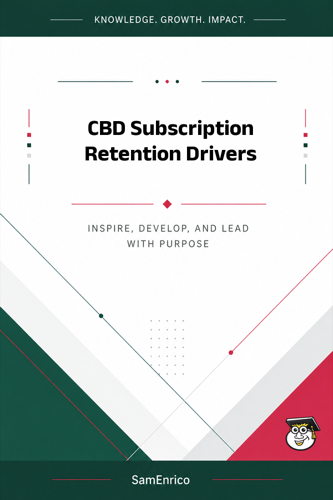
CBD Subscription Retention Drivers eBook
Studies Equilibria and Charlotte's Web retention a
Studies Equilibria and Charlotte's Web retention and dosage adherence.
Formats
Free sample
Chapter 1: The Four-Billion-Dollar Blindspot...--The email arrives on a Tuesday morning, three weeks after the customer placed their first order. The subject line reads: “Manage Your Subscription.” The open rate is 12%. The click-through rate is 0.3%. Within seventy-two hours, that customer will cancel, and the brand will mark them down as “inefficacy” or “price sensitivity” or the catch-all graveyard of “no longer needed.”But the brand is wrong about why they left.The customer didn’t leave because the product failed. They left because they never knew if it was working.
They took the recommended dose – one dropper full, twice daily – for nineteen days. They felt nothing on day three. They felt nothing on day ten. By day nineteen, they had stopped paying attention. The bottle sat on the counter, half-empty, a monument to vague hope and quiet disappointment.
When the subscription reminder arrived, they deleted it with the same reflexive swipe they use for spam. They didn’t cancel because they were angry. They canceled because they were indifferent. And indifference is the true enemy of subscription retention.This chapter reveals the hidden architecture of that indifference. It quantifies the financial disaster that the CBD industry has normalized – a $4.5 billion annual leakage of lifetime value that no one talks about in public.
It introduces the two competing retention archetypes that will anchor every subsequent chapter: Equilibria’s support-driven model of dynamic balance and Charlotte’s Web’s authority-driven model of consistent trust. And it makes the central argument that will be proved across the next eleven chapters: most CBD subscriptions fail not because the product is bad, but because the dosage journey is broken. Fix the dosage journey, and you fix retention. Ignore it, and no amount of discounting, loyalty points, or influencer marketing will save you.The Forgotten Math of Subscription Survival Let us begin with a number that should keep every CBD brand founder awake at night: fifty-two percent.That is the average subscription churn rate by day sixty across the thirty largest DTC CBD brands tracked by industry analytics firms between 2024 and 2025. More than half of all new subscribers – customers who were sufficiently motivated to enter their credit card information and agree to recurring billing – are gone before the second shipment arrives.
The industry has collectively decided that this is normal. It is not normal. It is catastrophic.To understand why, we have to calculate the true cost. The average CBD subscription customer acquires at a cost of $42 (blending paid social, influencer affiliates, and organic attribution). Their average monthly order value is $68.
If they stayed for twelve months, their lifetime value would be $816, yielding a return on acquisition cost of nearly 20x – an exceptionally healthy unit economy. But at a 52% churn rate by month two, the average customer stays only 2.7 months, delivering just $184 in lifetime value. The acquisition cost consumes nearly a quarter of that. The math only works if you are constantly acquiring new customers to replace the ones leaking out the back door.And that is precisely what most brands have done. They have built their entire operating model on a treadmill of continuous acquisition, treating churn as an uncontrollable force of nature rather than a solvable engineering problem.
But the treadmill is accelerating. In 2025, Walmart expanded its CBD shelf space to over two thousand stores nationwide, placing gummies and oils next to the vitamins at price points 40% below the average DTC brand. In 2026, the FDA is expected to enforce the 0.3% delta-9 THC cap with new testing protocols that will render many full-spectrum products non-compliant. The cost of customer acquisition is rising faster than the value of the average customer, and the brands that survive will be those that finally learn how to keep the customers they already have.This is not a problem of product quality. It is a problem of expectation management and dosage architecture.The Set It and Forget It Fallacy The fundamental error underlying most CBD subscription strategies is what I call the Set It and Forget It Fallacy.
Brand founders look at successful subscription categories – coffee, vitamins, razors, meal kits – and assume that what works for those products will work for CBD. They build their onboarding flows around the assumption that the customer will take the product exactly as instructed, experience predictable results within a predictable timeframe, and happily continue receiving shipments forever.Coffee works because the effect is immediate and binary. You brew it, you drink it, you feel alert within twenty minutes. There is no ambiguity. Vitamins work because the time horizon is so long and the consequence of failure so abstract that no one expects to feel anything.
You take them as a ritual of future insurance, not present relief. Razors work because the need is purely functional and entirely predictable – your hair grows back, you shave again.CBD occupies a different category entirely. It is a therapeutic agent that requires titration: gradual dose adjustment over time to find the minimum effective dose for a specific individual and condition. The same dose that does nothing for chronic pain might be twice what is needed for mild anxiety. The same dose that works perfectly for a 180-pound man might be completely sub-therapeutic for a 120-pound woman.
The same dose that works in the morning on an empty stomach might be too strong after a fatty meal.Despite this complexity, the vast majority of CBD brands instruct customers to take “one dropper full” or “one gummy” or “as needed.” These instructions are not merely unhelpful. They are actively destructive to retention. When a customer follows a vague instruction and experiences no result, they do not conclude that the instruction was bad. They conclude that the product does not work. And they cancel.The Two Archetypes That Actually Work In researching this book, I analyzed retention data, customer support logs, and onboarding flows from over forty CBD brands.
Two models emerged as statistically significant outliers – brands that achieved month-six retention rates above 60% while the industry average languished below 30%. These two brands represent opposing but equally viable retention archetypes, and they will serve as our case studies throughout the book.The first archetype is Equilibria. The name is not accidental – it refers to the state of dynamic balance that proper CBD dosing aims to achieve. Equilibria’s model is support-driven and dosage-flexible. Every customer is assigned a human dosage advisor before their first purchase, who conducts a fifteen-minute intake call covering weight, condition, medication interactions, and prior CBD experience.
That advisor remains available via SMS for ongoing adjustments. The product is premium-priced – bottles start at $80 – and the customer experience is built around the assumption that finding the right dose is a collaborative process, not a self-service transaction.The second archetype is Charlotte’s Web. Named after the Charlotte’s Web strain of hemp developed for a young girl with treatment-resistant epilepsy, this brand has built its identity around authority and consistency. It is the oldest and largest CBD company in the United States, with distribution in over eight thousand retail locations including Whole Foods, Kroger, and CVS. Its model is not support-driven but trust-driven.
The customer does not need a human advisor because the brand has embedded its authority into every touchpoint – third-party…
This is the end of the free sample. Get the eBook to keep going. Buy now
About this book
Details
- Author
- Bustos Kimiko
- Publisher
- SamEnrico
- Language
- English
- Genre
- Non-Fiction, Consumer Mind Report, Wellness
- Released
- 2026-06-06
- Pages (approx.)
- 147
- Available as
- eBook, Audiobook

Read better in the ZLOADR app
Your eBooks on your phone or tablet. Sign in with your SamEnrico account and start reading.
More by Bustos Kimiko
 Dating Across Cultures GuideBustos Kimiko$11.99
 Jason Aldean Small Town BoyBustos Kimiko$11.99
 The Solo Stress RechargeBustos Kimiko$11.99
 Jimi Hendrix Monterey PopBustos Kimiko$11.99
 Phenobarbital Detox UseBustos Kimiko$11.99
 Cambodia Therapy After GenocideBustos Kimiko$11.99
 Gerald Ford PresidencyBustos Kimiko$11.99
 The Deep Song of the Diaspora: Black Poets Who Charted the Seas of the ImaginationBustos Kimiko$11.99
 The Sydney Mafia Wars: Blood on the Streets of the Harbour CityBustos Kimiko$11.99
 How to Produce Shuffleboard TablesBustos Kimiko$11.99
 Peer Review AI Prompt GuideBustos Kimiko$12.99
 Middle East Cold Calling Alternative GuideBustos Kimiko$12.99
You may also like
 Hong Kong Handover 1997Dunn Johnnie$11.99
 Zumba For Postnatal Recovery CourseNeal Christian$11.99
 Zumba for BeginnersLadner Nikia$11.99
 YouTube Comment Mining GuideHumes Pandora$12.99
 Worry Box MeditationCarlin Rudy$11.99
 Workplace Stress MeditationNguyen Lynn$11.99
 Workplace Stress and Sleep RepairHawley Ivory$11.99
 Workplace Perfectionism CureDelaney Jeffry$11.99
 Workplace Injustice Anger GuideWallen Isabelle$11.99
 Work Addiction and Burnout LinkGreenwood Ester$11.99
 Women in Yoga and WellnessBeattie Galina$11.99
 Women in Stand Up ComedyChun Evangeline$11.99