
Non-FictionInformativeEducational
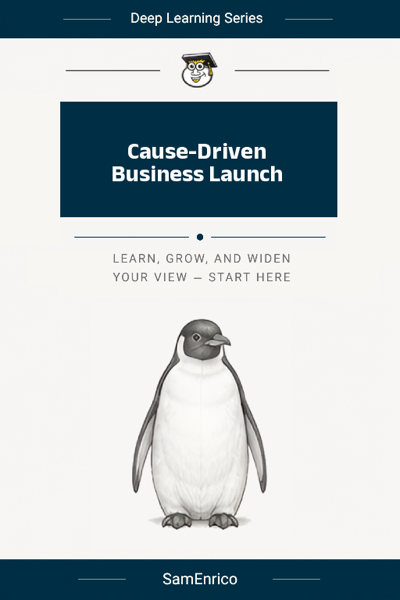
Cause-Driven Business Launch eBook
A Coursebook on Cause-Driven Business Launch
A Coursebook on Cause-Driven Business Launch
Formats
Free sample
Chapter 1: The Community Listening Pledge--Most entrepreneurs begin their journey with a mirror. They stare into it and ask, “What am I passionate about? What do I want to build? What is my why?” This is exactly backwards. The graveyard of failed cause-driven businesses is not filled with people who lacked passion.
It is filled with people who had plenty of passion and no community to receive it.Let me say that again, because it is the single most important sentence in this book: Your passion is irrelevant until a community validates it.I have watched dozens of founders pour their savings into businesses built around causes they cared deeply about—hunger, literacy, clean water, mental health—only to fail because they never stopped to ask the people they claimed to serve what they actually needed. They wrote manifestos. They designed beautiful packaging. They launched crowdfunding campaigns. And then, crickets.
Not because the cause was unworthy. Because the cause was theirs alone.This chapter will dismantle the most seductive myth in social entrepreneurship: that your personal “why” is the right place to start. In its place, I will give you something far more powerful and far less romantic. I will give you the Community Listening Pledge—a commitment to let the people you serve define your cause, not the other way around.By the end of this chapter, you will understand why the TOMS “one-for-one” model succeeded briefly then drew sharp criticism, why pink-washing is not just ineffective but actively harmful, and why a small sock company in Sydney outlasted billion-dollar brands by doing something that seems almost embarrassingly simple: they asked their community what they needed, then shut up and listened.You will also write nothing. Not yet.
Every other business book asks you to produce something in Chapter One. A vision statement. A manifesto. A “why” statement. I am asking you to produce nothing except a commitment to listen.
The manifesto comes later, after the community has spoken. If you cannot wait that long, close this book now and return it. This path is not for the impatient.The Mirror Trap: Why “Start With Why” Fails Cause-Driven Founders In 2009, Simon Sinek published Start With Why, and a generation of entrepreneurs began their journeys by asking a single question: “Why does my company exist?” For traditional businesses, this is sound advice. Apple’s “why” (challenge the status quo) preceded its “what” (great computers). But cause-driven businesses are different.
Their “why” is not about innovation or disruption. It is about human suffering, environmental degradation, or systemic injustice. And those things cannot be understood from inside your own head.I have reviewed over two hundred failed cause-driven business plans. In every single case, the founder could articulate a passionate “why” on page one. “I want to end plastic pollution.” “I want to provide clean water to villages.” “I want to reduce food waste.” These are noble intentions.
But when I asked follow-up questions—“What have people in those villages told you they need?” “Have you spent a week sorting through a community’s trash to understand what they actually discard?” “Did you interview restaurant owners about why they throw away food?”—the answer was almost always silence.The Mirror Trap is the belief that staring inward reveals outward truth. It does not. Your frustration, your anger, your passion—these are signals that something is wrong somewhere. But they do not tell you what is wrong, for whom, or what solution would actually help. For that, you need the community.A Story of Two Sock Companies Consider two sock companies.
Both started with a “why.” Both wanted to help people in need. Both gave away socks. One became a case study in how to do cause-driven business right. The other is a warning about what happens when you build for a community instead of with them.The warning is TOMS. In 2006, Blake Mycoskie founded TOMS Shoes with a simple promise: for every pair of shoes purchased, the company would donate a pair to a child in need.
The “one-for-one” model was elegant, easy to communicate, and wildly successful. TOMS sold millions of shoes. Mycoskie became a celebrity. Business schools taught TOMS as the gold standard of social enterprise.Then the criticism began. Researchers traveled to the villages where TOMS donated shoes and found something uncomfortable: the shoes were often the wrong size, the wrong style, and sometimes entirely unwanted.
In some communities, donated shoes actually harmed local cobblers who could no longer sell their own products. TOMS had built a giving model based on what felt good to the giver, not what the receiver needed. The company eventually added cash grants and local manufacturing to its model, but the damage to its reputation was done. TOMS had committed the original sin of cause-driven business: they assumed.Now consider the Sydney Sock Project. Founded in 2019 by a group of Australian social workers, the company also gives away socks.
But they do it differently. Before launching, the founders spent six months visiting homeless shelters, laundromats, and community kitchens. They did not arrive with prototypes or donation forms. They arrived with a notebook and two questions: “What do you need?” and “How have other charities let you down?”What they learned surprised them. Homeless individuals told them that donated socks were almost always the wrong material (cotton gets wet and stays wet, leading to trench foot and infections), the wrong color (white shows dirt immediately, making people feel ashamed), and the wrong distribution model (charities handed out socks at times when people were already at work).
The Sydney Sock Project responded by designing wool-blend socks in dark colors, distributed through laundromats rather than shelters, with no paperwork or proof of need required.The result? Sydney Sock Project has never run a paid ad. Their customers are their donors. Their community tells their story because the story is actually true. They did not start with a why.
They started with a who.The Community Listening Pledge: A New First Step Here is what you will do instead of writing a manifesto. You will take the Community Listening Pledge. It has four parts, and each part will hurt a little. That is how you know it is working.Part One: The Identity Surrender. You will acknowledge that you do not currently know what your community needs.
You may have suspicions. You may have expertise. You may have lived experience of the problem yourself. None of that is the same as knowing what a different community needs. Surrender your identity as the expert.
You are a student now.Part Two: The Silence Commitment. You will spend at least forty hours listening before you speak. Forty hours is one full work week. During this time, you will not pitch. You will not explain your idea.
You will not hand out business cards. You will ask questions and then you will shut your mouth. When you feel the urge to fill silence with your own voice, you will count to ten in your head.Part Three: The Stranger Rule. The majority of your listening hours will be spent with people who owe you nothing. Not your friends.
Not your family. Not your professional network. Strangers. People who will tell you hard truths because they do not care…
This is the end of the free sample. Get the eBook to keep going. Buy now
About this book
Details
- Author
- Slattery Jadwiga
- Publisher
- SamEnrico
- Language
- English
- Genre
- Non-Fiction, Informative, Educational
- Released
- 2026-05-08
- Pages (approx.)
- 157
- Available as
- eBook, Audiobook

Read better in the ZLOADR app
Your eBooks on your phone or tablet. Sign in with your SamEnrico account and start reading.
More by Slattery Jadwiga
 The Workaholic Emotional Sobriety GuideSlattery Jadwiga$11.99
 French Revolution LiteratureSlattery Jadwiga$11.99
 Validating Your Own EmotionsSlattery Jadwiga$11.99
 Stress and VasculitisSlattery Jadwiga$11.99
 The Great Gold Bullion Robbery: The Heist That Shook Victorian BritainSlattery Jadwiga$11.99
 US Title Raise CalculatorSlattery Jadwiga$12.99
 How to Become a Lozenge-dough MixerSlattery Jadwiga$11.99
 How to Produce Antibacterial Bar SOAPSlattery Jadwiga$11.99
You may also like
 Hong Kong Handover 1997Dunn Johnnie$11.99
 Zumba For Postnatal Recovery CourseNeal Christian$11.99
 Zumba for BeginnersLadner Nikia$11.99
 YouTube Comment Mining GuideHumes Pandora$12.99
 Worry Box MeditationCarlin Rudy$11.99
 Workplace Stress MeditationNguyen Lynn$11.99
 Workplace Stress and Sleep RepairHawley Ivory$11.99
 Workplace Perfectionism CureDelaney Jeffry$11.99
 Workplace Injustice Anger GuideWallen Isabelle$11.99
 Work Addiction and Burnout LinkGreenwood Ester$11.99
 Women in Yoga and WellnessBeattie Galina$11.99
 Women in Stand Up ComedyChun Evangeline$11.99