
Non-FictionProfessional's Cheat SheetCatering
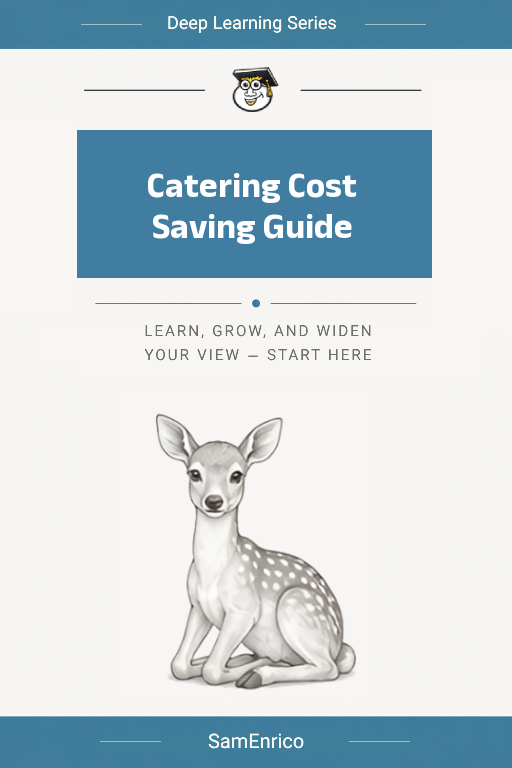
Catering Cost Saving Guide eBook
Reduce corporate event catering costs by 40 percen
Reduce corporate event catering costs by 40 percent. Choose buffet over plated, limit menu options, and negotiate beverage packages.
Formats
Free sample
Chapter 1: The Perception Trap--–- The first time Sarah watched a $78 plate of salmon be pushed aside after exactly two bites, she almost laughed. Not because it was funny, but because she had just calculated the waste in real time. Thirty-seven dollars per person, times two hundred guests. Seven thousand four hundred dollars. For food that would never be eaten.
She was the new event coordinator for a mid-sized financial firm, and her predecessor had been fired for budget overruns – exactly the kind of career-ending mistake Sarah was determined to avoid. But as she stood in the corner of the hotel ballroom, watching servers clear perfectly good food from tables where executives had barely touched their meals, she realized something that would change her entire approach to corporate catering. The guests weren't being picky or ungrateful. They were victims of a psychological trap that the catering industry has quietly exploited for decades. And Sarah had just fallen into it herself.This chapter reveals that trap.
It is called the perception gap – the difference between what guests actually enjoy and what event planners think they want. The catering industry has built an entire pricing model around this gap, charging premium prices for service styles and menu options that consistently underperform simpler, less expensive alternatives in blind tests. The data is overwhelming. Buffets outperform plated meals in guest satisfaction when measured honestly. Limited menus generate less waste and higher enjoyment than extensive options.
Beverage consumption is driven almost entirely by psychological framing, not by actual thirst or preference. And yet corporate event planners continue to choose expensive options because they believe – wrongly – that guests expect them.This chapter will dismantle those beliefs. It draws on behavioral economics, hospitality industry data, and real-world case studies to explain why your guests are lying to you – and why that is not their fault. By the end of this chapter, you will understand the three psychological principles that drive catering costs: the abundance illusion, choice paralysis, and the framing effect. More importantly, you will have specific tactics to flip each principle in your favor, cutting costs without cutting perceived quality.
The 40% savings begin here, not with spreadsheets or negotiation scripts, but with a fundamental shift in how you think about what your guests actually value.The Abundance Illusion: Why Buffets Feel More Generous (Even When They Cost Less)Let us start with a simple experiment conducted by Cornell University's Food and Brand Lab. Researchers set up two identical lunch spreads for two groups of corporate employees. One group was served a plated meal: a chicken breast, a scoop of mashed potatoes, and steamed broccoli, arranged neatly on a white plate. The other group was served a buffet: the exact same chicken, potatoes, and broccoli, but displayed in chafing dishes with guests serving themselves. After the meal, both groups completed satisfaction surveys.
The buffet group rated their meal as significantly more generous, more satisfying, and more abundant – despite consuming exactly the same food.The difference was not in the ingredients. It was in the psychology of abundance.When you see a buffet, your brain processes visual variety as abundance. A long table with multiple dishes – even if those dishes contain the same ingredients presented differently – triggers a primal response: there is plenty here, you will not go hungry. This is an evolutionary holdover from times when food scarcity was a genuine threat. Your guests are not consciously thinking about scarcity, but their brains are hardwired to respond to visual abundance with feelings of satisfaction and generosity.Plated service, by contrast, triggers what behavioral economists call the "portion effect." A single plate with a fixed portion looks finite.
It looks measured. It looks like someone decided exactly how much you should eat, and that decision was probably less than you wanted. Even when the portion size is objectively sufficient, the presentation signals limitation. Your guests feel slightly deprived before they take the first bite, and that feeling colors their entire dining experience.The catering industry knows this. That is why high-end caterers charge more for buffets than for plated meals – not because buffets cost more to produce (they cost significantly less, as we will see in Chapter 2), but because they know clients perceive buffets as more valuable.
The psychology works in reverse: if you assume guests expect plated service for formal events, you are paying more for a service style that actually delivers less satisfaction.Here is the data that matters. In a survey of 1,200 corporate event attendees conducted by the Hospitality Research Institute, 68% said they preferred buffets for events of 50 people or more. The top reasons given: "I can choose my own portions," "I like seeing what is available before deciding," and "buffets feel more relaxed." Only 22% preferred plated service, and their top reason was "it feels more professional" – not taste, not satisfaction, not fullness. Professionalism is a social signal, not a flavor.The implications for your catering budget are enormous. Switching from plated to buffet saves an average of 38% on food and labor costs, as we will see in Chapter 5.
But the psychological win is just as important. Your guests will not feel like you downgraded them. They will feel like you gave them more. They will eat what they actually want, leave less waste, and remember the meal as generous. The abundance illusion works in your favor the moment you stop assuming that expensive equals impressive.Choice Paralysis: How Too Many Options Destroy Satisfaction and Inflate Costs Now let us consider a second experiment, this one from a gourmet jam store in California.
Researchers set up a tasting booth with either 6 flavors of jam or 24 flavors. Shoppers who saw 24 flavors were far more likely to stop at the booth. But shoppers who saw only 6 flavors were ten times more likely to actually buy a jar. The reason is choice paralysis: when faced with too many options, the human brain experiences decision fatigue, anxiety, and a fear of making the wrong choice. The easiest way to resolve that anxiety is to make no choice at all.Corporate catering works exactly the same way.When you offer guests 8 entrées, 5 appetizers, 4 salads, and 3 desserts, you are not being generous.
You are creating decision fatigue. Your guests spend mental energy on choosing instead of enjoying. They second-guess their selections. They see what someone else ordered and feel regret. And most damaging to your budget, they take more food than they will eat because they want to try multiple options or because they cannot commit to a single portion.The waste numbers are staggering.
A catering industry study of 500 corporate events found that events with 6 or more entrée options generated 40% more plate waste than events with 3 or fewer entrées. Not because guests were hungrier, but because they over-selected. A guest choosing between chicken, fish, beef, vegetarian, vegan, and gluten-free options will often take a little of each, creating a plate that looks abundant but becomes a garbage bin after the first few bites. The same guest facing a choice between chicken, fish, and vegetarian will pick one, eat most of it, and feel satisfied.The cost impact goes beyond waste. Each additional menu option increases the…
This is the end of the free sample. Get the eBook to keep going. Buy now
About this book
Details
- Author
- Thornhill Soon
- Publisher
- SamEnrico
- Language
- English
- Genre
- Non-Fiction, Professional's Cheat Sheet, Catering
- Released
- 2026-06-01
- Pages (approx.)
- 156
- Available as
- eBook, Audiobook

Read better in the ZLOADR app
Your eBooks on your phone or tablet. Sign in with your SamEnrico account and start reading.
More by Thornhill Soon
 MMO Gaming Addiction HelpThornhill Soon$11.99
 Study Schedule Planning GuideThornhill Soon$11.99
 Squadron Leader MemoirThornhill Soon$11.99
 Parental Academic PressureThornhill Soon$11.99
 M18 Hellcat Tank Destroyer SpeedThornhill Soon$11.99
 Depression Social Support GuideThornhill Soon$11.99
 Psychological Relapse Prevention WorkbookThornhill Soon$11.99
 Disappointment In Genetic LotteryThornhill Soon$11.99
 The Pink Panther's Last Heist: The 1993 Tokyo Diamond CaperThornhill Soon$11.99
 The Edison Enigma: A World Lit by a Thousand BulbsThornhill Soon$11.99
 The Diamond Crown Conspiracy: How a Lost Heirloom Sparked a Royal RiftThornhill Soon$11.99
 Understanding Arrhythmogenic Right Ventricular CardiomyopathyThornhill Soon$17.99
You may also like
 Hong Kong Handover 1997Dunn Johnnie$11.99
 Zumba For Postnatal Recovery CourseNeal Christian$11.99
 Zumba for BeginnersLadner Nikia$11.99
 YouTube Comment Mining GuideHumes Pandora$12.99
 Worry Box MeditationCarlin Rudy$11.99
 Workplace Stress MeditationNguyen Lynn$11.99
 Workplace Stress and Sleep RepairHawley Ivory$11.99
 Workplace Perfectionism CureDelaney Jeffry$11.99
 Workplace Injustice Anger GuideWallen Isabelle$11.99
 Work Addiction and Burnout LinkGreenwood Ester$11.99
 Women in Yoga and WellnessBeattie Galina$11.99
 Women in Stand Up ComedyChun Evangeline$11.99