
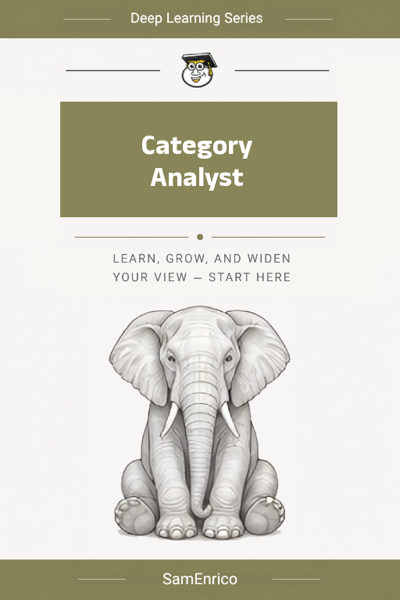
Non-FictionInformativeEducational
Category Analyst eBook
A Coursebook on Category Analyst
A Coursebook on Category Analyst
Formats
Free sample
Chapter 1: The Data Janitor’s Farewell--The most expensive mistake in retail isn’t a bad promotion or a failed product launch. It is the quiet, well-intentioned, and utterly invisible act of pulling the wrong report for the wrong question and handing it to the wrong person, who then makes a decision that costs the company three million dollars over eighteen months without ever knowing the report was the problem.I have seen this happen seventeen times across five different retailers and three consumer goods manufacturers. The pattern is always the same. A merchant wakes up worried about declining sales in a category. He asks an analyst for “the numbers.” The analyst, who is drowning in seventeen other requests, pulls the standard weekly sales report, adds a pivot table, highlights a few declines in yellow, and emails it back within two hours.
The merchant looks at the yellow boxes, cuts the price of the worst-performing SKU by fifteen percent, and moves on to the next fire. Six months later, the category is worse. Why? Because the analyst pulled the wrong data. Not fraudulent data.
Not incorrect data. Just the wrong data for the question. The decline was not a price problem. It was an out-of-stock problem on the top-selling item. The analyst never walked the aisle.
The merchant never asked why. And the category lost another three hundred thousand dollars.This book exists to make sure you are never that analyst again.You are about to learn the eight-step category management cycle, the five data pillars, the mathematics of elasticity, the psychology of shopper missions, and the art of the planogram. But before any of that, you need to hear the single most important sentence you will read in these four hundred pages: Your job is not to produce reports. Your job is to produce decisions.Reports are costs. Reports take time, consume attention, and create the illusion of progress.
Decisions are value. A decision changes what happens on the shelf, what the shopper sees, what the merchant approves, and what the P&L reports at the end of the quarter. The analyst who produces reports will always be replaceable. The analyst who produces decisions will always be promoted.This chapter redefines the category analyst from a passive data reporter to an active business driver. You will learn why the role has changed more in the past five years than in the previous twenty.
You will learn the eight-step cycle that forms the backbone of every chapter to come. You will meet the stakeholders who live in your ecosystem and learn how to speak their languages. You will adopt three mindset pillars that separate the order-takers from the strategic partners. And you will follow a twenty-four-year-old analyst named Priya who discovered a two-million-dollar opportunity hiding in plain sight because she asked one question that no one else thought to ask: “What if we defined the category wrong?”This is not a book about spreadsheets. This is a book about what happens when you close the spreadsheet and walk the aisle.The Evolution of a Role: From Spreadsheet Monkey to Strategic Partner Twenty years ago, category analysis was a clerical function.
A merchant would hand a list of SKUs to an analyst and say, “Show me last week’s sales by store.” The analyst would run a query, paste the results into Excel, format the columns, and email it back. The analyst had no opinion, no insight, and no authority. The analyst was a data janitor.That world is over.Today, retailers and consumer goods companies generate more data in a single day than an entire category department produced in a year in 2005. Point-of-sale systems scan millions of transactions per hour. Loyalty cards track individual shopper behavior across years.
Syndicated data providers deliver weekly updates on every competitor in every geography. Internal systems log every promotion, every out-of-stock, every shelf change, every truck delivery.The volume of data has made the old model impossible. No merchant has the time or the training to interpret this much information. The analyst is no longer a report puller. The analyst is the only person in the room who understands what the data actually means.Here is what that means for you.
When a merchant asks for “the numbers,” your job is not to provide numbers. Your job is to ask three questions before you open a single spreadsheet. First: “What decision are you trying to make?” Second: “What data would give you confidence in that decision?” Third: “What would change your mind?” If you cannot answer those three questions, you are not ready to pull data. You are ready to have a conversation.The best category analysts I have ever worked with spend less than half their time in Excel. They spend the other half in meetings, in store aisles, and in front of whiteboards.
They are not hired for their pivot table speed. They are hired for their curiosity, their skepticism, and their ability to connect a number on a screen to a shopper standing in an aisle.The Eight-Step Cycle That Will Structure Your Entire Career Every chapter in this book maps to one or more steps in the eight-step category management cycle. This cycle has existed in various forms for thirty years, but most textbooks present it as a dry flowchart. I am going to present it as a story.Step one: Define the category. What products belong together?
What substitutes live outside your current definition? What complements should you consider? This sounds simple, but as you will see in Chapter Two, most category definitions are wrong in ways that cost millions.Step two: Assign the category’s role. Is this a destination category that brings shoppers into the store? A routine category that generates steady revenue?
A seasonal category that spikes for six weeks? An occasional category that surprises and delights? A convenience category that serves the fill-in trip? You will learn these five roles in Chapter Five, and you will learn exactly how they map to strategy in Chapter Nine.Step three: Assess current performance. What is selling?
What is not? Where are the gaps between your category and the market? Between your stores and your best stores? Between your plan and reality? Assessment without a scorecard is just guessing.
You will build your first scorecard in Chapter Four.Step four: Build a balanced scorecard. Sales, profit, distribution, productivity, supply. Five families of metrics. One dashboard. Red, yellow, green.
You will learn to build this in Chapter Four, and you will update it every thirty days for the rest of your career.Step five: Choose your strategy. Are you trying to bring traffic into the store? Build bigger baskets? Generate profit? Turn slow inventory into cash?
Create excitement around something new? These five strategies are not interchangeable. Pick the wrong one and no amount of tactical excellence will save you. Chapter Nine gives you the decision matrix that links your category role to your strategy.Step six: Select your tactics. Assortment changes.
Pricing moves. Promotions. Shelf resets. Supplier negotiations. Each strategy has a set of tactics that naturally align with it.
Chapters Six, Seven, and Eight cover the major tactical families.Step seven: Implement. This is where most books stop. This is…
This is the end of the free sample. Get the eBook to keep going. Buy now
About this book
Details
- Author
- Flanders Lawrence
- Publisher
- SamEnrico
- Language
- English
- Genre
- Non-Fiction, Informative, Educational
- Released
- 2026-05-06
- Pages (approx.)
- 144
- Available as
- eBook, Audiobook

Read better in the ZLOADR app
Your eBooks on your phone or tablet. Sign in with your SamEnrico account and start reading.
More by Flanders Lawrence
 Assertive Communication for TeachersFlanders Lawrence$11.99
 Gratitude for ChangeFlanders Lawrence$11.99
 Senior Celebration GuideFlanders Lawrence$11.99
 Single Father ScrapingFlanders Lawrence$11.99
 The Beginner Meditation Timeline GuideFlanders Lawrence$11.99
 The Siege of Khartoum: Gordon's Last Stand Against the MahdiFlanders Lawrence$11.99
 Understanding Myopathy Mitochondrial CataractFlanders Lawrence$17.99
 Accounting Formulas for Construction ContractsFlanders Lawrence$12.99
 Elastic SWOT Analysis GuideFlanders Lawrence$12.99
 How to Start a Music Teacher (own Account) Business (Beginners Guide)Flanders Lawrence$11.99
You may also like
 Hong Kong Handover 1997Dunn Johnnie$11.99
 Zumba For Postnatal Recovery CourseNeal Christian$11.99
 Zumba for BeginnersLadner Nikia$11.99
 YouTube Comment Mining GuideHumes Pandora$12.99
 Worry Box MeditationCarlin Rudy$11.99
 Workplace Stress MeditationNguyen Lynn$11.99
 Workplace Stress and Sleep RepairHawley Ivory$11.99
 Workplace Perfectionism CureDelaney Jeffry$11.99
 Workplace Injustice Anger GuideWallen Isabelle$11.99
 Work Addiction and Burnout LinkGreenwood Ester$11.99
 Women in Yoga and WellnessBeattie Galina$11.99
 Women in Stand Up ComedyChun Evangeline$11.99