
Non-FictionInformativeEducational
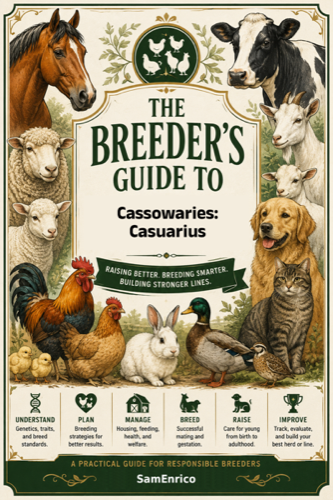
Cassowaries: Casuarius eBook
This wildlife publication, published by SamEnrico,
This wildlife publication, published by SamEnrico, covers Cassowaries: Casuarius
Formats
Free sample
Chapter 1: The Murderbird Myth...–- The cassowary has a problem. It is not a lack of food, a shortage of habitat, or even the cars that slice through its rainforest home – though those are grave threats. The cassowary’s most persistent problem is a single, sticky label affixed to it like a price tag on a second-hand appliance: the world’s most dangerous bird. This title, awarded by the Guinness World Records and repeated in thousands of clickbait articles, travel blogs, and documentary voiceovers, has done more to shape public perception of this animal than any scientific paper ever written. It is also, as this chapter will reveal, a spectacular oversimplification – a truth twisted into a cartoon.The label sticks because it contains a grain of reality.
Cassowaries can kill you. Their claws are long, their legs are powerful, and their tempers, when provoked, are genuine. But the gap between “can kill” and “will kill” is where the real story lives. Between 1900 and the present day, there has been exactly one confirmed human death caused by a wild cassowary – a single fatality in 1926, which we will examine in detail in Chapter 7. By comparison, domestic dogs kill tens of thousands of people annually, horses kill hundreds, and even deer cause more human deaths through car collisions.
Yet no one calls the family Labrador the world’s most dangerous mammal. The cassowary has been singled out, and the reasons tell us as much about human psychology – our love of monsters, our fear of the unfamiliar – as they do about bird biology.This opening chapter serves as the book’s grand entrance, confronting the reader with the cassowary’s stark duality. On one hand, it is a living dinosaur, a creature so strange that the first Europeans to see one thought they had stumbled upon a mythical beast. On the other hand, it is a vital rainforest gardener, a shy and solitary bird that would rather vanish into the undergrowth than confront a human. The “murderbird” myth is the lens through which most people first encounter the cassowary.
This chapter will introduce that myth, trace its origins, and then gently set it aside – because the rest of this book is about what remains when the sensationalism falls away: a bird of profound beauty, ecological importance, and unexpected vulnerability.The 1597 Sensation: A Monster Arrives in Amsterdam Long before the internet discovered the cassowary, Europeans had their first encounter with the bird – and their reaction was identical to ours. They lost their minds.The year was 1597. The Dutch East India Company was still in its infancy, but its ships were already ranging across the Indonesian archipelago, returning to Amsterdam with spices, silks, and the occasional living curiosity. That year, a ship docked with a bird no European had ever seen. It stood nearly as tall as a man, with a helmet of horn on its head, a neck painted in neon blues and reds, and feathers that looked more like fur or quills than anything that belonged on a bird.
It could not fly. It did not seem to want to.The cassowary – for that is what it was, likely a Southern Cassowary (Casuarius casuarius) captured in the Aru Islands or coastal New Guinea – became an instant celebrity. Scholars came to sketch it. Clergymen wrote sermons about it (was this proof of God’s whimsy or the devil’s handiwork?). The public paid admission to gawk at it.
One contemporary account describes the bird as “a monstrous fowle, with a great shell on its head,” adding that it “runneth so fast that no dogge can overtake it, and fighteth so fiercely that it will strike a man dead with a single blow.”That last part was an exaggeration. But the pattern was set. From the very first moment of contact between European eyes and cassowary body, the narrative leaned toward threat. The bird was not described as beautiful, strange, or wonderous – though it was all those things. It was described as dangerous.
Monster. Fowle. We have been telling ourselves the same story for more than four centuries.The Amsterdam cassowary did not survive long in captivity – no one yet knew what to feed it – but its brief life left an indelible mark. Illustrations of the bird circulated across Europe, copied and recopied by artists who had never seen the original. Each copy introduced new errors: longer claws, a more threatening posture, a beak opened as if to strike.
The cassowary became a stock character in bestiaries, those medieval-style catalogues of animals real and imagined, where it sat alongside dragons and griffins. It was not a bird. It was a monster.The Indigenous Counter-Narrative: Before the Europeans But there is another story, much older than the European one, that we must honor before proceeding. For at least 40,000 years – and possibly longer – the cassowary has lived alongside humans in New Guinea, the Aru Islands, and the northern tip of Australia. The people of these islands did not see a monster.
They saw a relative.Indigenous cultures across New Guinea developed rich and varied relationships with the cassowary. There is no single “indigenous view” – the island speaks more than 800 languages, and each language group has its own stories – but common threads run through many of them. In some traditions, the cassowary is a mother figure, an ancestral being who gave birth to the first humans and taught them which fruits were safe to eat. In others, the cassowary is a guardian of the forest, a spirit who punishes those who take more than they need. In still others, the cassowary is a trickster, a cunning bird who outsmarts hunters and escapes traps through wit rather than violence.One of the most widespread myths, found in various forms from the Highlands of Papua New Guinea to the lowlands of West Papua, tells of a woman who married a cassowary.
In some versions, the cassowary husband provides for his human wife, bringing her fruit and meat. In others, the human woman must learn to live as a cassowary does – eating fallen fruit, sleeping on the forest floor, moving silently through the understory. The children of these unions are half-human, half-bird, and they become the first of a particular clan. To this day, some clans in New Guinea consider the cassowary their totem animal, and clan members are forbidden from harming or eating the bird.We will explore these cultural traditions at length in Chapter 8. For now, the crucial point is this: when humans have lived alongside cassowaries for millennia – when they have raised cassowary chicks, traded them as gifts, and woven them into creation stories – they have not called them the world’s most dangerous bird.
That label is a European invention, born of first contact, amplified by sensationalism, and cemented by a single tragic incident in 1926. The indigenous relationship with the cassowary is far more nuanced: respect, not fear; reciprocity, not avoidance. The cassowary is powerful and deserves caution, but it is not a monster.The Three Living Species: A Brief Introduction Before we proceed further, we must establish the cast of characters. The genus Casuarius contains three living species, and any serious book about cassowaries – including this…
This is the end of the free sample. Get the eBook to keep going. Buy now
About this book
Details
- Author
- Slaughter Birgit
- Publisher
- SamEnrico
- Language
- English
- Genre
- Non-Fiction, Informative, Educational
- Released
- 2026-05-11
- Pages (approx.)
- 158
- Available as
- eBook, Audiobook

Read better in the ZLOADR app
Your eBooks on your phone or tablet. Sign in with your SamEnrico account and start reading.
More by Slaughter Birgit
 Constraints for EngineersSlaughter Birgit$11.99
 US Green Tax Credits GuideSlaughter Birgit$11.99
 Postpartum Self Care WorkbookSlaughter Birgit$11.99
 Thunberg Greenwashing ExposéSlaughter Birgit$11.99
 Omnichannel Inventory AISlaughter Birgit$11.99
 Boundary Setting for Adult ChildrenSlaughter Birgit$11.99
 Sales Strategy One PagerSlaughter Birgit$11.99
 Chunking for Law StudentsSlaughter Birgit$11.99
 Icarus: The Architect of the ImpossibleSlaughter Birgit$11.99
 The Burj Khalifa: A Tower of Dreams and DefianceSlaughter Birgit$11.99
 Modifier Placement PromptsSlaughter Birgit$12.99
 Automating Your Camera Rental BusinessSlaughter Birgit$12.99
You may also like
 Hong Kong Handover 1997Dunn Johnnie$11.99
 Zumba For Postnatal Recovery CourseNeal Christian$11.99
 Zumba for BeginnersLadner Nikia$11.99
 YouTube Comment Mining GuideHumes Pandora$12.99
 Worry Box MeditationCarlin Rudy$11.99
 Workplace Stress MeditationNguyen Lynn$11.99
 Workplace Stress and Sleep RepairHawley Ivory$11.99
 Workplace Perfectionism CureDelaney Jeffry$11.99
 Workplace Injustice Anger GuideWallen Isabelle$11.99
 Work Addiction and Burnout LinkGreenwood Ester$11.99
 Women in Yoga and WellnessBeattie Galina$11.99
 Women in Stand Up ComedyChun Evangeline$11.99