
Non-FictionBusiness BriefDecision Science
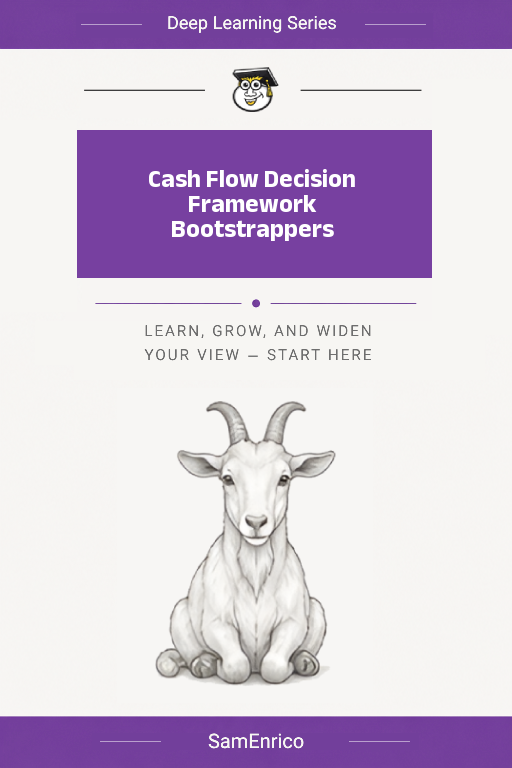
Cash Flow Decision Framework Bootstrappers eBook
Apply a three-question test to every expense: nece
by Sweet Dann
Apply a three-question test to every expense: necessity, timing, and ROI before signing any check.
Formats
Free sample
Chapter 1: The Million-Dollar Bankruptcy---- I met Sarah at a coffee shop in Austin, Texas, three days after she had closed the doors of her company for the last time. She was thirty-four years old. She had raised no venture capital. She had taken no outside investment. She had built her business from nothing over six years, scraping together savings, maxing out credit cards, and reinvesting every dollar of profit back into growth.
In her final year of operation, she generated over $1.2 million in revenue. Her business was profitable on paper. And she was completely, utterly, devastatingly bankrupt.Not the kind of bankruptcy where you owe a few thousand dollars to a supplier and work out a payment plan. The kind where the IRS is garnishing your wages, your landlord is evicting you from the office, and your largest customer is suing you for non-delivery. The kind where you cannot sleep, cannot eat, and cannot look at yourself in the mirror without feeling the hot shame of failure burning in your chest.I asked her what happened.
Her answer was six words. "I spent money before I had it."She had signed a three-year office lease based on projected revenue from a contract that was not yet signed. She had hired six people based on a single good month. She had prepaid for a year of expensive software to get a discount. She had bought inventory in bulk because the supplier offered a volume discount.
And then, one by one, the dominoes fell.A major client paid sixty days late. A wave of refunds hit from unhappy customers. Her payment processor froze 20% of her revenue as a reserve after a chargeback spike. She could not make payroll. She could not pay rent.
She could not fulfill the orders she had already taken. The business died not from lack of sales, not from lack of customers, not from a bad product. It died from lack of discipline. From spending cash that did not exist yet. From treating revenue on paper as money in the bank.Sarah is not alone.
I have seen this story play out hundreds of times. The bootstrapped founder who generates a million dollars in revenue and still goes broke. The ecommerce store with a 40% gross margin that cannot pay its bills. The agency with a waiting list of clients that is weeks away from insolvency. The pattern is always the same.
Revenue grows. Confidence grows. Spending grows faster than revenue. And then something goes wrong. A client pays late.
A refund wave hits. A payment processor freezes funds. And the whole house of cards collapses.This book is for Sarah. And for you. It is for every bootstrapped founder who has ever looked at their bank account after a record sales month and wondered where all the money went.
It is for every entrepreneur who has ever signed a check and immediately felt a pang of dread. It is for everyone who knows that they should be more disciplined with cash but does not know how.I wrote this book because I made the same mistakes Sarah made. Not once. Several times. I spent money before I had it.
I confused urgency with necessity. I invested in things that felt productive but generated no return. And I learned, painfully and repeatedly, that revenue is not cash, hope is not a strategy, and discipline is the only thing that separates the businesses that survive from the businesses that die.The Most Dangerous Lie in Bootstrapping There is a lie that circulates among bootstrapped founders like a virus. You have heard it. You may have said it.
You may believe it right now. The lie is this: "If I can just grow revenue, my cash flow problems will solve themselves."It sounds reasonable. It sounds logical. More revenue means more money coming in. More money coming in means less stress about bills.
Less stress means more freedom to invest and grow. It is a beautiful story. It is also completely, demonstrably false.Revenue is not cash. Revenue is a promise. It is a number on an invoice, a line on a profit and loss statement, a projection in a spreadsheet.
Cash is what sits in your bank account, available to pay rent, make payroll, and buy inventory. Revenue can arrive late, if it arrives at all. Revenue can be clawed back through refunds and chargebacks. Revenue can be frozen by payment processors who decide, arbitrarily, that you are a risk. Revenue can be eaten by fees, reserves, and chargebacks.Cash is real.
Cash is now. Cash is the oxygen of your business.Here is the truth that no one tells you. More revenue often makes cash flow worse before it makes it better. When you grow revenue, you also grow expenses. You spend money to fulfill orders.
You spend money to acquire customers. You spend money to support new users. Those expenses happen today. The revenue from those activities arrives in thirty, sixty, or ninety days. In the gap between spending and receiving, your cash position worsens.I call this the Cash Flow Gap.
It is the distance between the day you spend money and the day you receive money from the activity that spending enabled. A wide gap means you need more cash on hand to survive. A narrow gap means you can grow more safely.Most bootstrapped founders do not even know the Cash Flow Gap exists. They look at their profit and loss statement, see a healthy margin, and assume everything is fine. Meanwhile, their bank account is draining.
They are growing their way into insolvency.The Revenue Illusion The Revenue Illusion is the tendency to treat future revenue as current cash. It is the voice that says, "We will have the money by the time the bill is due." It is the spreadsheet that shows a healthy projected balance next quarter. It is the confidence that comes from a signed contract that has not yet paid.The Revenue Illusion is seductive because it feels optimistic. It feels like growth mindset. It feels like believing in your business.
But the Revenue Illusion is not optimism. It is delusion. And it has destroyed more businesses than bad products, bad marketing, and bad luck combined.Every founder who has ever signed a lease based on projected revenue has fallen for the Revenue Illusion. Every founder who has hired based on a single good month has fallen for it. Every founder who has prepaid for a year of software to save 20% has fallen for it.
They spent cash they did not have based on revenue they had not yet received. And when the revenue did not arrive on time, the business collapsed.The antidote to the Revenue Illusion is the Expense Reality Principle. You can only spend cash you have already received, minus a safety reserve. Not cash you expect to receive. Not cash a customer promised.
Not cash from a contract that is signed but not funded. Cash in the bank, right now, available to spend.This principle sounds simple. It is not easy. It requires saying no to opportunities that feel urgent. It requires delaying gratification.
It requires admitting that you cannot afford something, even when you want it desperately. But it is the only principle…
This is the end of the free sample. Get the eBook to keep going. Buy now
About this book
Details
- Author
- Sweet Dann
- Publisher
- SamEnrico
- Language
- English
- Genre
- Non-Fiction, Business Brief, Decision Science
- Released
- 2026-06-01
- Pages (approx.)
- 128
- Available as
- eBook, Audiobook

Read better in the ZLOADR app
Your eBooks on your phone or tablet. Sign in with your SamEnrico account and start reading.
More by Sweet Dann
 Commercial Lease Abstraction GuideSweet Dann$11.99
 Meeting Interruption BusterSweet Dann$11.99
 Mass Shooting Grief GuideSweet Dann$11.99
 Gulf War Combat MedicSweet Dann$11.99
 Loving Kindness for a Stray AnimalSweet Dann$11.99
 Depreciation of Restaurant EquipmentSweet Dann$11.99
 Sunrise Yoga VisualizationSweet Dann$11.99
 Social Media Time BoxingSweet Dann$11.99
 Memory for DrivingSweet Dann$11.99
 The Night the Music Died: How a Single Decision Toppled a GovernmentSweet Dann$11.99
 The Ghost Fleet of Operation K: The Doomed Convoy That Changed the Pacific WarSweet Dann$11.99
 Shadows of the Silk Road: The Lost War Correspondents of the 19th CenturySweet Dann$11.99
You may also like
 Hong Kong Handover 1997Dunn Johnnie$11.99
 Zumba For Postnatal Recovery CourseNeal Christian$11.99
 Zumba for BeginnersLadner Nikia$11.99
 YouTube Comment Mining GuideHumes Pandora$12.99
 Worry Box MeditationCarlin Rudy$11.99
 Workplace Stress MeditationNguyen Lynn$11.99
 Workplace Stress and Sleep RepairHawley Ivory$11.99
 Workplace Perfectionism CureDelaney Jeffry$11.99
 Workplace Injustice Anger GuideWallen Isabelle$11.99
 Work Addiction and Burnout LinkGreenwood Ester$11.99
 Women in Yoga and WellnessBeattie Galina$11.99
 Women in Stand Up ComedyChun Evangeline$11.99