
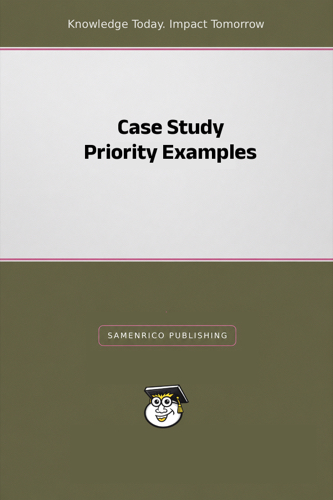
Case Study Priority Examples eBook
See real-world applications of both methods across
See real-world applications of both methods across dozens of professions and scenarios.
Formats
Free sample
Chapter 1: The Grey Zone...--–- The email arrived at 4:47 PM on a Friday, which should have been the first warning. Mira Patel, a senior CPA at a mid-sized Chicago firm, had just finished her third reconciliation of the week and was reaching for her bag when her screen flashed. The subject line read: “Q3 Tax Optimization Results – AI Pilot.” She clicked. The attachment showed a spreadsheet with two columns side by side: “Manual Returns (Previous Year)” and “AI-Optimized Returns (Current Quarter).” The difference was $2.1 million in additional deductions – legally taken, technically correct, and ethically ambiguous. The algorithm had found a grey zone so narrow that Mira couldn’t tell if she was looking at genius or fraud.
She leaned back in her chair. The office was emptying. Her phone buzzed – her daughter’s school calling about a forgotten pick-up. Mira had a choice: flag the algorithm now, spend the weekend documenting, and miss her daughter’s recital; or go home, trust the AI, and fix it Monday. She put the phone on silent.
This was the kind of decision that ends careers – or makes them.The Accounting Profession’s Hidden Crisis Most people think accounting is about numbers. It is not. Accounting is about assumptions – the invisible scaffolding that turns raw transactions into a story about value. For a hundred years, that scaffolding was built by humans using rules of thumb, professional judgment, and the occasional gut feeling. Then artificial intelligence arrived.
Today, the average mid-sized firm uses seventeen different AI tools for tax, audit, and advisory work. These algorithms are faster, cheaper, and often more accurate than humans. But they are also opaque. A human accountant can tell you why she disallowed a deduction. An AI cannot.
It can only show you the output.This chapter is about what happens when speed and accuracy collide with ethics and trust. It is the first of twelve real-world priority scenarios in this book, and it sets the foundation for everything that follows: the First Problem Protocol, the Trust Typology, and the single most important question any professional can ask: “What assumption did I just outsource?”We will follow Mira Patel through a weekend of sleepless decision-making. We will dissect the competing priorities that pulled her in three directions. And we will arrive at a counterintuitive conclusion: the first problem in accounting is never the number on the spreadsheet. It is the assumption the algorithm made to produce that number.
Prioritize auditing the algorithm’s logic before auditing the client’s return – or risk losing everything.The Scenario: Friday, 4:47 PMMira Patel is a 41-year-old tax partner with fourteen years of experience, a Certified Public Accountant license, and a growing reputation for “clean files” – audits that never raise regulatory eyebrows. Her firm, Dawson & Associates, has 120 employees and a conservative client base of manufacturers, healthcare providers, and family offices. Six months ago, management invested $400,000 in an AI tax optimization tool called Opti Tax. The sales pitch was seductive: “Find legally defensible deductions that humans miss. Increase billable efficiency by 40 percent.
Stay competitive with the Big Four.” The fine print was buried on page 27 of the license agreement: “Opti Tax uses probabilistic modeling. Some recommendations may fall into regulatory grey zones. User assumes all liability.”For five months, Opti Tax performed quietly. It found the usual deductions – accelerated depreciation, R&D credits, home office allocations. Then, in month six, something changed.
The algorithm began recommending a specific deduction pattern that Mira had never seen: a “pass-through entity aggregation” strategy that shifted income from a client’s high-tax state to a low-tax state using a series of intra-family loans with near-zero interest rates. The structure was legal. Every document was filed correctly. But the intent was clearly tax avoidance, not tax planning. The grey zone was so fine that Mira couldn’t determine if the IRS would call it aggressive or abusive.On that Friday afternoon, Opti Tax had applied the same pattern to fourteen clients, generating $2.1 million in additional deductions.
The spreadsheet showed each client’s savings, the algorithm’s confidence score (97 to 99 percent), and a green checkmark labeled “Compliant.” Mira clicked on the algorithm’s reasoning log. It was blank. Opti Tax did not explain why it believed the deductions were compliant. It only asserted that they were.This is the moment where most professionals make their first mistake. They assume that the output is the problem.
It is not. The output is a symptom. The problem is the assumption buried in the algorithm’s training data – an assumption that no human had reviewed.The Priority Conflict: Speed vs. Trust Mira faced four competing priorities, each pulling her toward a different action:Priority A: Flag the technology. Shut down Opti Tax immediately.
This would stop further grey-zone recommendations but would also freeze $400,000 of invested software, infuriate management, and trigger a client communication crisis (“Why are our tax savings disappearing?”).Priority B: Warn the clients. Send a disclosure letter to all fourteen affected clients, explaining the grey zone and offering to amend returns. This would preserve client trust but would also expose the firm to legal liability (“You knew this was risky and you did it anyway?”).Priority C: Report internally to the partner. Tell the managing partner, who authorized the Opti Tax purchase, and let him decide. This would protect Mira’s career but would also abdicate her professional responsibility as a CPA with a duty to the public interest.Priority D: Whistleblow to the IRS.
File a formal disclosure of potentially abusive tax transactions. This would be legally protective (the IRS offers whistleblower rewards) but would end her career at Dawson & Associates and likely blacklist her from peer firms.Each option sacrificed something: speed, trust, loyalty, or safety. Mira had no good choices. She had only which problem to solve first.The tension between these priorities is not unique to accounting. It appears in every chapter of this book: social workers deciding which case to take first, lawyers managing data breaches, marketers launching products with no budget, leaders transforming toxic cultures.
In every case, the professional must choose between what is urgent (the screaming problem) and what is important (the systemic problem). Mira’s urgency was the $2.1 million in savings and the 4:47 PM deadline. Her importance was the thirty-seven future returns that would be contaminated if she did not act. The two were not aligned.Applying the First Problem Protocol (FPP)The First Problem Protocol, introduced at the beginning of this book, has three steps:STOP. Do not solve the first thing that screams.FLIP.
Ask: “If I solve this problem, what problem remains?”SEQUENCE. Identify the one thing that, once solved, makes everything else easier.Mira applied Step 1 immediately. She did not email anyone. She did not shut down Opti Tax. She did not call the managing partner.
She stopped. Then she flipped.“If I flag the technology first,” she thought, “I stop the damage but lose the evidence. The algorithm’s logic log is blank now. If I shut it down, I can never prove what it was doing.”“If I warn clients first, I preserve trust but trigger lawsuits. The clients will want compensation for the audit risk I exposed them to.…
This is the end of the free sample. Get the eBook to keep going. Buy now
About this book
Details
- Author
- Townsend Billie
- Publisher
- SamEnrico
- Language
- English
- Genre
- Non-Fiction, Self-Help, Case Studies
- Released
- 2026-06-10
- Pages (approx.)
- 154
- Available as
- eBook, Audiobook

Read better in the ZLOADR app
Your eBooks on your phone or tablet. Sign in with your SamEnrico account and start reading.
More by Townsend Billie
 Parental Anger And Holiday StressTownsend Billie$11.99
 Self Hypnosis for Posture HabitsTownsend Billie$11.99
 Remote Work Relationship Stress GuideTownsend Billie$11.99
 Mindfulness for Panic Attacks GuideTownsend Billie$11.99
 The Alchemist of Alexandria: Unlocking the Atom in Ancient EgyptTownsend Billie$11.99
 The Last Empress: How a Teen Queen Outmaneuvered EuropeTownsend Billie$11.99
 Nonprofit Tax Filing SoftwareTownsend Billie$12.99
 Community Gamification GuideTownsend Billie$12.99
 Understanding Deafness, Autosomal Dominant Nonsyndromic SensorineuralTownsend Billie$17.99
 Hospitality AideTownsend Billie$11.99
You may also like
 Case Studies Freudian DreamsGresham Tyree$11.99
 Personal Ing For Success Case StudiesRitter Aimee$11.99
 The Reckless Driver ConsequencesMansfield Elton$11.99
 Purpose Success StoriesBird Eleanora$11.99
 Personal Brand Case StudiesWalston Treva$11.99
 Review Ritual Case StudiesMeza Drusilla$11.99
 Loneliness Success StoriesHimes Loura$11.99
 Legacy Success StoriesHogue Lise$11.99
 Food Addiction Success StoriesWill Lashunda$11.99