
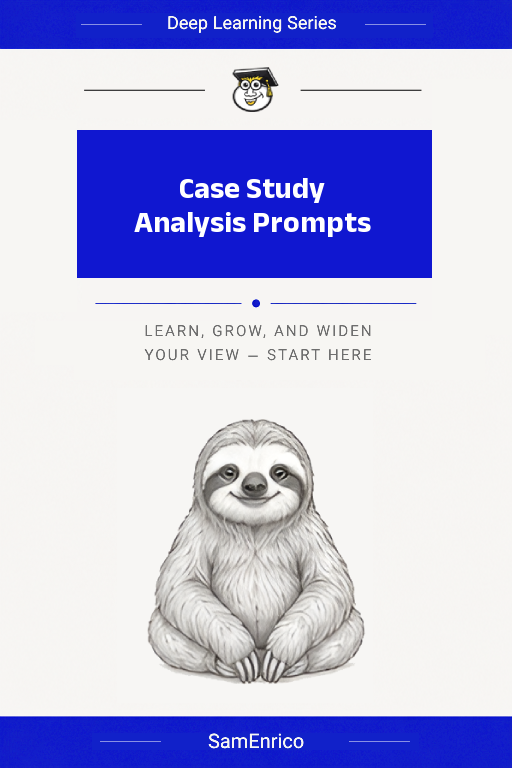
Case Study Analysis Prompts eBook
Apply theoretical frameworks to specific cases usi
by Hooks Robt
Apply theoretical frameworks to specific cases using GPT prompts for structured case analysis.
Formats
Free sample
Chapter 1: The Fluff Trap--Every day, thousands of smart, hardworking students and professionals do the same thing. They open Chat GPT, Claude, or Gemini. They paste a 22-page case study about a struggling company, a strategic dilemma, or a market disruption. They type some version of "Analyze this case and give me recommendations." And then they receive 800 words of generic, citation-free, almost-plausible fluff that could apply to almost any company facing almost any problem.The AI writes something like: "The company should focus on its core competencies while exploring new market opportunities. It is important to consider stakeholder interests and mitigate risks. A SWOT analysis reveals both strengths and weaknesses. The recommended path forward involves strategic alignment with organizational goals."This is nonsense. It is grammatically correct, confidently stated, and utterly useless. And here is the painful truth that no one wants to admit: the problem is not the AI. The problem is the prompt. Or more precisely, the absence of a prompt.I have watched MBA students from top-tier programs, consultants from global firms, and experienced executives make the same mistake. They assume that because GPT can write a sonnet or debug code, it should be able to analyze a business case without guidance. They treat the AI as an oracle rather than what it actually is: a powerful but directionless reasoning engine that will faithfully execute whatever structure you give it—and will faithfully generate plausible-sounding fluff if you give it no structure at all.This book exists because that mistake is expensive. It costs students grades, credibility, and hours of wasted time rewriting. It costs consultants the confidence of their clients. It costs executives the clarity they need to make million-dollar decisions. And it is completely avoidable.I learned this lesson the hard way, failing publicly in front of a Mc Kinsey partner who had asked me to analyze a case on a retail turnaround. I had all the facts, none of the structure, and an AI-generated first draft that he correctly described as "politely saying nothing." That humiliation took me down a five-year path of studying how experts actually analyze cases, how AI actually processes language, and where those two worlds intersect. This book is the result.The Paradox at the Heart of Case Analysis Here is the paradox that confuses almost everyone who starts working with cases. A case study is not a story, though it reads like one. It is not a dataset, though it contains data. It is not a problem to be solved, though it presents a problem. A case study is all of these things at once, which is precisely why raw intelligence fails without structure.Let me be specific. The novice approach to case analysis looks like this: read the case, summarize the facts, offer an opinion, and propose a solution. This approach feels productive because it generates output quickly. But it is fundamentally backward because the solution is the last thing you should produce, not the first. The novice jumps from symptoms to recommendations without ever identifying the root cause. They treat falling sales as the problem rather than as a symptom of a broken incentive system, a flawed distribution model, or a misaligned pricing strategy.The expert approach looks completely different. The expert first asks: what kind of problem is this? Is it a decision case where someone must choose between clear options? Is it an evaluation case where we need to assess performance against criteria? Or is it a problem diagnosis case where something is broken and we need to find out why? Each type requires a different analytical lens, a different set of questions, and a different relationship with the AI.Here is what makes this difficult for AI. GPT has been trained on millions of case analyses, but most of those analyses are mediocre. The AI has learned the surface patterns of case writing without understanding the deep structure of case reasoning. It knows that SWOT analyses often have four bullet points. It knows that recommendations often start with "the company should." But it does not know whether those bullet points are actually relevant to your specific case or whether those recommendations follow logically from your specific diagnosis.This is why generic prompts produce generic outputs. You are asking the AI to do something impossible: to guess the correct analytical framework without being told what problem you are solving. Imagine asking a brilliant but blindfolded surgeon to operate without telling them where the injury is. That is what you are doing when you paste a case and type "analyze this."The Three-Act Case Structure That Changes Everything Before we write a single prompt, we need a shared language for what a case actually is. Drawing on the work of William Ellet, whose taxonomy has shaped case method teaching for decades, I want to introduce the Three-Act Case Structure. This is not a theoretical exercise. It is the backbone of every effective prompt you will write in this book.Act One: Context. Every case begins with a situation. A company, an industry, a moment in time, a set of characters, a history, a crisis or an opportunity. The novice reads this context as background color. The expert reads it as constraint. Everything that follows must be faithful to the facts established in Act One. If the case says the company has no R&D budget, you cannot recommend a moonshot innovation project. If the case says the CEO is risk-averse, you cannot recommend a bold acquisition. Context is not decoration. It is the box within which you must think.Act Two: Application. This is where analysis happens. You take a theoretical framework—PESTEL, Porter's Five Forces, VRIO, the 5 Whys, a weighted decision matrix—and you apply it to the context. But application is not mechanical. You do not simply list factors. You interpret them through the specific lens of the case. You ask: given this context, which forces matter most? Where are the tensions? What is missing? The expert knows that application is where most people go wrong because they apply frameworks without adaptation.Act Three: Insight. This is the output. Not a summary of what you did, but a conclusion that could not have been reached without going through Acts One and Two. Insight is what the case actually teaches you. It is the recommendation, the evaluation, or the root cause. But here is the critical point: insight without context and application is just opinion. And opinion is what generic prompts produce.Most GPT prompts collapse this structure entirely. They ask for insight without context or application. The AI, trying to be helpful, invents a generic context and a generic application and delivers a generic insight. The result reads smoothly and means nothing.The prompts in this book will force the three-act structure. Every prompt will begin with context, specify the application framework, and demand insight that is traceable back to both. This is not slower than generic prompting. It is faster, because you only write the prompt once and the AI does not have to guess what you want.The Case Classification System: Diagnosis Before Prescription The three-act structure tells you how to organize a case analysis. But it does not tell you which framework to apply. That is the job of the…
This is the end of the free sample. Get the eBook to keep going. Buy now
About this book
Details
- Author
- Hooks Robt
- Publisher
- SamEnrico
- Language
- English
- Genre
- Non-Fiction, Student's Shortcut, Case Studies
- Released
- 2026-06-01
- Pages (approx.)
- 158
- Available as
- eBook, Audiobook

Read better in the ZLOADR app
Your eBooks on your phone or tablet. Sign in with your SamEnrico account and start reading.
More by Hooks Robt
 Palliative Care Emotional SupportHooks Robt$11.99
 Divorce After Domestic ViolenceHooks Robt$11.99
 Cold Chain Inventory AIHooks Robt$11.99
 Carson Endangered BirdsHooks Robt$11.99
 Netherlands Green IncentivesHooks Robt$11.99
 Exit Strategy StatementHooks Robt$11.99
 Boundary Setting for ManagersHooks Robt$11.99
 Constraints for TeachersHooks Robt$11.99
 The Piper's Lament: How a Fairy's Curse Shaped Irish MusicHooks Robt$11.99
 The Little Prince Takes Flight: How a French Studio Defied Hollywood (1966)Hooks Robt$11.99
 Renting Out Drone Photography GearHooks Robt$12.99
 A Collector's Handbook to the Tracta 11HPHooks Robt$11.99