
Non-FictionCompliance & Risk ArchiveLeniency Programs
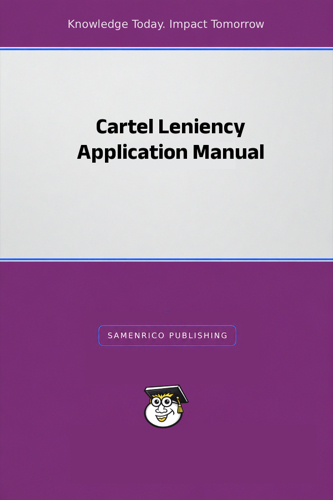
Cartel Leniency Application Manual
Steps for first-in applicants to avoid fines throu
Steps for first-in applicants to avoid fines through corporate cooperation with authorities.
Formats
About this book
Free sample
Chapter 1: The Defector’s Advantage--The moment you suspect your company is in a cartel, an invisible clock begins to tick. That clock does not pause for board meetings, external legal advice, or forensic audits. Every hour you wait, another company somewhere else is considering whether to walk through the same door you are eyeing. And in almost every major jurisdiction, only one company gets to walk through that door for free. The second company pays.
The third pays more. The last pays everything.This is not moral philosophy. It is game theory etched into antitrust law.For decades, cartels were stable. Members colluded, raised prices, divided markets, and rarely betrayed one another because the penalty for defection was the collapse of the conspiracy and certain prosecution. Then, in the 1990s, a handful of competition agencies – led by the United States Department of Justice and later the European Commission – invented a radical inversion of incentives.
They created corporate leniency programs. The first cartel member to confess, cooperate fully, and provide original evidence would receive immunity. Not a discount. Not a plea bargain. Immunity.
Zero fine. Zero corporate criminal liability.The prisoner’s dilemma, long a theoretical construct in economics classrooms, became a weapon of enforcement. Agencies no longer needed to prove cartels from the outside. They only needed to wait for the first insider to defect.This chapter explains why that defection is not an act of betrayal but a rational, disciplined, and urgent corporate survival strategy. It establishes the economic logic of leniency, clarifies the critical distinction between immunity and mere fine reduction, and sets the unified timeline that will govern every subsequent chapter in this manual.
More importantly, it forces you to confront a single uncomfortable question: if your company discovered a cartel tomorrow morning, would you be ready to move within 72 hours? If the answer is no, every page that follows is essential reading.The Economics of Instability Cartels are not accidents. They are deliberate, secret agreements among competitors to fix prices, allocate customers, rig bids, or restrict output. They generate supra-competitive profits. And they are inherently unstable.Without…
This is the end of the free sample. Get the eBook to keep going. Buy now
Contents
- Chapter 1
- Chapter 2
- Chapter 3
- Chapter 4
- Chapter 5
- Chapter 6
- Chapter 7
- Chapter 8
- Chapter 9
- Chapter 10
- Chapter 11
- Chapter 12
Details
- Author
- Fredericks Sunni
- Publisher
- SamEnrico
- Language
- English
- Genre
- Non-Fiction, Compliance & Risk Archive, Leniency Programs
- Released
- 2026-06-09
- Pages (approx.)
- 156
- Available as
- eBook, Audiobook

Read better in the ZLOADR app
Your eBooks on your phone or tablet. Sign in with your SamEnrico account and start reading.
More by Fredericks Sunni
 Core Body Temperature GuideFredericks Sunni$11.99
 Sugar Addiction And Fatty Liver GuideFredericks Sunni$11.99
 Sudden Resignation Confidentiality Protection GuideFredericks Sunni$11.99
 Pain Visualization Healing ImageryFredericks Sunni$11.99
 Spouse Death and AngerFredericks Sunni$11.99
 The Phone Lockdown MethodFredericks Sunni$11.99
 Cannabis Use Disorder BooksFredericks Sunni$11.99
 Recording Yourself PrepFredericks Sunni$11.99
 The Cosmic Visionary: Dr. Daniel Hale Williams and the Birth of Open-Heart SurgeryFredericks Sunni$11.99
 The Lamia’s Last Lament: A Roman Tragedy of Love and RevengeFredericks Sunni$11.99
 How to Start a Compounds With Nitrogen Functions (commission Agent) Business (Beginners Guide)Fredericks Sunni$11.99
 The Complete Guide to the Zero Calorie Foods DietFredericks Sunni$11.99
You may also like
 Hong Kong Handover 1997Dunn Johnnie$11.99
 Zumba For Postnatal Recovery CourseNeal Christian$11.99
 Zumba for BeginnersLadner Nikia$11.99
 YouTube Comment Mining GuideHumes Pandora$12.99
 Worry Box MeditationCarlin Rudy$11.99
 Workplace Stress MeditationNguyen Lynn$11.99
 Workplace Stress and Sleep RepairHawley Ivory$11.99
 Workplace Perfectionism CureDelaney Jeffry$11.99
 Workplace Injustice Anger GuideWallen Isabelle$11.99
 Work Addiction and Burnout LinkGreenwood Ester$11.99
 Women in Yoga and WellnessBeattie Galina$11.99
 Women in Stand Up ComedyChun Evangeline$11.99