
Non-FictionBiographyConservation Planning
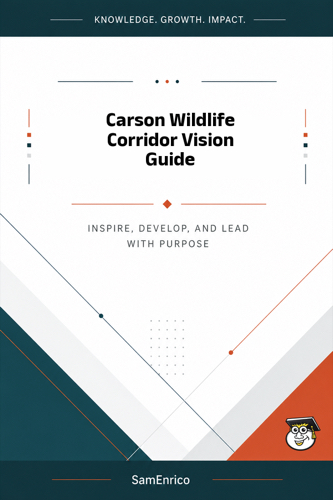
Carson Wildlife Corridor Vision Guide
Apply Carson's early calls for connected habitats
Apply Carson's early calls for connected habitats to modern conservation corridor planning and rewilding.
Formats
About this book
Free sample
Chapter 1: The Living Web...–- In the summer of 1951, a marine biologist named Rachel Carson sat on a rocky ledge overlooking Maine's Sheepscot River, watching the tide creep inland through a salt marsh. She was not thinking about pesticides—that work was still a decade away. She was not thinking about silent springs or dying eagles. She was thinking about edges. The place where marsh met upland, where salt water met fresh, where cordgrass gave way to blueberry bushes—that thin, transitional ribbon held her attention for hours.
In her notebook, she sketched the boundary, marking where a great blue heron had lifted off from a tidal pool and where a deer had emerged from the forest to browse on salt meadow hay. She could not have known it then, but she was drawing the first blueprint for wildlife corridors in America.The insight that would become Carson's greatest contribution to conservation—greater even than her warnings about DDT—was hiding in plain sight on that ledge. She understood, before the term "landscape connectivity" existed, that nature does not operate in closed and separate compartments. The heron needed the marsh for food but the forest for nesting. The deer needed the upland for cover but the marsh for forage.
The eel needed the river to reach the sea, and the sea to return to the river. Everything moved. Everything crossed boundaries. And wherever humans erected barriers—whether chemical clouds or concrete walls—those movements ceased, and the silence Carson would later describe in Silent Spring was not just the absence of birdsong but the absence of connection itself.A Definition to Ground Us Before we go further, let us establish what we mean when we say "wildlife corridor." The International Union for Conservation of Nature (IUCN) defines a wildlife corridor as "a linear habitat or structure that connects isolated patches of habitat, allowing movement of organisms between them." That is the technical definition, but Carson might have put it differently: a corridor is a permission slip for wildlife to move through landscapes we have otherwise claimed as our own. It is a bridge…
This is the end of the free sample. Get the eBook to keep going. Buy now
Contents
- Chapter 1
- Chapter 2
- Chapter 3
- Chapter 4
- Chapter 5
- Chapter 6
- Chapter 7
- Chapter 8
- Chapter 9
- Chapter 10
- Chapter 11
- Chapter 12
Details
- Author
- Holloman Cayla
- Publisher
- SamEnrico
- Language
- English
- Genre
- Non-Fiction, Biography, Conservation Planning
- Released
- 2026-06-07
- Pages (approx.)
- 134
- Available as
- eBook, Audiobook

Read better in the ZLOADR app
Your eBooks on your phone or tablet. Sign in with your SamEnrico account and start reading.
More by Holloman Cayla
 Failure Fear for Autistic AdultsHolloman Cayla$11.99
 Emotional Intelligence For DoctorsHolloman Cayla$11.99
 Loretta Lynn Coal Miner DaughterHolloman Cayla$11.99
 Fasting and Brain Autophagy GuideHolloman Cayla$11.99
 The Lost Treasures of the Indian Ocean: The Museum That Changed Marine ScienceHolloman Cayla$11.99
 Silicon Samurai: The Untold Rise of Japan's First Digital MogulHolloman Cayla$11.99
 AI Sales Tax CalculationHolloman Cayla$12.99
 AI Survey Analysis HandbookHolloman Cayla$12.99
 Understanding Fragile X Syndrome Type 2Holloman Cayla$17.99
 Wealth Management Services BusinessHolloman Cayla$11.99
 Ultimate Handbook Guide to Wafangdian : (China) Travel GuideHolloman Cayla$11.99
You may also like
 Hong Kong Handover 1997Dunn Johnnie$11.99
 Zumba For Postnatal Recovery CourseNeal Christian$11.99
 Zumba for BeginnersLadner Nikia$11.99
 YouTube Comment Mining GuideHumes Pandora$12.99
 Worry Box MeditationCarlin Rudy$11.99
 Workplace Stress MeditationNguyen Lynn$11.99
 Workplace Stress and Sleep RepairHawley Ivory$11.99
 Workplace Perfectionism CureDelaney Jeffry$11.99
 Workplace Injustice Anger GuideWallen Isabelle$11.99
 Work Addiction and Burnout LinkGreenwood Ester$11.99
 Women in Yoga and WellnessBeattie Galina$11.99
 Women in Stand Up ComedyChun Evangeline$11.99