
Non-FictionBiographyScience Writing
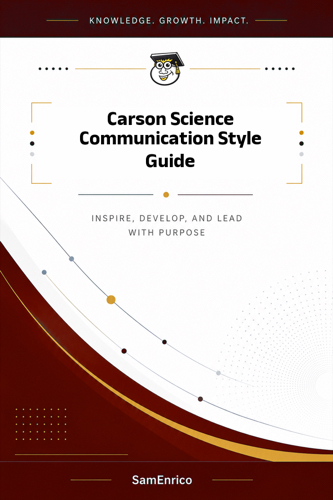
Carson Science Communication Style Guide eBook
Emulate Carson's lyrical yet precise prose, making
by Hahn Vennie
Emulate Carson's lyrical yet precise prose, making ecology accessible without losing scientific rigor.
Formats
Free sample
Chapter 1: The Clarity Tax--Every scientist I have ever met wants to be understood. Not admired, not cited, not promoted—though those are nice too. Understood. They want the person sitting across from them at a dinner party, the legislator reading their policy brief, the journalist scrolling through their email, the student in the back row of an introductory lecture to look up and say, “Oh, I get it. That’s what you found.
That’s why it matters.”And yet, almost every scientist I have ever met writes sentences that make understanding impossible.Not because they are lazy. Not because they are bad writers. Because they have been taught, systematically and without mercy, that clear writing is simple writing. That short words and short sentences require less effort than long ones. That if a sentence reads smoothly, it must have flowed from the writer’s mind that way—effortless, unlabored, like water running downhill.This is a lie.
And it is one of the most expensive lies in the history of science communication.The truth is that clear writing is not simple writing. Clear writing is expensive writing. It costs more time, more revision, more deletion, more sleepless nights staring at a single clause than any dense, jargon-filled, passive-voiced monolith you could produce in a single caffeine-fueled afternoon. The shortest sentence in this paragraph—“This is a lie”—took longer to write than the three sentences that preceded it combined. Because those three sentences could be sloppy.
That short sentence had to be perfect.Welcome to the Clarity Tax. This chapter is about what it is, why you have to pay it, and how to pay it efficiently. We will begin with the scientist who paid it more faithfully than anyone.The Most Expensive Sentence Rachel Carson Ever Wrote In 1962, Rachel Carson published Silent Spring, a book that would ban DDT, launch the modern environmental movement, and make her the target of one of the most vicious smear campaigns ever waged against a scientist. But before any of that happened, she wrote a single sentence that nearly broke her.The sentence appears in Chapter 3, where Carson is explaining how DDT persists in the environment long after it has been sprayed. The conventional way to write this sentence—the way a toxicologist might write it in a peer-reviewed paper—would be something like: “DDT exhibits environmental persistence due to its lipophilic molecular structure and resistance to microbial degradation.” That sentence is accurate.
It is also a brick wall.Here is what Carson actually wrote:“Over a very large part of the earth, DDT has become so widely distributed that it is now found in the tissues of virtually every living organism, from the single-celled algae of the open sea to the birds that fly overhead and the fish that swim in the deepest currents, and it remains there, stored in fat, waiting.”That sentence is forty-nine words long. It contains two clauses, three images (algae, birds, fish), a shift in tense (from present perfect to present), and a chilling final verb: “waiting.” It took Carson three weeks to get it right. Three weeks. For one sentence.She did not spend those three weeks adding words. She spent them subtracting.
The first draft of that sentence was longer, clunkier, and full of qualifications that she later realized the reader did not need. She removed “it is interesting to note that.” She removed “as researchers have discovered.” She removed “to a degree that is truly remarkable.” She kept the algae, the birds, the fish, and the waiting. She paid the Clarity Tax.The lesson is not that you should spend three weeks on every sentence. The lesson is that the sentence you admire—the one that reads as if it were whispered in your ear by the sea itself—was not born that way. It was edited that way.
The effort is invisible in the final product. That is the point.The Curse of Knowledge: Why You Cannot See Your Own Jargon Before we can fix bad writing, we need to understand why smart people produce so much of it. The answer is not laziness, not incompetence, not a conspiracy of journal editors (though they do not help). The answer is a cognitive bias so pervasive and so invisible to its victims that it has its own name in the psychological literature: the curse of knowledge.The curse works like this. Once you know something, it becomes nearly impossible to remember what it was like not to know it.
The knowledge feels obvious, inevitable, as natural as breathing. You forget that you spent weeks learning it. You forget the confusion, the false starts, the moment when the concept finally clicked. All you remember is the click. And because you remember only the click, you assume that everyone else will click just as quickly.Here is a demonstration.
Read the following sentence:“Anthropogenic nutrient loading drives eutrophication in lentic systems, resulting in hypolimnetic oxygen depletion and subsequent ichthyofaunal mortality events.”If you are a limnologist or a freshwater ecologist, that sentence is fine. Boring, perhaps, but clear. If you are not, that sentence is a brick wall. You hit it at full speed. The words “lentic” and “hypolimnetic” blur together.
“Ichthyofaunal mortality events” sounds like a euphemism, because it is a euphemism—it means “fish die,” but the writer was too embarrassed to say so directly.Now read Carson’s version of the same information, from a 1956 essay on the Chesapeake Bay:“When the fields are fertilized, the rain carries the nutrients into the creeks. The creeks carry them to the bay. In the bay, the nutrients feed the algae, and the algae multiply until the water turns green and thick. Then the algae die, and their decay steals the oxygen from the deep water. The crabs leave first, then the fish.
What remains is a dead zone, silent and still.”What did Carson do that the first sentence did not? She did not add information. She subtracted it—and then added texture. She replaced the abstract nouns (“anthropogenic nutrient loading,” “eutrophication,” “ichthyofaunal mortality”) with concrete verbs (“carries,” “feed,” “multiply,” “dies,” “steals,” “leave”). She replaced the static description of a state (“oxygen depletion”) with a story of a process (“the decay steals the oxygen”).
She reminded you, at every step, that the bay is a place where things happen, not a set of categories on a diagram.The curse of knowledge traps you in the first sentence. You know what eutrophication is. You have internalized the concept so thoroughly that you cannot see why anyone would need a crab or a dead zone to understand the same idea. Carson, by contrast, wrote as if she had never heard of eutrophication before—or rather, as if she remembered exactly how confusing it was when she first encountered it. She wrote from the other side of the curse.The rule: Before you write a sentence, ask yourself: What did I not understand about this concept six months ago?
What question did I ask that made it click? Then write the answer to that question. Not the definition. The answer.The Grandmother Test (The Real One, Not the…
This is the end of the free sample. Get the eBook to keep going. Buy now
About this book
Details
- Author
- Hahn Vennie
- Publisher
- SamEnrico
- Language
- English
- Genre
- Non-Fiction, Biography, Science Writing
- Released
- 2026-06-10
- Pages (approx.)
- 152
- Available as
- eBook, Audiobook

Read better in the ZLOADR app
Your eBooks on your phone or tablet. Sign in with your SamEnrico account and start reading.
More by Hahn Vennie
 Atychiphobia Recovery HandbookHahn Vennie$11.99
 Thesis and Dissertation Stress GuideHahn Vennie$11.99
 The Caregiver Agitation Management GuideHahn Vennie$11.99
 Physical Exercise Neuroprotective EffectsHahn Vennie$11.99
 The Troll’s Bridge: A Nordic Architect’s FollyHahn Vennie$11.99
 The Arabic Algorithms: How a 21st-Century Scholar Revolutionized Computer ScienceHahn Vennie$11.99
 Title ExaminerHahn Vennie$11.99
 Efficiency Improvement StatsHahn Vennie$12.99
 AI Audit Trail HandbookHahn Vennie$12.99
 Understanding Flynn–aird SyndromeHahn Vennie$17.99
 How to Become a Disc-pad GrinderHahn Vennie$11.99
You may also like
 Hong Kong Handover 1997Dunn Johnnie$11.99
 Zumba For Postnatal Recovery CourseNeal Christian$11.99
 Zumba for BeginnersLadner Nikia$11.99
 YouTube Comment Mining GuideHumes Pandora$12.99
 Worry Box MeditationCarlin Rudy$11.99
 Workplace Stress MeditationNguyen Lynn$11.99
 Workplace Stress and Sleep RepairHawley Ivory$11.99
 Workplace Perfectionism CureDelaney Jeffry$11.99
 Workplace Injustice Anger GuideWallen Isabelle$11.99
 Work Addiction and Burnout LinkGreenwood Ester$11.99
 Women in Yoga and WellnessBeattie Galina$11.99
 Women in Stand Up ComedyChun Evangeline$11.99