
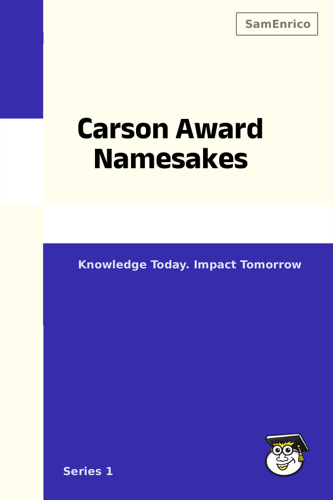
Carson Award Namesakes eBook
Organizations honoring her legacy.
by Aponte Kit
Organizations honoring her legacy.
Formats
Free sample
Chapter 1: The Silent Spring...–- The town began as a work of fiction. Rachel Carson called it “A Fable for Tomorrow,” and she placed it somewhere in the heart of America, though it could have been anywhere. In this town, birds had stopped singing. Apple trees bloomed, but no bees hummed among the blossoms. Roadsides were littered with the bodies of small animals, and children played in yards that had gone strangely quiet.
The streams, once clear, ran with a colorless film. People fell ill without understanding why. It was a portrait of a world quietly unraveling—not with an explosion, not with a single catastrophic event, but with the slow, almost invisible creep of chemicals.Carson wrote that fable as the opening chapter of Silent Spring, published in September 1962. She was fifty-five years old, already famous for her books about the sea, and already dying of breast cancer. The chemical industry would spend the next year and a half trying to destroy her reputation, calling her hysterical, unscientific, and politically dangerous.
She would not live to see the Environmental Protection Agency founded, nor the ban on DDT, nor the global environmental movement that she is now credited with launching. But she would live long enough to know that she had changed the terms of the argument. After Silent Spring, no one could honestly claim that pesticides were merely a technical question. They were a moral one.The fable was not really fiction. Carson had spent four years gathering evidence from scientists, doctors, and wildlife biologists across the country and around the world.
She had read studies that the chemical companies chose to ignore. She had interviewed cancer researchers who suspected that synthetic pesticides were accumulating in human tissue. She had watched as state and federal agencies—captured by the very industries they were supposed to regulate—sprayed DDT over Long Island neighborhoods, California orchards, and southern farm fields without notifying residents, without posting warnings, and without long-term studies on what the chemicals might do to the people breathing them.The Miracle That Wasn't To understand why Silent Spring landed like a thunderclap, one must first understand the world into which it was dropped. The 1950s were an era of almost religious faith in chemistry. DDT, synthesized in 1874 but rediscovered as an insecticide during World War II, was widely credited with saving countless lives by controlling typhus and malaria.
After the war, Swiss chemist Paul Hermann Müller received the Nobel Prize in Medicine for his work on DDT. The chemical industry expanded into peacetime production with astonishing speed. By 1962, Americans were spraying nearly a billion pounds of synthetic pesticides each year on crops, forests, homes, and public parks. Suburban children ran through clouds of mosquito fogging trucks as if they were playing in summer sprinklers.The rhetoric of the time was almost messianic. A 1959 advertisement for the chemical giant Velsicol Corporation depicted a farmer standing in a lush field, arms outstretched, under the headline: “Thank God for Pesticides.” Another industry pamphlet asked, “Is your town really healthy?” and answered that only regular spraying of insecticides could ensure a disease-free community.
The United States Department of Agriculture promoted DDT as safe enough to be used directly on food crops right up to the day of harvest. No one asked for long-term toxicology studies. No one required environmental impact assessments. The precautionary principle—the idea that chemicals should be proven safe before being released into the common environment—was nowhere in the legal or cultural vocabulary.Carson herself had not started as a critic of pesticides. In fact, she had written promotional material for the chemical industry early in her career.
But by the mid-1950s, she began hearing troubling reports from friends in conservation and ornithology. Robins were dying in Michigan after Dutch elm disease spraying. Entire songbird populations collapsed in Wisconsin. A letter from a woman on Cape Cod described dead birds dropping from trees, their bodies still warm, after a mosquito control operation. Carson started collecting these reports, almost as a private hobby at first.
She was not yet sure what she would do with them.The Unlikely Revolutionary Rachel Louise Carson was born in 1907 on a small farm in Springdale, Pennsylvania, along the banks of the Allegheny River. She was the youngest of three children, and her mother, Maria Carson, was a former schoolteacher who believed that daughters deserved the same education as sons. The family was poor but books were not. Rachel taught herself to read by the age of five and published her first story—about a soldier, surprisingly—in a children’s magazine when she was ten.She fell in love with the sea before she ever saw it. Reading marine biology texts in the local library, she imagined the Atlantic as a kind of living cathedral, full of creatures and rhythms that humans could barely comprehend.
When she graduated from the Pennsylvania College for Women (now Chatham University) with a degree in biology, she applied to graduate programs. Most rejected her because she was a woman. The Woods Hole Marine Biological Laboratory accepted her for a summer program, but only after she found her own housing because women were not permitted in the dormitories.In 1935, Carson was hired by the U.S. Bureau of Fisheries as a junior aquatic biologist—the second woman ever employed by the agency in a professional scientific capacity. She wrote radio scripts for a weekly educational program called “Romance of the Seas.” Her prose was so vivid that her supervisors encouraged her to publish a popular article about marine life.
That article became a book proposal, which became Under the Sea Wind (1941). It was published to excellent reviews and dismal sales—only about 1,500 copies. The attack on Pearl Harbor happened twelve days after its release, and the nation had other preoccupations.Carson did not give up. She continued working for the Bureau (later the Fish and Wildlife Service) during the day and writing at night. In 1951, she published The Sea Around Us, a lyrical and scientifically rigorous portrait of oceanography that became an instant bestseller.
It remained on the New York Times bestseller list for eighty-six weeks, won the National Book Award, and made Carson financially independent for the first time in her life. She quit government service to write full-time. Two years later, The Edge of the Sea appeared, completing a trilogy that established her as the most trusted voice in American nature writing.By the late 1950s, Carson was famous, respected, and, by outward appearances, content. She lived in a small cottage on the coast of Maine in the summers and in Silver Spring, Maryland, during the winters. Her health was generally good, though she had always been prone to infections and bouts of exhaustion.
She had an adopted son, Roger, who was the child of her recently deceased niece. She was not a firebrand, not a rabble-rouser, not an activist. She was a writer. And she had just become aware of a story that would not let her go.The Gathering Storm The story, as Carson initially conceived it, was supposed to be a modest article for The New Yorker about the dangers of pesticides—something on…
This is the end of the free sample. Get the eBook to keep going. Buy now
About this book
Details
- Author
- Aponte Kit
- Publisher
- SamEnrico
- Language
- English
- Genre
- Non-Fiction, Biography, Awards
- Released
- 2026-06-09
- Pages (approx.)
- 130
- Available as
- eBook, Audiobook

Read better in the ZLOADR app
Your eBooks on your phone or tablet. Sign in with your SamEnrico account and start reading.
More by Aponte Kit
 The Neurodivergent Teen GuideAponte Kit$11.99
 Medical Bill Financial Stress GuideAponte Kit$11.99
 Travel Blogger Wanderlust EnvyAponte Kit$11.99
 Senior Adult ImmunizationAponte Kit$11.99
 The Comparison Sibling WoundAponte Kit$11.99
 Failure Resilience GuideAponte Kit$11.99
 Love Has Won EscapeAponte Kit$11.99
 Entrepreneur Imposter SyndromeAponte Kit$11.99
 The Ottoman Astronomer and the Relativity Prelude: A Forgotten Genius in the Age of EnlightenmentAponte Kit$11.99
 Frozen Echoes: The Vanishing of the Northwind ExpeditionAponte Kit$11.99
 Fionn mac Cumhaill: The Giant Who Shaped IrelandAponte Kit$11.99
 Customer Support Systems for DropshippingAponte Kit$11.99
You may also like
 Hong Kong Handover 1997Dunn Johnnie$11.99
 Zumba For Postnatal Recovery CourseNeal Christian$11.99
 Zumba for BeginnersLadner Nikia$11.99
 YouTube Comment Mining GuideHumes Pandora$12.99
 Worry Box MeditationCarlin Rudy$11.99
 Workplace Stress MeditationNguyen Lynn$11.99
 Workplace Stress and Sleep RepairHawley Ivory$11.99
 Workplace Perfectionism CureDelaney Jeffry$11.99
 Workplace Injustice Anger GuideWallen Isabelle$11.99
 Work Addiction and Burnout LinkGreenwood Ester$11.99
 Women in Yoga and WellnessBeattie Galina$11.99
 Women in Stand Up ComedyChun Evangeline$11.99