
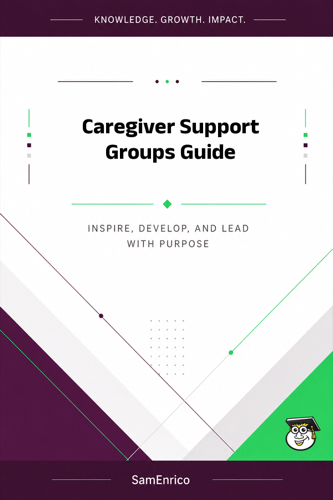
Non-FictionSelf-HelpSupport Networks
Caregiver Support Groups Guide eBook
Find community and share struggles with other fami
by Larue Alva
Find community and share struggles with other family caregivers using this workbook.
Formats
Free sample
Chapter 1: The Silent Epidemic--The first time you realize you might be drowning, it doesn’t look like the movies. There are no dramatic splashes, no desperate cries for help. Instead, you are sitting in a parked car in a hospital garage at 11:47 on a Tuesday night, having just spent four hours arguing with a night nurse about your mother’s pain medication. Your phone shows seventeen unread text messages—three from your boss (increasingly urgent), eight from your sibling (“Have you thought about assisted living?”), four from your teenager (mostly emojis you don’t understand), and two from the pharmacy saying a prescription is ready that you don’t remember ordering. Your back hurts from lifting your father last week.
You cannot remember the last time you ate a meal while sitting down. And somewhere beneath the exhaustion, beneath the guilt, beneath the low-grade panic that has become your baseline, you have started to believe a quiet, terrible lie: This is just what it means to be a good person. This is what love costs.That lie is killing you. Not metaphorically. Literally.This chapter is not here to scare you.
It is here to wake you up. Before you can walk into a support group, before you can share your story with strangers, before you can even convince yourself that you deserve community, you need to understand one thing: you are not failing at caregiving. Caregiving, as it is currently structured in our society, is failing you. And the silence that surrounds that failure is the most dangerous force in your life right now.The 80% That No One Sees Let us start with a number that should stop you cold: eighty percent. According to decades of research synthesized by organizations like the National Alliance for Caregiving and the AARP, family members provide approximately eighty percent of all home care in the United States.
That means the vast majority of long-term care for aging parents, disabled spouses, chronically ill children, and vulnerable loved ones is not being delivered by trained professionals in sterile facilities. It is being delivered by people like you, in living rooms and bedrooms and kitchenettes, often without pay, without training, and without backup.Eighty percent.Here is what that number looks like in human terms. It looks like a daughter who has postponed her own knee surgery because she cannot find anyone to stay with her father for the two weeks of recovery. It looks like a husband who has lost forty pounds because he is too exhausted to cook for himself after feeding his wife with early-onset Alzheimer’s. It looks like a young adult who dropped out of college to care for a grandparent, telling themselves they will go back “next year” for five years in a row.
It looks like you, reading this sentence, wondering when you last had a conversation that did not involve medication schedules, insurance appeals, or bowel movements.The eighty percent is not a statistic. It is a shadow workforce. And you are unpaid.Here is what the research actually says about unpaid family caregivers, compiled from studies spanning nearly four decades. Family caregivers report significantly higher rates of depression than the general population—some studies show rates two to three times higher. They report higher rates of anxiety disorders, including panic attacks and generalized anxiety disorder.
They report higher rates of physical illness, including hypertension, cardiovascular disease, and weakened immune function. A landmark study by Schulz and Beach in 1999 found that caregivers experiencing high levels of strain had a sixty-three percent higher risk of mortality than non-caregivers of the same age. More recent research has confirmed and extended these findings, showing that chronic caregiving stress actually shortens telomeres—the protective caps at the ends of chromosomes—accelerating biological aging.Let me translate that from academic language into plain English. Caregiving does not just make you feel old and tired. It literally ages you at the cellular level.
The stress is rewriting your biology. And no amount of positive thinking or “self-care Sunday” can undo that damage if the underlying stress remains unaddressed.Role Captivity: The Trap You Didn't Choose Now let us give a name to the feeling you have been carrying. Psychologists and caregiving researchers call it role captivity. The term was first introduced in the caregiving literature by Andrew Scharlach in his 1987 study of family caregivers, and it has been validated by decades of subsequent research. Role captivity is the experience of feeling trapped in a caregiving role that you did not explicitly choose, that you cannot easily leave, and that has come to define your entire identity against your will.Here is what role captivity feels like in the body.
It feels like a low-grade claustrophobia that never fully goes away. It feels like looking at photographs of your life from three years ago and not recognizing the person in the image—that person went to concerts, had hobbies, laughed easily. It feels like driving past a coffee shop where you used to sit for hours reading and feeling a wave of grief for a version of yourself that no longer exists. It feels like loving the person you care for with your whole heart while also, in the darkest part of the night, wishing they would just die so this could all be over. Then hating yourself for having that thought.
Then doubling down on being a perfect caregiver to atone for your secret selfishness. Then burning out a little more. Then the cycle repeats.Role captivity is not a sign of moral failure. It is a predictable psychological response to an unsustainable situation. Every human being has a fundamental need for autonomy—the sense that we have some control over our own lives and choices.
Psychologists call this self-determination theory, and it is one of the most well-established frameworks in human motivation research. The three core needs are autonomy (the feeling that you choose your actions), competence (the feeling that you are effective), and relatedness (the feeling that you are connected to others). Caregiving, as it is currently structured, systematically undermines all three. You cannot choose when your loved one needs help. You cannot choose when the phone rings with bad news.
You may feel incompetent when medical crises arise that you are not trained to handle. And you are increasingly isolated from the social connections that sustain relatedness.The captivity is real. Naming it is the first step toward escaping it—not by abandoning your loved one, but by finding ways to reclaim pieces of yourself within the role. That is what this entire workbook is designed to help you do.Anticipatory Grief: Mourning Someone Who Is Still Here There is another layer of suffering that caregivers rarely name, in part because it feels wrong to even acknowledge it. Anticipatory grief is the process of mourning a loved one who has not yet died—who may not die for months or years, but who is slowly, progressively slipping away.
This concept was first developed by psychiatrist Erich Lindemann in the 1940s and has since been extensively studied in caregivers of patients with dementia, ALS, Parkinson’s, and other progressive conditions.Anticipatory grief is most…
This is the end of the free sample. Get the eBook to keep going. Buy now
About this book
Details
- Author
- Larue Alva
- Publisher
- SamEnrico
- Language
- English
- Genre
- Non-Fiction, Self-Help, Support Networks
- Released
- 2026-06-07
- Pages (approx.)
- 155
- Available as
- eBook, Audiobook

Read better in the ZLOADR app
Your eBooks on your phone or tablet. Sign in with your SamEnrico account and start reading.
More by Larue Alva
 Five AM Club Morning RoutineLarue Alva$11.99
 Alcoholism Spiritual AwakeningLarue Alva$11.99
 Zapier Memory WorkflowsLarue Alva$11.99
 Affirmations For ForgivenessLarue Alva$11.99
 Self Esteem Mentoring GuideLarue Alva$11.99
 Weekly Review for LawyersLarue Alva$11.99
 Meditation for Plantar FasciitisLarue Alva$11.99
 The Last Shovel of EldoradoLarue Alva$11.99
 Velvet & Dynamite: The Untold Story of the 1970s Jet-Set HeistsLarue Alva$11.99
 How to Become a Cosmetologist ApprenticeLarue Alva$11.99
 How to Produce Recorder PartsLarue Alva$11.99
 A Collector's Handbook to the AC 70Larue Alva$11.99
You may also like
 Hong Kong Handover 1997Dunn Johnnie$11.99
 Zumba For Postnatal Recovery CourseNeal Christian$11.99
 Zumba for BeginnersLadner Nikia$11.99
 YouTube Comment Mining GuideHumes Pandora$12.99
 Worry Box MeditationCarlin Rudy$11.99
 Workplace Stress MeditationNguyen Lynn$11.99
 Workplace Stress and Sleep RepairHawley Ivory$11.99
 Workplace Perfectionism CureDelaney Jeffry$11.99
 Workplace Injustice Anger GuideWallen Isabelle$11.99
 Work Addiction and Burnout LinkGreenwood Ester$11.99
 Women in Yoga and WellnessBeattie Galina$11.99
 Women in Stand Up ComedyChun Evangeline$11.99