
Non-FictionNon-Obvious CareerCareer Pace
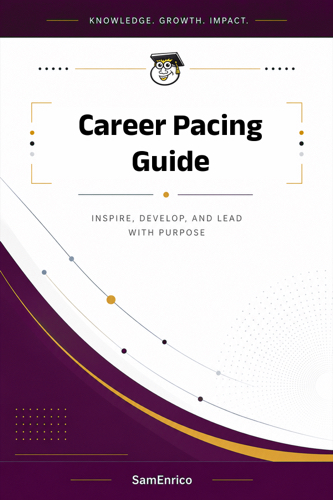
Career Pacing Guide eBook
Match sector speed to your personal acceleration p
by Engle Bailey
Match sector speed to your personal acceleration preference.
Formats
Free sample
Chapter 1: The Pace Paradox--–- You are not lazy. You are not weak. You are not a failure. And you are not broken.If you feel exhausted by a job that everyone else seems to thrive in, or bored senseless by a role that others call “stable” and “secure,” the problem is not your work ethic. The problem is not your ambition.
The problem is not that you lack grit or gratitude or some secret ingredient that successful people possess.The problem is pace dissonance.This is the hidden stressor that career books have ignored for decades. They tell you to find your passion, to align with your values, to build your network, to negotiate your salary. All of that matters. But none of it will save you if the speed of your work environment clashes violently with the speed your nervous system was built to handle.Imagine for a moment that you are a marathon runner. You have trained for years to run twenty-six point two miles at a steady, sustainable pace.
Your stride is efficient. Your breathing is controlled. Your mind settles into a rhythm that can carry you for hours. Now imagine someone forces you to run the hundred-meter dash instead. The starting gun fires.
You explode out of the blocks, but within fifteen seconds, your muscles are screaming, your lungs are on fire, and you collapse before the finish line. Everyone around you says you failed. But you didn't fail at sprinting. You were never supposed to be a sprinter.Now imagine the reverse. You are a sprinter.
You have trained for explosive power, lightning reflexes, and the ability to empty your entire tank in ten seconds. Now someone puts you on a marathon course. The first mile feels easy. By mile three, you are restless. By mile ten, you are bored out of your mind.
By mile eighteen, you have quit not because you are tired but because your brain is screaming for the intensity that never comes. Everyone around you says you lack endurance. But you don't lack endurance. You lack the right race.This is what happens to millions of professionals every single day. They are marathoners trapped in sprint sectors, dying slowly from exhaustion.
Or they are sprinters trapped in steady sectors, dying slowly from boredom. And no one—not their managers, not their mentors, not the fifty self-help books on their nightstand—has given them language for what is wrong.Until now.The Two Faces of Pace Dissonance Let us name the two faces of this problem, because naming is the first step toward liberation.The first face is Over-Acceleration. This is the red-lining feeling. You work in a high-pressure sector—startups, tech, marketing agencies, sales, crisis management, event planning, journalism, trading floors. The pace is relentless.
Deadlines are always tomorrow. The Slack channel never sleeps. Your inbox is a hydra: for every email you answer, three more appear. You are praised for your responsiveness, your availability, your willingness to “go the extra mile.” But the miles are adding up. You wake up tired.
You go to bed wired. Your weekends are not recovery; they are pre-exhaustion for the next week. You have started to resent your phone. You have started to resent the people who message you at nine PM and expect an answer. You have started to resent yourself for answering anyway.The medical literature on burnout describes symptoms like emotional exhaustion, depersonalization, and reduced personal accomplishment.
But those clinical terms miss the visceral reality. Over-acceleration feels like driving a car with the parking brake on. You are pressing the gas as hard as you can, the engine is roaring, but something is dragging. You are moving fast and going nowhere. And the worst part?
Everyone around you seems fine with it. They answer emails at midnight. They skip lunch. They brag about how many hours they worked. Either they are secretly suffering like you, or they are genuinely built for this speed.
And you cannot tell which is true, because no one talks about it.The second face is Under-Acceleration. This is the stuck-in-mud feeling. You work in a legacy sector—government, large manufacturing, academia, healthcare administration, utilities, traditional corporate environments. The pace is glacial. Decisions that could take a day take a month.
Approvals that could be one signature require twelve. Your ideas are met with “we have always done it this way.” Your enthusiasm is met with “let's form a committee to study the feasibility.” Your entire career feels like waiting. Waiting for a promotion. Waiting for a project to start. Waiting for someone to retire so a slot opens up.
You have stopped learning. Not because you are lazy, but because the organization does not reward learning. It rewards patience. It rewards compliance. It rewards showing up for thirty years and collecting a gold watch.Under-acceleration is more insidious than over-acceleration because it is harder to name.
At least the over-accelerated person can point to their exhaustion and call it burnout. The under-accelerated person looks around and sees coworkers who seem perfectly content. They are not complaining. They are not quitting. They are just...
there. And you start to wonder if something is wrong with you. Why can't you just be grateful for a stable job? Why do you need constant stimulation like a child? Why can't you just sit still and collect your paycheck like everyone else?Here is the truth: there is nothing wrong with you.
You are a sprinter in a marathon. You need velocity the way a plant needs sunlight. Without it, you do not just get bored. You get depressed. Your motivation doesn't fade; it atrophies.
Your skills don't plateau; they regress. And the most dangerous part is that under-acceleration can last for years, even decades, because the human nervous system can tolerate low-grade misery much longer than high-grade crisis. The over-accelerated person burns out in two years and leaves. The under-accelerated person slowly wilts over twenty years and never understands why they feel half-dead.The Hidden Cost of Mismatch Let us be precise about the damage. Pace dissonance is not merely uncomfortable.
It is expensive. It costs you money, health, relationships, and years of your life.The financial cost is the easiest to measure. When you are over-accelerated, you make impulsive decisions. You take the first job offer because you need a break from the chaos, not because it is the right fit. You spend money on convenience—takeout, delivery, cabs, subscriptions—because you have no time to cook, no energy to comparison shop, no margin to think.
You stay in toxic jobs because you are too exhausted to job hunt. When you are under-accelerated, you stagnate. Your salary lags because you are not pushing for raises, not developing new skills, not building a network that could lead to better opportunities. You accept mediocrity because the environment has convinced you that ambition is inappropriate.The health cost is steeper. Over-acceleration raises cortisol, disrupts sleep, weakens the immune system, and increases the risk of cardiovascular disease.
The World Health Organization now classifies burnout as an occupational phenomenon. But the research shows something even more troubling: chronic over-acceleration changes your brain…
This is the end of the free sample. Get the eBook to keep going. Buy now
About this book
Details
- Author
- Engle Bailey
- Publisher
- SamEnrico
- Language
- English
- Genre
- Non-Fiction, Non-Obvious Career, Career Pace
- Released
- 2026-06-09
- Pages (approx.)
- 132
- Available as
- eBook, Audiobook

Read better in the ZLOADR app
Your eBooks on your phone or tablet. Sign in with your SamEnrico account and start reading.
More by Engle Bailey
 Chronic Illness and Self WorthEngle Bailey$11.99
 Domestic Worker Reunited With KidsEngle Bailey$11.99
 Meditation For Tinnitus AnxietyEngle Bailey$11.99
 The Journalist CapturedEngle Bailey$11.99
 Paul Farmer PartnersEngle Bailey$11.99
 Healing The Inner Child GuideEngle Bailey$11.99
 Whales and Leverage: The Liquidation MachineEngle Bailey$11.99
 The Dragon’s Hoard: A Knight’s Bargain with the Beast of the Black ForestEngle Bailey$11.99
 Freya’s Golden Tears: The Love That Shattered AsgardEngle Bailey$11.99
 The Mineral Guide to BertranditeEngle Bailey$11.99
 How to Start a Adventure Playground Business (Beginners Guide)Engle Bailey$11.99
 Growing Dennstaedtia (Cup Fern)Engle Bailey$11.99
You may also like
 Hong Kong Handover 1997Dunn Johnnie$11.99
 Zumba For Postnatal Recovery CourseNeal Christian$11.99
 Zumba for BeginnersLadner Nikia$11.99
 YouTube Comment Mining GuideHumes Pandora$12.99
 Worry Box MeditationCarlin Rudy$11.99
 Workplace Stress MeditationNguyen Lynn$11.99
 Workplace Stress and Sleep RepairHawley Ivory$11.99
 Workplace Perfectionism CureDelaney Jeffry$11.99
 Workplace Injustice Anger GuideWallen Isabelle$11.99
 Work Addiction and Burnout LinkGreenwood Ester$11.99
 Women in Yoga and WellnessBeattie Galina$11.99
 Women in Stand Up ComedyChun Evangeline$11.99