
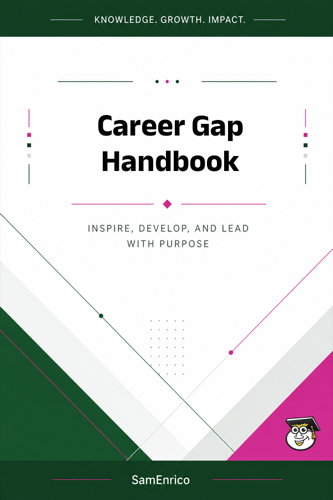
Non-FictionNon-Obvious CareerComplete Guide
Career Gap Handbook eBook
Complete guide to explaining employment breaks.
by Dix Amie
Complete guide to explaining employment breaks.
Formats
Free sample
Chapter 1: The Gap Penalty--–- Margaret had done everything right. Ivy League education. Ten years of rising through the ranks at a respected financial services firm. Consistently rated "exceeds expectations." A promotion to vice president at thirty-three. Then her mother was diagnosed with early-onset Alzheimer's, and Margaret made a choice that 47 million other Americans have made in the past five years: she stepped away from her career to provide full-time care.Eighteen months later, she was ready to return.
Smarter. More focused. More efficient than ever because she had learned, in the crucible of caregiving, exactly what mattered and what didn't. She updated her resume—the same chronological format that had served her perfectly for a decade—and began applying.Seventy-three applications. Seven interviews.
Zero offers.One recruiter, in a rare moment of candor, told her why: "The gap. It's not that you aren't qualified. It's that we have other candidates who don't have a gap. It's just... cleaner."Cleaner.
As if Margaret's eighteen months of keeping her mother safe, managing medications across four specialists, and navigating the brutal logistics of long-term care was somehow dirty. As if those months had erased the decade of excellence that came before.Margaret's story is not unusual. It is not exceptional. It is, in fact, the new normal—and the old systems of career evaluation are utterly failing to account for it.The Myth of the Linear Career Let us begin with a simple provocation: the chronological resume is a relic of an industrial economy that no longer exists.Think about what a traditional resume asks you to do. It demands that you account for every month of your adult life in a straight line from your first job to your current one.
Any deviation from that line—a gap between positions, a leave of absence, a period of caregiving, travel, illness, or simply breathing—appears as a wound in the narrative. The resume does not ask what you learned during those months. It does not ask what skills you built while managing a household, caring for a dying parent, or recovering from burnout. It asks only one question, silently and brutally: Why weren't you working?The implicit assumption is that work—paid, formal, employer-sanctioned work—is the only legitimate use of adult time. Everything else is a void to be explained, excused, or hidden.This assumption is not only cruel; it is economically stupid.Consider the data.
A 2021 study from the Federal Reserve Bank of St. Louis found that workers who took career breaks for family caregiving returned with higher productivity ratings than their peers who never left—but received lower starting salaries. They were better workers, paid less, because their resumes had a hole in them. A 2023 analysis of 2.5 million job applications by the talent platform Indeed found that candidates with employment gaps of twelve months or longer received 45% fewer callbacks than statistically identical candidates without gaps. The penalty existed regardless of the reason for the gap.
A parent returning from leave was treated the same as someone who had been laid off. The algorithm did not care. The algorithm saw only absence.And here is the deeper problem: the penalty is not just unfair. It is counterproductive for employers. Multiple studies have shown that returners from sabbaticals, parental leave, and caregiving breaks outperform their peers on measures of loyalty, crisis management, and efficiency.
They have learned, often the hard way, how to prioritize. They have developed patience, systems thinking, and emotional intelligence in environments where a mistake could mean a missed medication, a blown budget, or a family crisis. These are not liabilities. These are superpowers that the traditional resume cannot see.The Career Gap Analysis Framework This book is built on a single foundational framework: the Career Gap Analysis. It is a simple but powerful tool for transforming how you think about—and present—time away from formal employment.The framework begins with a distinction that may seem small but changes everything.Void vs.
Break A void is a period of time during which you engaged in no intentional activity, pursued no learning, built no skills, and maintained no professional connections. Voids are rare. Most people think they have voids when they actually have breaks. The difference is not about what you did for money but about what you learned.A break, by contrast, is a period of intentional redirection, rest, caregiving, or exploration that builds transferable skills. Note the word intentional.
You do not need to have planned the break from the beginning for it to qualify as a break. Intention can be discovered mid-way. A layoff is not planned, but the way you spend the following six months—taking courses, freelancing, volunteering, even deeply resting after years of burnout—is a choice. That choice transforms a void into a break.Here is the rule: If you learned something, built something, maintained something, or healed something, it is a break, not a void.The vast majority of career gaps fall into the break category. The problem is not that people have voids.
The problem is that people believe they have voids and present them as such—apologetically, vaguely, as empty space—when in fact those months or years were dense with experience.The "Math of Time" Exercise Before we go any further, I want you to do a short exercise. Take out a piece of paper or open a blank document.Write down your age.Write down the age at which you started your first full-time job (or the age you entered the workforce if you are a trade professional).Subtract the second number from the first. This is your total adult working years so far.Now, calculate how many months of that total were spent outside of formal, paid employment. Include parental leave, sabbaticals, periods between jobs, caregiving, travel, illness, and any other time you were not receiving a W-2 or 1099.Divide that number by 12 to get years. Then divide that number by your total adult working years.
Multiply by 100.You now have a percentage: the proportion of your adult life spent in "gaps."For most people, that number is between 10% and 30%. One-tenth to nearly one-third of your working life has been spent in activities that the traditional resume treats as invisible or shameful.Now ask yourself: does that percentage represent a void—empty, wasted time? Or does it represent a set of experiences that shaped who you are and how you work?This book exists because for the vast majority of readers, the honest answer is the second one. Your gaps are not voids. They are breaks.
And breaks are not problems to be solved. They are assets to be leveraged.The Break Typology: Which Kind of Gap Do You Have?Different breaks require different strategies. A planned sabbatical for travel is not the same as a layoff, which is not the same as a mental health break, which is not the same as incarceration. Each has its own challenges, its own opportunities, and its own optimal framing.This chapter introduces the Break Typology—a grid that will be referenced throughout the book. For each break type, we identify whether it functions as an asset, a neutral event, or a…
This is the end of the free sample. Get the eBook to keep going. Buy now
About this book
Details
- Author
- Dix Amie
- Publisher
- SamEnrico
- Language
- English
- Genre
- Non-Fiction, Non-Obvious Career, Complete Guide
- Released
- 2026-06-08
- Pages (approx.)
- 147
- Available as
- eBook, Audiobook

Read better in the ZLOADR app
Your eBooks on your phone or tablet. Sign in with your SamEnrico account and start reading.
More by Dix Amie
 Noting Technique For SleepDix Amie$11.99
 Evening Wind Down RitualDix Amie$11.99
 Dyspareunia Pain GuideDix Amie$11.99
 The British Steam Engine RevolutionDix Amie$11.99
 The Titan of Industry: Andrew Carnegie and the Gospel of WealthDix Amie$11.99
 The Breeder's Guide to Choctaw PigsDix Amie$11.99
 Nairobi Agritech StartupsDix Amie$12.99
 Multi Member Foreign LLC GuideDix Amie$12.99
 Customer Relations SpecialistDix Amie$11.99
You may also like
 Hong Kong Handover 1997Dunn Johnnie$11.99
 Zumba For Postnatal Recovery CourseNeal Christian$11.99
 Zumba for BeginnersLadner Nikia$11.99
 YouTube Comment Mining GuideHumes Pandora$12.99
 Worry Box MeditationCarlin Rudy$11.99
 Workplace Stress MeditationNguyen Lynn$11.99
 Workplace Stress and Sleep RepairHawley Ivory$11.99
 Workplace Perfectionism CureDelaney Jeffry$11.99
 Workplace Injustice Anger GuideWallen Isabelle$11.99
 Work Addiction and Burnout LinkGreenwood Ester$11.99
 Women in Yoga and WellnessBeattie Galina$11.99
 Women in Stand Up ComedyChun Evangeline$11.99