
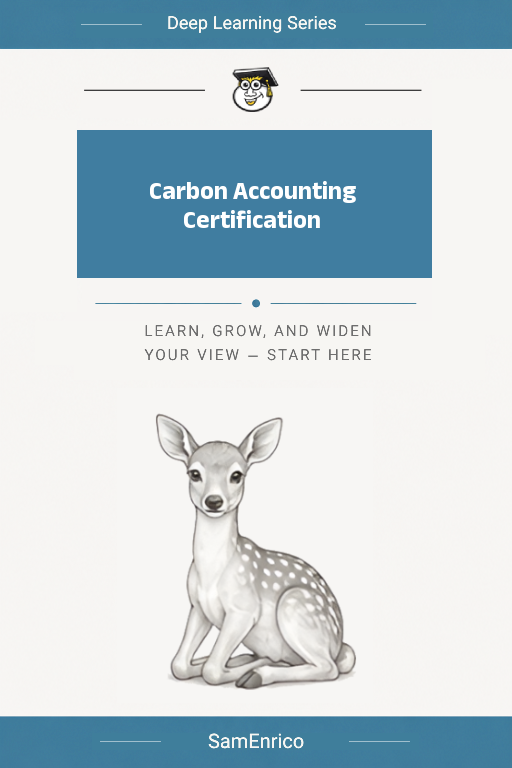
Non-FictionNon-Obvious CareerCarbon AccountingGHG Protocol
Carbon Accounting Certification eBook
Get certified in GHG Protocol via online course, t
by Swartz Elia
Get certified in GHG Protocol via online course, then join sustainability teams.
Formats
Free sample
Chapter 1: The Carbon Ledger...--In the spring of 2023, a Fortune 500 retailer received a letter that would change the trajectory of its sustainability department forever. It wasn’t from an environmental activist group or a concerned customer. It was from its own auditor, a Big Four firm, stating that the company’s publicly reported emissions inventory contained material errors in its Scope 2 calculations. The error was not malicious. An analyst had used location-based emission factors for a facility that had been purchasing renewable energy credits for three years.
The result? An overstatement of approximately 40,000 metric tons of CO2e. The correction triggered a restatement, a dip in the company’s CDP score, and a quiet but urgent hiring spree: three new carbon accountants within sixty days.This story is not an anomaly. It is the new normal.For the past decade, carbon accounting lived in the murky waters of voluntary reporting. Companies published glossy sustainability reports filled with prose about “commitment” and “journeys,” but the numbers beneath the narratives were often inconsistent, unaudited, and incomparable.
That era is ending. And it is ending not because corporations suddenly discovered a conscience, but because regulators, investors, and litigators discovered the balance sheet.Welcome to the golden era of carbon accounting. You are holding a book that promises to do what the top ten bestselling guides on this topic have failed to accomplish: take you from zero to certified in the GHG Protocol, then land you a seat on a real sustainability team, and keep you employed for the next decade. The other books will teach you theory. They will show you screenshots of software dashboards.
They will quote the Kyoto Protocol. This book will teach you how to pass the exam, impress a hiring manager who is drowning in bad data, and survive your first ninety days without being eaten alive by operations directors who have never heard of an emission factor.But before we talk about certification, before we talk about Scope 3 categories or control approaches, we need to talk about why you are here. And why now.The Regulatory Tsunami That Made Carbon a Currency Let us begin with a simple statement of fact: carbon is no longer an environmental metric. It is a financial liability.In 2024, the U.S. Securities and Exchange Commission (SEC) finalized its climate disclosure rules, requiring publicly traded companies to report Scope 1 and Scope 2 emissions in their annual filings.
While the Scope 3 requirement was walked back under political pressure, the message was clear: the federal government now considers greenhouse gas emissions material information for investors. The same year, the European Union’s Corporate Sustainability Reporting Directive (CSRD) came into full effect, mandating detailed reporting on all three scopes for over 50,000 companies doing business in Europe. If your company sells a single product in France or maintains a server in Germany, you are in scope. And in 2026, the International Sustainability Standards Board (ISSB) S2 standard is rapidly becoming the global baseline, with jurisdictions from Japan to Brazil adopting it into local law.Collectively, these regulations form what I call the “Regulatory Tsunami.” And like any tsunami, it creates a massive displacement. Not of water, but of labor.Consider the math.
Approximately 10,000 publicly traded companies in the US. Another 50,000 under CSRD. Tens of thousands more in supply chains. Each of these companies needs at least one dedicated carbon accountant to produce compliant disclosures. Many need teams of five to twenty.
Yet as of 2025, the qualified talent pool – individuals who understand both the GHG Protocol and the practical realities of corporate data – is estimated at fewer than 15,000 globally. This is a supply-demand imbalance that economists call a “seller’s market.” In plain English: if you get certified, you will be fought over.But the regulations are only the first wave. The second wave is litigation.In 2024, a Dutch court ruled against Shell in a landmark climate case, ordering the company to reduce its absolute emissions by 45% by 2030. In the United States, several municipalities have sued fossil fuel companies for climate damages, and while those cases are still pending, the legal theory – that inaccurate or misleading emissions disclosures constitute securities fraud – is being tested in lower courts. Meanwhile, the SEC has already issued fines to companies for misleading ESG statements.
These are not abstract risks. The carbon accountant sitting in a corporate headquarters today is not merely filling out a spreadsheet. He or she is producing evidence that could appear in a deposition. That is why CFOs, who have historically ignored sustainability as a “nice to have,” are now personally signing off on emissions data. And that is why they are desperate for qualified people.The Myth of the ESG Generalist If you have been following the sustainability job market, you have likely seen a proliferation of job titles: Sustainability Manager, ESG Analyst, Corporate Responsibility Lead.
These are what I call “ESG generalist” roles. They require a broad understanding of environmental issues, social justice, supply chain ethics, and corporate reporting. They are valuable positions. They are also not the roles I am preparing you for.The carbon accountant is a different animal entirely.The carbon accountant does not write policy. The carbon accountant does not design diversity programs or draft community engagement plans.
The carbon accountant sits in a room with procurement spreadsheets, utility bills, and emission factor databases, and produces a number that is defensible, auditable, and repeatable. The carbon accountant is to the ESG generalist what a tax accountant is to a corporate strategist. Related, yes. Interdependent, certainly. But fundamentally different in temperament and training.Let me share a story that illustrates the distinction.
In 2022, a large tech company hired a new Head of Sustainability – a charismatic former NGO director with a master’s degree in environmental policy. She gave brilliant presentations about net zero commitments. She spoke at conferences. She rallied employees. But when the CSRD deadline approached and the company needed to produce a verified inventory, she had no idea how to calculate fugitive emissions from her data centers’ refrigerant leaks.
Her team of ESG generalists had never heard of the GHG Protocol’s “operational control” approach. The company ended up paying a consultant $250,000 to do the work that a single certified carbon accountant could have done for a fraction of the cost. Six months later, that consultant was hired full-time, and the Head of Sustainability was reassigned to government relations.I tell you this not to denigrate ESG generalists. They have their place. But the market is currently flooded with generalists and starving for specialists.
A Linked In search in early 2026 for “GHG Protocol” yields over 8,000 job postings. A search for “ESG” yields 40,000 – but 80% of those are for generalist roles that pay significantly less than the specialist positions requiring carbon accounting skills. The average GHG reporting specialist in the United States earns between 85,000and85,000 and 85,000and140,000. A senior carbon accountant at a Big Four consulting firm can clear $180,000. These are not “save the planet for free” jobs.
These are professional, career-track positions with benefits, bonuses, and mobility.What the Top 10 Books Won’t Tell You Before I wrote this book, I read the top ten bestsellers on carbon accounting. I read The Handbook of Carbon Accounting…
This is the end of the free sample. Get the eBook to keep going. Buy now
About this book
Details
- Author
- Swartz Elia
- Publisher
- SamEnrico
- Language
- English
- Genre
- Non-Fiction, Non-Obvious Career, Carbon Accounting, GHG Protocol
- Released
- 2026-05-29
- Pages (approx.)
- 160
- Available as
- eBook, Audiobook

Read better in the ZLOADR app
Your eBooks on your phone or tablet. Sign in with your SamEnrico account and start reading.
More by Swartz Elia
 Parent Emotion RegulationSwartz Elia$11.99
 Litigation Lawyer Burnout GuideSwartz Elia$11.99
 Contract Abstraction Data SchemaSwartz Elia$11.99
 Egyptian Amulets GuideSwartz Elia$11.99
 Mindful Breathing For PTSDSwartz Elia$11.99
 Forest Meditation JourneySwartz Elia$11.99
 Ancient Coral Diver LogSwartz Elia$11.99
 Self Talk For OverwhelmSwartz Elia$11.99
 Meeting Agenda PalaceSwartz Elia$11.99
 The Last Stand of Vijaya: Champa's Defiance Against the Khmer EmpireSwartz Elia$11.99
 The Shadow Crown: How Queen Victoria’s Private Secretary Ruled an EmpireSwartz Elia$11.99
 The Last Transmission: The Mysterious Vanishing of the North Pole 37Swartz Elia$11.99
You may also like
 Hong Kong Handover 1997Dunn Johnnie$11.99
 Zumba For Postnatal Recovery CourseNeal Christian$11.99
 Zumba for BeginnersLadner Nikia$11.99
 YouTube Comment Mining GuideHumes Pandora$12.99
 Worry Box MeditationCarlin Rudy$11.99
 Workplace Stress MeditationNguyen Lynn$11.99
 Workplace Stress and Sleep RepairHawley Ivory$11.99
 Workplace Perfectionism CureDelaney Jeffry$11.99
 Workplace Injustice Anger GuideWallen Isabelle$11.99
 Work Addiction and Burnout LinkGreenwood Ester$11.99
 Women in Yoga and WellnessBeattie Galina$11.99
 Women in Stand Up ComedyChun Evangeline$11.99