
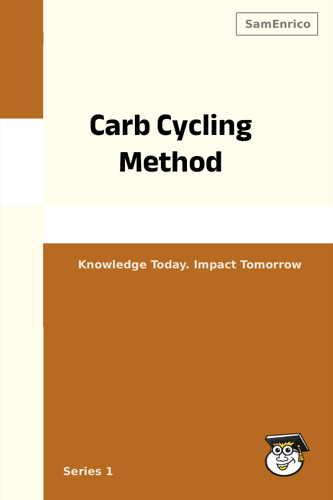
Non-FictionHealth & WellnessPeriodization
Carb Cycling Method eBook
Teaches alternating high and low carb days for per
Teaches alternating high and low carb days for performance.
Formats
Free sample
Chapter 1: The Static Diet Trap--–- The marathoner hit the wall at mile twenty. Not the famous “Heartbreak Hill” wall that every Boston runner expects. A different wall. A quieter, more humiliating wall. Her name was Sarah, she was thirty-four years old, she had trained for eighteen weeks, and she had done everything “right.” She had followed a low-carb, high-fat diet for the entire training cycle because every podcast and every influencer told her that fat adaptation was the secret to endless endurance.
She could burn fat now, they said. She would never bonk again.She bonked. Hard. Her legs turned to concrete. Her brain turned to static.
She watched her goal time—3:45, which she had worked toward for nearly half a year—slip away one painful step at a time. By the time she crossed the finish line, she was walking. She was crying. And she was furious.Across the country, a powerlifter named Marcus was having the opposite problem. Marcus ate high-carb every single day.
Oatmeal for breakfast. Rice and chicken for lunch. Pasta for dinner. He followed the standard bodybuilding playbook: carbs fuel muscle, so eat carbs all the time. But Marcus felt “soft.” His muscles looked full, sure, but they also looked smooth.
His waistline was creeping up. His bench press had plateaued for six months. He was eating “clean,” training hard, and getting nowhere.Two people. Two diets. Two different versions of failure.Sarah and Marcus are not real people.
But they represent every email, every DM, every desperate question that has landed in my inbox over the past decade. “Why am I so tired?” “Why am I not losing fat?” “Why do I have no energy for my workouts?” “Why do I feel puffy even though I eat healthy?”The answer, in every single case, was the same. It was not that Sarah chose the “wrong” diet. It was not that Marcus lacked discipline. The problem was not the type of carbohydrates they were eating.
The problem was that they were eating the same amount of carbohydrates every single day.This chapter will show you why static eating—eating the same macronutrient ratios day after day—is the single greatest hidden saboteur of performance, body composition, and energy. You will learn why the human body is designed for metabolic variety, not sameness. You will discover the concept of hormesis, the biological principle that small, strategic stressors make you stronger. And you will understand, for the first time, why you are not broken. Your diet is just stuck.The Myth of the Perfect Daily Diet Every few years, the nutrition world crowns a new king.
In the 1990s, it was low-fat, high-carb. In the 2000s, it was high-protein, moderate-everything-else. In the 2010s, it was low-carb, high-fat. In the 2020s, it has been intermittent fasting, keto, paleo, vegan, carnivore, and a dozen other “-ans” and “-os” that promise to be the final, definitive answer to human nutrition.Here is the truth that none of these diets want you to hear: there is no perfect daily diet.Not because nutrition science is confusing. Not because researchers cannot agree.
But because the human body is not designed to eat the same thing every day. We are designed for feast and famine. For abundance and scarcity. For summer fruit and winter roots. For the hunt and the harvest.Your ancestors did not eat the same breakfast, lunch, and dinner for three hundred and sixty-five days in a row.
They ate what was available. Some days, that meant a massive haul of starchy tubers and wild berries—a high-carb day. Other days, it meant fasting or eating only lean game meat—a low-carb day. And some days, it meant a mix of whatever they could find—a moderate day.Your metabolism evolved under those conditions. It expects variety.
It expects oscillation. It expects to switch between fuel sources.When you ignore that evolutionary reality and eat the same amount of carbohydrates every single day, you trigger a phenomenon called metabolic adaptation. Your body, which is brilliantly efficient, notices that you are giving it the same fuel signal repeatedly. So it adapts. It downregulates certain enzymes.
It changes how sensitive your cells are to insulin. It adjusts your hunger hormones. It does all of this to maintain homeostasis—the biological drive for stability.Homeostasis is not your friend when you are trying to change your body. Homeostasis is the force that keeps you exactly where you are.The Glucose and Insulin Story (Told Once)Let me explain something that will be referenced throughout this book but never fully re-explained. Pay attention here, because this is the only time I will cover this ground in detail.Glucose is a sugar molecule.
It is the primary fuel source for your brain, your muscles during high-intensity activity, and countless other processes in your body. You get glucose from digesting carbohydrates—bread, rice, potatoes, fruit, sugar, and so on.Insulin is a hormone. Think of insulin as a traffic cop. When glucose enters your bloodstream, insulin shows up and directs that glucose to one of three destinations: (1) into your muscle cells to be used as immediate energy, (2) into your liver and muscle cells to be stored as glycogen (a stored form of glucose), or (3) into your fat cells to be stored as, well, fat.Where insulin sends the glucose depends on two things: how hungry your muscles are and how sensitive your cells are to insulin’s signal.When you exercise, your muscles become ravenous for glucose. They essentially rip open their doors and shout, “Send it in!” In that state, insulin barely has to work.
Glucose rushes into muscle tissue, where it is burned for energy or stored as glycogen.When you are sedentary, your muscles are not hungry. Insulin has to knock harder. If your cells are insulin sensitive (meaning they respond easily to insulin’s knock), glucose can still find its way into muscle and liver glycogen. But if your cells are insulin resistant (meaning they have stopped listening to insulin’s knock), glucose gets redirected to fat cells.Here is the critical point that most people misunderstand: insulin is not the enemy. Without insulin, you would die.
Diabetics who cannot produce insulin must inject it to survive. The problem is not insulin. The problem is chronically elevated insulin caused by constantly eating carbohydrates in the absence of exercise.When you eat the same amount of carbs every day—whether that is three hundred grams or fifty grams—you create a static insulin environment. Your cells stop having to “listen” because the signal never changes. Insulin sensitivity plateaus.
Metabolic adaptation sets in. And your progress stops.Homeostasis vs. Hormesis: The Battle Inside You Let me introduce you to two competing biological principles. Understanding these two words will change how you think about diet and exercise forever.Homeostasis is your body’s drive for stability. It wants your body temperature at ninety-eight point six degrees.
It wants your blood p H in a narrow range. It wants your blood sugar stable. Homeostasis is why you shiver when you are cold (to generate heat) and sweat when you are hot (to cool down). Homeostasis…
This is the end of the free sample. Get the eBook to keep going. Buy now
About this book
Details
- Author
- Chalmers Michal
- Publisher
- SamEnrico
- Language
- English
- Genre
- Non-Fiction, Health & Wellness, Periodization
- Released
- 2026-06-05
- Pages (approx.)
- 154
- Available as
- eBook, Audiobook

Read better in the ZLOADR app
Your eBooks on your phone or tablet. Sign in with your SamEnrico account and start reading.
More by Chalmers Michal
 Face Recognition TrainingChalmers Michal$11.99
 Animal Crossing Daily RoutineChalmers Michal$11.99
 PTSD Relationship Stress GuideChalmers Michal$11.99
 Applewhite's Hospitalization HistoryChalmers Michal$11.99
 Time Based Pricing GuideChalmers Michal$11.99
 Desk Nap TechniquesChalmers Michal$11.99
 The Toy Drive OrganizerChalmers Michal$11.99
 The Golden Calculus: Mathematicians of the Nile and BeyondChalmers Michal$11.99
 Quetzalcoatl's Celestial Spine: The Tower of HeavenChalmers Michal$11.99
 A Collector's Handbook to the Jowett 7 HP ShortChalmers Michal$11.99
 Service Providers Guide to Hair Salons & BarbersChalmers Michal$11.99
 How to Produce JigsawsChalmers Michal$11.99
You may also like
 Hong Kong Handover 1997Dunn Johnnie$11.99
 Zumba For Postnatal Recovery CourseNeal Christian$11.99
 Zumba for BeginnersLadner Nikia$11.99
 YouTube Comment Mining GuideHumes Pandora$12.99
 Worry Box MeditationCarlin Rudy$11.99
 Workplace Stress MeditationNguyen Lynn$11.99
 Workplace Stress and Sleep RepairHawley Ivory$11.99
 Workplace Perfectionism CureDelaney Jeffry$11.99
 Workplace Injustice Anger GuideWallen Isabelle$11.99
 Work Addiction and Burnout LinkGreenwood Ester$11.99
 Women in Yoga and WellnessBeattie Galina$11.99
 Women in Stand Up ComedyChun Evangeline$11.99