
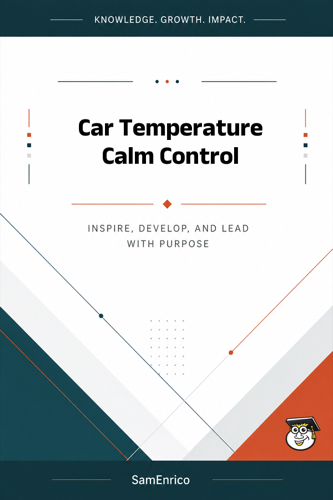
Non-FictionSelf-HelpTemperature
Car Temperature Calm Control eBook
Keep vehicle cool to prevent heat triggered aggres
by Stockton Rae
Keep vehicle cool to prevent heat triggered aggression and discomfort.
Formats
Free sample
Chapter 1: The Honk Paradox–- You did not plan to lose your temper. It was just another Tuesday afternoon commute, the same road you had driven a thousand times before. The sun was high, the air conditioner was struggling, and the driver ahead of you hesitated for exactly 1.5 seconds after the light turned green. Before you could think, your hand slammed into the horn. A long, loud, angry blast that startled even you.
The driver ahead flinched and sped away. Your knuckles were white on the steering wheel. Your face was hot. Your heart was pounding. And then came the wave of shame.
Why did I do that? That was not me. What is wrong with me?Here is the answer that will change everything about how you drive: absolutely nothing is wrong with you. You are not broken. You are not secretly an aggressive person.
You are not a bad parent, a bad partner, or a bad human being. You are a mammal in a hot box, and your mammal brain is doing exactly what evolution designed it to do sixty million years ago. The problem is not your character. The problem is that your brain cannot tell the difference between a predator and a hot day.This chapter will dismantle the myth that heat-induced aggression is a moral failing. You will learn the neurobiology of the hypothalamus, the strange physics of misattributed arousal, and the single most important reframe that makes every other technique in this book possible.
By the end of this chapter, you will never look at your hot car the same way again. And more importantly, you will never look at your own anger the same way again.The Biology You Never Chose Deep inside your brain, just above the brainstem and behind your eyes, sits a tiny structure about the size of an almond. It weighs less than four grams—about the same as a standard postage stamp. Its name is the hypothalamus, and it is the oldest, most primitive, most stubborn part of your nervous system. You share it with every mammal on Earth.
Your dog has one. Your cat has one. The deer that darts across the highway has one. It has been honed by evolution for hundreds of millions of years, and it has exactly two jobs that matter for this book.First, the hypothalamus is your body's thermostat. It monitors your core temperature constantly, receiving data from temperature sensors embedded in your skin, your spinal cord, and your internal organs.
When your core temperature rises above its set point—usually around 98.6°F, though individual baselines vary by about half a degree in either direction—the hypothalamus activates your body's cooling systems. You sweat. Your blood vessels dilate to release heat. You feel an urge to remove clothing, seek shade, or drink something cold. Your thermostat is doing its job, keeping you alive in an environment that ranges from freezing winters to blistering summers.Second, the hypothalamus is your brain's alarm system.
It is the command center for the sympathetic nervous system—the famous "fight or flight" network. When the hypothalamus perceives a threat, it signals the pituitary gland to release a cascade of hormones that ultimately flood your bloodstream with cortisol and adrenaline. Your heart rate accelerates. Your breathing quickens. Your pupils dilate.
Blood diverts from your digestive system to your large muscles. Your peripheral vision narrows to focus on the threat. You are now a weapon, primed for combat or escape. This response has kept your ancestors alive through predators, wars, and countless other dangers. It is elegant, efficient, and completely automatic.Here is the critical insight that changes everything: your hypothalamus does not distinguish between different kinds of threats.
A physical threat—say, a stranger charging at you with a knife—and a thermal threat—say, your core temperature rising toward dangerous levels—trigger the exact same alarm response. From the hypothalamus's perspective, overheating is an existential danger. If your core temperature rises above 104°F, you risk heat stroke, organ failure, and death. Your brain is not overreacting when it sounds the alarm at 99.5°F. It is doing its job.
It is trying to keep you alive.The problem is that the alarm response—the adrenaline, the cortisol, the racing heart, the narrowed focus—feels exactly like anger. Because anger is, neurologically speaking, a low-grade fight-or-flight response. Your brain does not know you are angry at a slow driver. It knows you are hot, and hot means danger, and danger means prepare to fight. The honking, the yelling, the aggressive lane change—these are not expressions of your true character.
They are your survival instincts misfiring in an environment your ancestors never evolved to handle.The 1-Degree Shift That Hijacks Your Mood Perhaps the most important finding from the thermal biology literature is how little heat it takes to trigger this response. You do not need to be in danger of heat stroke. You do not need to be visibly sweating. You do not need to feel uncomfortable. A rise in core temperature of just 1°F above your personal baseline is enough to activate the hypothalamus's alarm pathway.One degree.
That is all.Consider what this means for your daily life. Your core temperature varies naturally throughout the day—slightly lower in the early morning, slightly higher in the late afternoon. It rises when you exercise, when you eat a large meal, when you are fighting off an infection, when you are stressed. A 1°F rise is well within the range of normal daily variation. You might not even notice it consciously.
You might feel perfectly fine, perfectly comfortable, perfectly in control. But your hypothalamus notices. And it responds.This is why you can feel angry for "no reason" on a moderately warm day. Your core temperature might have crept from 98.6°F to 99.6°F—not enough to make you feel hot, not enough to make you sweat, but enough to tip your hypothalamus into low-grade alarm mode. The anger you feel is real, but its cause is invisible.
You look for an explanation—the slow driver, the long red light, the noisy passenger, the construction zone—and you find one, because your brain is a meaning-making machine that cannot tolerate the idea that your emotions have a purely physical cause. Your brain needs a story. So it writes one. And that story almost always blames something outside of you.This is the great tragedy of heat-induced aggression. You suffer the consequences—the guilt, the shame, the damaged relationships—for a biological response you did not choose and do not control.
You apologize to your children for snapping at them. You avoid your spouse for an hour after a tense drive. You replay the honking incident in your mind, wondering why you overreacted. All the while, the real culprit is a 1°F shift in your core temperature and an almond-shaped cluster of neurons that cannot tell the difference between a predator and a hot car.The Hidden Prison of the Hot Car There is a second neurological amplifier at work in your car, and it has a name: vehicular claustrophobia. Not the clinical phobia that requires treatment, but the universal…
This is the end of the free sample. Get the eBook to keep going. Buy now
About this book
Details
- Author
- Stockton Rae
- Publisher
- SamEnrico
- Language
- English
- Genre
- Non-Fiction, Self-Help, Temperature
- Released
- 2026-06-10
- Pages (approx.)
- 159
- Available as
- eBook, Audiobook

Read better in the ZLOADR app
Your eBooks on your phone or tablet. Sign in with your SamEnrico account and start reading.
More by Stockton Rae
 Cooperative Flower Farming GuideStockton Rae$11.99
 Rusticle Forensic AnalysisStockton Rae$11.99
 Performance Anxiety at Work GuideStockton Rae$11.99
 Depression and Substance Use GuideStockton Rae$11.99
 The Silent War Beneath the Waves: The First Submarine Assault in HistoryStockton Rae$11.99
 How to Start a Chromite Articles Business (Beginners Guide)Stockton Rae$11.99
 Portrait PhotographerStockton Rae$11.99
 Understanding Organic Personality SyndromeStockton Rae$17.99
 American Express SWOTStockton Rae$12.99
 Provincial Nominee Program for GradsStockton Rae$12.99
You may also like
 Hong Kong Handover 1997Dunn Johnnie$11.99
 Zumba For Postnatal Recovery CourseNeal Christian$11.99
 Zumba for BeginnersLadner Nikia$11.99
 YouTube Comment Mining GuideHumes Pandora$12.99
 Worry Box MeditationCarlin Rudy$11.99
 Workplace Stress MeditationNguyen Lynn$11.99
 Workplace Stress and Sleep RepairHawley Ivory$11.99
 Workplace Perfectionism CureDelaney Jeffry$11.99
 Workplace Injustice Anger GuideWallen Isabelle$11.99
 Work Addiction and Burnout LinkGreenwood Ester$11.99
 Women in Yoga and WellnessBeattie Galina$11.99
 Women in Stand Up ComedyChun Evangeline$11.99