
Non-FictionSelf-HelpCapstone Projects
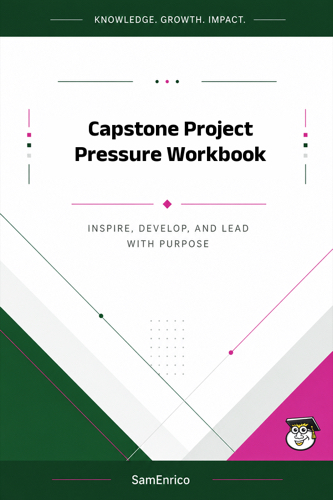
Capstone Project Pressure Workbook eBook
Breaks down final year projects into manageable mi
by Phelps Jacob
Breaks down final year projects into manageable milestones.
Formats
Free sample
Chapter 1: The Valley of Despair--–- You are not broken. You are not lazy. You are not secretly incapable of doing hard things. You are, however, standing at the base of a mountain you have never climbed before, and no one handed you a map.Every capstone project begins the same way: with a flicker of excitement, a surge of ambition, and then—within days or weeks—a slow, creeping nausea that settles into your chest like uninvited houseguests. You picked a topic you cared about.
You told your friends you were finally going to prove yourself. You imagined the feeling of walking across the stage, diploma in hand, the hard part behind you.And then you opened a blank document. And you stared at it. And you closed it.Or worse: you opened seventeen tabs, downloaded forty-three PDFs, highlighted three paragraphs of a methodology guide, and then watched You Tube videos about how to organize a desk. You told yourself you were "researching how to research." Three weeks later, you have a perfectly color-coded folder system and zero words written.If this sounds familiar, this chapter is for you.The Problem That No One Talks About The capstone year is uniquely cruel because it asks you to do something you have never been trained to do: manage an ambiguous, multi-month project with no weekly structure, no hand-holding, and a grade that feels like it determines your entire future.In every previous course, your professor chopped the semester into bite-sized pieces.
Read Chapter 4 by Tuesday. Write a 500-word response by Thursday. Take a quiz by Friday. You didn't have to think about the arc of the semester. You just had to show up and do the next small thing.Now, suddenly, the scaffolding is gone.
You are looking at a single deadline three months away and a blank page that seems to mock you. Your advisor says, "Just keep me updated." Your friends say, "You'll figure it out." And inside your head, a voice whispers: Everyone else knows what they're doing. You are the only one who is lost.That voice is lying.The Valley of Despair: Where Projects Go to Die Psychologists who study how humans adapt to major changes have identified a predictable pattern called the change curve, popularized by Elisabeth Kübler-Ross. When applied to long-term projects, the curve looks like this:Phase 1: Uninformed Optimism. You pick a topic.
You feel excited. You tell yourself this will be the best work you have ever done.Phase 2: Informed Pessimism. You start reading. You realize your topic has been done before. You realize your methodology is harder than you thought.
You realize you have no idea what you are doing. The excitement curdles into dread.Phase 3: The Valley of Despair. This is where most students get stuck. You are far enough in to know how hard the project is, but not far enough to see the finish line. Every task feels impossible.
Every page you write feels wrong. You start to believe you chose the wrong topic, the wrong advisor, the wrong major, the wrong life. You consider quitting.Phase 4: Informed Optimism. You push through the valley. You start to see progress, even if it is ugly.
You realize that finished is better than perfect. The mountain still looms, but you can see the path.Phase 5: Completion and Reflection. You submit. You defend. You realize you were capable all along.Here is the secret that no professor will tell you: Everyone goes through the Valley of Despair.
The students who finish are not smarter or more talented than you. They are simply the ones who recognized the valley for what it was—a normal, predictable, temporary phase—and kept walking anyway.The Two Archetypes of Stuck Students Over a decade of teaching capstone courses, researchers and advisors have noticed two distinct ways students get trapped in the valley. You are likely one of them.Archetype 1: The Over-Planner The Over-Planner believes that the only thing standing between them and a perfect capstone is more information. They think, If I just read one more book chapter, I will feel ready. If I just find five more sources, my argument will click.
If I just organize my notes one more time, the writing will flow.The Over-Planner has:A browser with more than twenty tabs open A hard drive full of PDFs they have not read A beautifully formatted outline with no paragraphs beneath the headings A deep, secret fear that they are using research to avoid writing Zero finished pages after three weeks The Over-Planner's Trap: You have confused feeling prepared with making progress. You will never feel fully prepared. The feeling of readiness is a mirage. It recedes every time you approach it.Archetype 2: The Under-Estimator The Under-Estimator believes that they work best under pressure. They have a history of pulling all-nighters and still getting B+s.
They think, I don't need to start yet. I have plenty of time. When the deadline gets close, the adrenaline will kick in, and I'll knock this out in a week.The Under-Estimator has:A calendar with no capstone tasks scheduled for the next month A vague sense that "something will happen" to make it easier later A pattern of telling their advisor "things are going fine" when they have not started A deep, secret fear that this time, the adrenaline might not come A looming deadline that is much closer than they think The Under-Estimator's Trap: You have fallen for the Planning Fallacy, a cognitive bias identified by Nobel Prize-winning psychologists Daniel Kahneman and Amos Tversky. Humans consistently underestimate how long tasks will take—even when they have done similar tasks before. A project that feels like one week of work is almost always three.
A project that feels like three weeks is almost always six. And a capstone, which you have never done before, will take longer than you think. Always.The Anxiety Map: Seeing Where You Stand Before we go any further, you need to take a snapshot of where you are right now. Not where you want to be. Not where you think you should be.
Where you actually are.Turn to the next page in this workbook. You will find a large grid.On the horizontal axis (X-axis), mark your Progress Made from 0% to 100%. Be honest. If you have written nothing, you are at 0%. If you have a proposal drafted, you might be at 20%.
If you have a full draft, you might be at 70%.On the vertical axis (Y-axis), mark your Anxiety Level from 1 to 10. 1 means "I feel completely calm and in control." 10 means "I feel like I might throw up or drop out."Place a dot where your progress and anxiety intersect.Now, below the grid, write down three specific fears. Not vague ones like "I'm going to fail." Specific ones. The kind that keep you up at 2 a.m.Examples:"My advisor will read my draft and think I don't belong in this program.""I will run out of time and have to submit something embarrassing.""I will discover halfway through that my research question doesn't work, and it will be too late to change."After you write each…
This is the end of the free sample. Get the eBook to keep going. Buy now
About this book
Details
- Author
- Phelps Jacob
- Publisher
- SamEnrico
- Language
- English
- Genre
- Non-Fiction, Self-Help, Capstone Projects
- Released
- 2026-06-09
- Pages (approx.)
- 112
- Available as
- eBook, Audiobook

Read better in the ZLOADR app
Your eBooks on your phone or tablet. Sign in with your SamEnrico account and start reading.
More by Phelps Jacob
 Weekly Project Review RoutinePhelps Jacob$11.99
 The Voice of a NationPhelps Jacob$11.99
 After School Activity Logistics GuidePhelps Jacob$11.99
 Mushroom Nutrition Vegan GuidePhelps Jacob$11.99
 The Manhattan Project: How a Secret War Cabinet Shaped the Atomic AgePhelps Jacob$11.99
 Understanding Neuropathy Sensory Spastic ParaplegiaPhelps Jacob$17.99
 Small Business AI Credit Card ReconciliationPhelps Jacob$12.99
 African Scholarship Follow-Up GuidePhelps Jacob$12.99
 Otter AI Meeting Notes and TranscriptionPhelps Jacob$11.99
 How to Start a Periodical Publishing BusinessPhelps Jacob$11.99
You may also like
 Hong Kong Handover 1997Dunn Johnnie$11.99
 Zumba For Postnatal Recovery CourseNeal Christian$11.99
 Zumba for BeginnersLadner Nikia$11.99
 YouTube Comment Mining GuideHumes Pandora$12.99
 Worry Box MeditationCarlin Rudy$11.99
 Workplace Stress MeditationNguyen Lynn$11.99
 Workplace Stress and Sleep RepairHawley Ivory$11.99
 Workplace Perfectionism CureDelaney Jeffry$11.99
 Workplace Injustice Anger GuideWallen Isabelle$11.99
 Work Addiction and Burnout LinkGreenwood Ester$11.99
 Women in Yoga and WellnessBeattie Galina$11.99
 Women in Stand Up ComedyChun Evangeline$11.99