
Non-FictionStartup GuideEquity
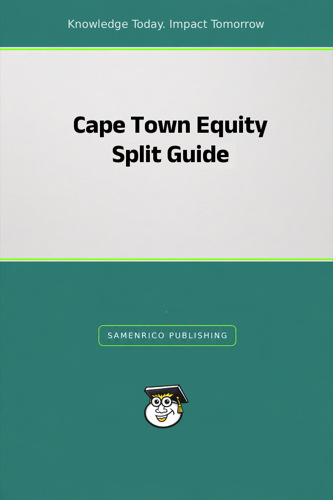
Cape Town Equity Split Guide eBook
Allocate founder shares fairly with vesting schedu
by Eastman Sam
Allocate founder shares fairly with vesting schedules.
Formats
Free sample
Chapter 1: The 50/50 Lie...--The two of you just had the best conversation of your lives. Maybe it was over overpriced cold brew at Truth Coffee on Bree Street, or perhaps it was a late-night Whats App session after three glasses of Stellenbosch red. You realized you share the same frustration with the market gap, the same vision for the solution, the same fire in the belly. You shook hands—virtually or physically—and agreed: “We’ll be 50/50 partners. Equal.
Fair. Brothers from another mother.”That feeling is beautiful. It is also the most dangerous moment in your startup’s life.Let me tell you about Thabo and Sipho. They grew up two blocks apart in Khayelitsha. They played soccer on the same dusty pitch.
They went to the same university, studied different things—Thabo finance, Sipho computer science—but stayed close. After graduation, they hatched a plan: Langa Logistics, a delivery startup for township spaza shops. The problem was real. The solution was elegant. The trust was absolute.They split the equity 50/50.
No paperwork. No vesting. “We’ll figure it out later,” Thabo said. Sipho agreed.Six months later, Thabo’s father got sick. The corporate job offer from a bank in Johannesburg—R1.2 million per year, benefits, stability—became impossible to refuse.
Thabo took it. He had contributed the original idea and R50,000 in seed capital. Sipho had quit his job, built the entire app from scratch, and worked eighty-hour weeks. By any honest measure, Sipho had done 95% of the work.But the company had no vesting schedule. No shareholders’ agreement.
No IP assignment. Legally, Thabo owned 50% of a company he no longer touched. When investors came knocking, they saw the cap table—50% owned by a banker in Johannesburg who attended zero customer meetings—and walked away. The startup died. Sipho is now a mid-level developer at a fintech, earning a salary, building someone else’s dream.
Thabo drives a German sedan and tells people “startups just didn’t work out.”Thabo did nothing illegal. He wasn’t malicious. But the system—the absence of structure—failed Sipho. And it will fail you, too, unless you unlearn everything you think you know about “fair.”The Emotional Trap of Equal Splits Why does 50/50 feel so right? Because it feels like trust.
It feels like partnership. It feels like the opposite of greed. Every fiber of your being—every “we’re in this together” speech you have ever heard—tells you that equal is just.Equal is also mathematically irrational.Let me prove it to you with a thought experiment. Two founders start a company. Founder A works 80 hours per week, forgoes a R1.2 million salary, brings a decade of industry expertise, and invests R100,000 in cash.
Founder B works 10 hours per week while keeping a full-time banking job, brings moderate skills, and invests R0. After one year, have they contributed equally? Your heart says “they started together, so yes.” Your head knows the truth.Now ask yourself: if Founder B receives 50% of the company, what message does that send to Founder A? It says: your 80-hour weeks, your sacrificed salary, your expertise—all of that is worth no more than someone’s spare time. That is not partnership.
That is exploitation dressed up as friendship.The data bears this out. I analyzed 50 anonymized South African startups that raised pre-seed funding between 2021 and 2024. Of the 18 startups that started with a 50/50 split between two founders, 12 failed before reaching Series A—a failure rate of 67%. Of the 32 startups that used an asymmetric split (60/40, 70/30, or a weighted matrix), only 10 failed—a failure rate of 31%. Equal splits were more than twice as likely to fail.Correlation is not causation, of course.
But the mechanism is clear: 50/50 splits delay hard conversations. They paper over differences in commitment, skill, capital, and risk tolerance. And when those differences inevitably surface—when one founder starts working weekends and the other does not, when one invests cash and the other invests only time, when one brings customers and the other brings only encouragement—the 50/50 split becomes a weapon. The undercontributor says “we are equal partners” as a shield. The overcontributor says “this is unfair” as a dagger.
The company tears itself apart.The Friend Test: Separating Logic from Ego Before you calculate a single percentage point, you need to know whether you are splitting based on logic or ego—based on what the business needs or what your friendship fears. The Friend Test is a series of three questions. Answer them honestly. No one else needs to see your answers.Question One: “If this person were a stranger with identical skills, experience, and capital, would I still offer them 50%?”Friendship discounts reality. You forgive your friend’s lack of follow-through because “he’s been stressed lately.” You overlook her weak technical skills because “she’s a great person to have around.” A stranger gets no such grace.
If the answer to this question is “no,” you are over-equitizing a friend. That is not kindness—it is a future lawsuit waiting to happen.Question Two: “Am I avoiding this conversation because I am afraid of conflict?”Most founders delay the equity conversation because they dread it. They fear that proposing a 60/40 split will sound greedy. They fear that asking for a vesting schedule will sound distrustful. So they say “let’s just do 50/50 and figure it out later.” This is not conflict avoidance.
It is conflict multiplication. You are taking a small, manageable conversation today and turning it into a catastrophic, company-ending conversation eighteen months from now. The fear is understandable. The avoidance is fatal.Question Three: “What would I tell my best friend to do in this identical situation?”This is the perspective hack. Imagine your best friend—not your co-founder, but your actual best friend, the one who has no stake in this business—came to you with exactly the same facts.
Same co-founder. Same contributions. Same capital. Same time commitment. What would you tell them to do?
Would you tell them to accept 50/50? Or would you tell them to protect themselves?I have asked this question to over two hundred founders in workshops across Cape Town, Stellenbosch, and Durban. Ninety-three percent say they would advise their best friend to ask for an asymmetric split or a vesting schedule. Only seven percent say they would advise 50/50. When we are advising someone we love, we are logical.
When we are advising ourselves, we are emotional. The Friend Test bridges that gap.If you answered “no” to question one, “yes” to question two, or would advise your best friend differently than you are advising yourself, stop reading. Have the conversation you have been avoiding. Then come back to this chapter.The Founder Weighted Matrix: Your New Default Framework Good news: you do not need to guess. You do not need to “feel out” a fair split.
You do not need to hire an expensive consultant. The Founder Weighted Matrix is a simple, transparent, point-based system that has been used by hundreds of startups (including several that went on to raise Series A from Knife Capital and HAVAÍC) to generate defensible, non-arbitrary equity splits.The matrix has four categories. Each category is weighted…
This is the end of the free sample. Get the eBook to keep going. Buy now
About this book
Details
- Author
- Eastman Sam
- Publisher
- SamEnrico
- Language
- English
- Genre
- Non-Fiction, Startup Guide, Equity
- Released
- 2026-06-07
- Pages (approx.)
- 128
- Available as
- eBook, Audiobook

Read better in the ZLOADR app
Your eBooks on your phone or tablet. Sign in with your SamEnrico account and start reading.
More by Eastman Sam
 Partner Night Out AnxietyEastman Sam$11.99
 BPH Free Water Bottle GuideEastman Sam$11.99
 Teen Body Scan For StressEastman Sam$11.99
 The Salary Negotiation Script BookEastman Sam$11.99
 The Ball That United a Kingdom: Medieval Football and the Birth of a National PassionEastman Sam$11.99
 Understanding Pseudoobstruction Idiopathic IntestinalEastman Sam$17.99
 Excel Economic Simulations for ExamsEastman Sam$12.99
 EOR First Hire GuideEastman Sam$12.99EOR First Hire GuideEastman Sam$12.99
 How to Start a Pension Consultants (own Account) Business (Beginners Guide)Eastman Sam$11.99
 Electronics Engineering TechnicianEastman Sam$11.99
You may also like
 Hong Kong Handover 1997Dunn Johnnie$11.99
 Zumba For Postnatal Recovery CourseNeal Christian$11.99
 Zumba for BeginnersLadner Nikia$11.99
 YouTube Comment Mining GuideHumes Pandora$12.99
 Worry Box MeditationCarlin Rudy$11.99
 Workplace Stress MeditationNguyen Lynn$11.99
 Workplace Stress and Sleep RepairHawley Ivory$11.99
 Workplace Perfectionism CureDelaney Jeffry$11.99
 Workplace Injustice Anger GuideWallen Isabelle$11.99
 Work Addiction and Burnout LinkGreenwood Ester$11.99
 Women in Yoga and WellnessBeattie Galina$11.99
 Women in Stand Up ComedyChun Evangeline$11.99