
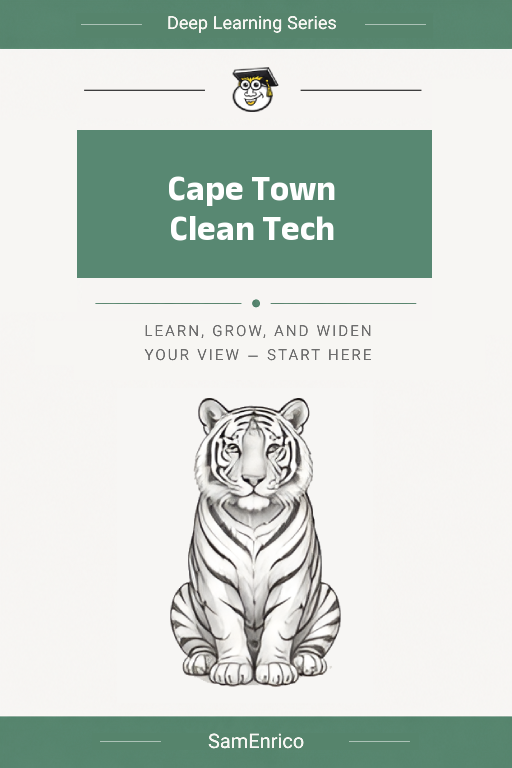
Non-FictionStartup GuideHub Comparison
Cape Town Clean Tech eBook
Launch clean tech startup in Cape Town. Green ener
Launch clean tech startup in Cape Town. Green energy and sustainability ecosystem.
Formats
Free sample
Chapter 1: The Lights Go Out--It was 8:47 PM on a Tuesday in August when Thabo Mbeki’s phone rang for the seventeenth time. Outside his window, the entire southern half of Cape Town had vanished into darkness. Stage 6 load-shedding. Again. The caller was a woman he had never met—a retired schoolteacher in Bishopscourt whose R4.2 million solar installation, completed just three months earlier, had stopped working the moment the grid failed.
“I paid for energy independence,” she said, her voice trembling more from frustration than fear. “Why am I sitting in the dark?”Thabo didn’t have an answer for her that night. He was a former electrical engineer who had been laid off from a failing municipality two years prior. He had started a one-man business installing backup systems for neighbors. By August of that year, he had forty-seven clients, a waiting list of ninety-three, and a problem he couldn’t solve: most of the systems he installed worked perfectly on paper but failed in the real world because nobody had designed them for Cape Town’s specific chaos.
The batteries were Chinese, the inverters were German, and the software was Californian. None of it was built for a grid that died without warning, came back with a surge, and died again two hours later.That night, Thabo made a decision that would turn his side hustle into a seven-figure business. He stopped installing other people’s products. He started building his own.The Geography of Desperation Cape Town is not Berlin. It is not Silicon Valley.
It is not Nairobi. Those cities have problems, certainly, but their problems wear suits and arrive on schedule. Berlin’s energy transition is a policy debate. Silicon Valley’s sustainability conversation happens over $18 cold brew and involves words like “impact” and “roadmap.” Nairobi’s challenges are real, but they are diffuse—a thousand small fires rather than one inferno.Cape Town has a different quality. Here, the failure is concentrated, predictable, and personal.
Every resident knows exactly when the lights will go out because Eskom publishes a schedule. Every business owner can calculate, to the rand, what load-shedding cost them last quarter. Every parent has explained to a child why dinner is being eaten by candlelight.This concentration of pain is the entrepreneur’s greatest asset.When a problem is diffuse—when it hurts everyone a little bit—nobody is desperate enough to pay for a solution. When a problem is acute and personal, customers will pay almost anything to make it stop. Cape Town’s energy crisis is not a tragedy.
It is a paycheck distribution system disguised as a catastrophe. Every time the grid fails, money flows from the desperate to the resourceful. The only question is whether you will be on the receiving end.The Six Lanes to Riches In the sustainable venturing literature, academics like York and Venkataraman have developed frameworks for understanding when and where green businesses succeed. These frameworks are useful but bloodless. Let me translate them into something you can use.I call them The Six Lanes to Riches.
Each one represents a force that is actively pushing money toward clean tech entrepreneurs in Cape Town right now. If you understand these six forces, you can position your startup to catch the flow rather than fight it.Lane One: Cost The price of Eskom electricity has increased by an average of 17.3 percent annually for the past decade. Not total. Per year. In 2025, a typical mid-sized factory in Montague Gardens pays R3.80 per kilowatt-hour for grid power during peak times.
A solar installation can deliver that same kilowatt-hour for R0.95 over its lifetime. The math is not subtle. When the utility becomes the most expensive option on the market, the utility loses.But here is what the solar installers don't tell you: the real cost advantage is not in generation. It is in avoidance. Every kilowatt-hour you do not draw from the grid during a load-shedding event is a kilowatt-hour you effectively generate at zero marginal cost.
This is why battery storage has better unit economics than solar panels alone. Panels only work when the sun shines. Storage works when the grid fails.Lane Two: Capital South Africa has a dysfunctional venture capital market. This is widely known and endlessly lamented. What is less understood is that the dysfunction creates opportunity.
Because traditional VCs are risk-averse and slow, non-dilutive funding sources have proliferated. The Technology Innovation Agency (TIA) disburses hundreds of millions of rands annually in grants that do not require equity. The Allan Gray Orbis Foundation gives young founders R500,000 to test their ideas. The UCT Solution Space runs a fellowship program that provides desk space, mentorship, and R250,000 in seed funding.The global capital is also waking up. The Breakthrough Energy Fellowship, funded by Bill Gates and a coalition of billionaires, has funded multiple Cape Town startups including C STAR, which is turning CO2 into jet fuel.
The University Technology Fund (UTF) exists specifically to spin out research from South African universities.The money is here. It is just wearing different clothes than you expected.Lane Three: Customers Let me be precise about who your customers are not. They are not the 32 percent of South Africans who are unemployed. They are not the township spaza shop owner struggling to keep the lights on. They are not the average Capetonian earning R25,000 per month.Your customers are the top 10 percent of earners plus the commercial and industrial sector.
This is a smaller market than the breathless "Africa rising" narratives suggest, but it is still enormous. The top decile in Cape Town alone represents more than 300,000 individuals with disposable income. Add in the businesses—wineries in Stellenbosch, factories in Killarney Gardens, data centers in Century City, shopping malls in Canal Walk—and you have a market worth tens of billions of rands.These customers have three characteristics that matter. First, they are desperate. A Constantia homeowner with a R30 million property does not care about the price of a solar system.
She cares about not hosting dinner parties in the dark. Second, they are educated. They have done the research. They know what a kilowatt-hour is. They will ask hard questions.
Third, they are skeptical. They have been burned by bad installers, broken promises, and Chinese inverters that arrived with no manual.If you can earn their trust, they will pay you premium prices and defend you to their neighbors.Lane Four: Climate Cape Town has one of the best solar resources on the planet. The average annual solar insolation is 2,200 kilowatt-hours per square meter. For comparison, Berlin gets 1,000. London gets 950.
The sun in Cape Town is not a nice-to-have. It is a superpower.The wind is also exceptional. The Cape Doctor, the fierce southeaster that blows from October to March, has been a nuisance for three centuries. For a wind farm in Atlantis or the Karoo, it is jet fuel. The Western Cape has some of the highest and most consistent wind speeds in the southern hemisphere.Climate is not destiny.
But when combined with the other five lanes, it becomes an accelerant.Lane Five: Consciousness South Africans care about sustainability. This is not the performative…
This is the end of the free sample. Get the eBook to keep going. Buy now
About this book
Details
- Author
- Batson Raymundo
- Publisher
- SamEnrico
- Language
- English
- Genre
- Non-Fiction, Startup Guide, Hub Comparison
- Released
- 2026-05-29
- Pages (approx.)
- 149
- Available as
- eBook, Audiobook

Read better in the ZLOADR app
Your eBooks on your phone or tablet. Sign in with your SamEnrico account and start reading.
More by Batson Raymundo
 Spice Food Generously GuideBatson Raymundo$11.99
 Faith Based Comparison GuideBatson Raymundo$11.99
 Star Gazing Sleep MeditationBatson Raymundo$11.99
 Pessary Fitting GuideBatson Raymundo$11.99
 The Austrian Industrial GuideBatson Raymundo$11.99
 The Crown's Last Dance: When a King Walked AwayBatson Raymundo$11.99
 Drone Operation (Commercial)Batson Raymundo$11.99
 Non Resident LLC Capital Call GuideBatson Raymundo$12.99
 The Breeder's Guide to Cubalaya ChickensBatson Raymundo$11.99
 How to Start a Bed Heads Made of Metal Business (Beginners Guide)Batson Raymundo$11.99
You may also like
 Hong Kong Handover 1997Dunn Johnnie$11.99
 Zumba For Postnatal Recovery CourseNeal Christian$11.99
 Zumba for BeginnersLadner Nikia$11.99
 YouTube Comment Mining GuideHumes Pandora$12.99
 Worry Box MeditationCarlin Rudy$11.99
 Workplace Stress MeditationNguyen Lynn$11.99
 Workplace Stress and Sleep RepairHawley Ivory$11.99
 Workplace Perfectionism CureDelaney Jeffry$11.99
 Workplace Injustice Anger GuideWallen Isabelle$11.99
 Work Addiction and Burnout LinkGreenwood Ester$11.99
 Women in Yoga and WellnessBeattie Galina$11.99
 Women in Stand Up ComedyChun Evangeline$11.99