
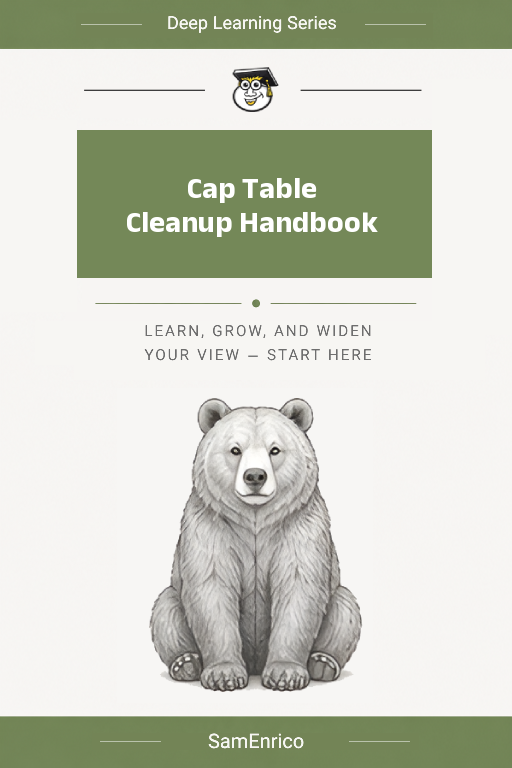
Non-FictionStartup GuideEquity Management
Cap Table Cleanup Handbook Audiobook
Resolve common cap table issues including undocume
Resolve common cap table issues including undocumented convertible notes, missing option grants, and founder equity discrepancies before investor review.
Formats
Free sample
Chapter 1: The $10 Million Napkin--The most expensive document in your startup is not your term sheet, your patent, or your incorporation certificate. It is the napkin, email, or text message where you wrote down a number next to someone’s name and never looked at it again.Priya learned this the hard way.In 2021, Priya co-founded a B2B Saa S company with her college friend Amit. They built the first version of the product in four months, landed three pilot customers, and celebrated with a bottle of cheap champagne. Six months in, Amit decided he wanted to pursue a different idea. He offered to leave amicably.“No hard feelings,” Priya said.
“You’ll keep ten percent.”She never wrote it down. No restricted stock purchase agreement. No vesting schedule. No board consent. Just a sentence, spoken over takeout containers, that she assumed was generous and final.Eighteen months later, Priya had 3millioninannualrecurringrevenue,ateamoftwenty−twopeople,andatermsheetfromatop−tierventurecapitalfirmfor3 million in annual recurring revenue, a team of twenty-two people, and a term sheet from a top-tier venture capital firm for 3millioninannualrecurringrevenue,ateamoftwenty−twopeople,andatermsheetfromatop−tierventurecapitalfirmfor8 million at a $32 million pre-money valuation.
The due diligence lawyer pulled the cap table and asked a simple question: “Who is Amit?”“Oh, he’s my ex-co-founder,” Priya said. “He owns ten percent.”“Where is the restricted stock purchase agreement?”“We didn’t have one.”“Where is the vesting schedule?”“We didn’t have one.”“Where is the repurchase right that allows the company to buy back his shares when he left?”Priya stared at the lawyer. She did not have an answer.Amit was now living in Thailand, running a different startup, and had not touched Priya’s code in two years. But legally, he owned ten percent of a company that was about to be valued at 32million.The VCdemandedthat Priyabuyback Amit’ssharesbeforeclosing.Amitheardaboutthetermsheetandaskedfor32 million. The VC demanded that Priya buy back Amit’s shares before closing.
Amit heard about the term sheet and asked for 32million.The VCdemandedthat Priyabuyback Amit’ssharesbeforeclosing.Amitheardaboutthetermsheetandaskedfor800,000 cash to walk away.Priya did not have $800,000.The VC walked. The next investor offered a 20millionpre−moneyvaluation—fortypercentlower.Priyatookit.Herownstakedroppedfromsixtypercenttothirty−sixpercent.Amitreceived20 million pre-money valuation—forty percent lower. Priya took it. Her own stake dropped from sixty percent to thirty-six percent. Amit received 20millionpre−moneyvaluation—fortypercentlower.Priyatookit.Herownstakedroppedfromsixtypercenttothirty−sixpercent.Amitreceived200,000 to sign a release.One verbal promise.
$10 million in lost value. A CEO who will never make that mistake again.This chapter is about making sure you…
This is the end of the free sample. Get the Audiobook to keep going. Buy now
About this book
Details
- Author
- Jolley Leonel
- Publisher
- SamEnrico
- Language
- English
- Genre
- Non-Fiction, Startup Guide, Equity Management
- Released
- 2026-05-30
- Pages (approx.)
- 140
- Available as
- eBook, Audiobook

Listen in the VoxFlicks app
Audiobooks and audio dramas wherever you go. Sign in with your SamEnrico account and press play.
More by Jolley Leonel
 The Trigger Hotspot MapJolley Leonel$11.99
 Menopause Metal Taste GuideJolley Leonel$11.99
 Creative Leadership Team GuideJolley Leonel$11.99
 The Workaholic's Decluttering GuideJolley Leonel$11.99
 SAS Falklands War MissionJolley Leonel$11.99
 Whispers in the Empty Quarter: The Djinn of the SandsJolley Leonel$11.99
 The Spice Road Chronicles: Dutch Explorers and the Secrets of the Ancient WorldJolley Leonel$11.99
 Cell Phone ForensicsJolley Leonel$11.99
 Understanding Functioning Pancreatic Endocrine TumorJolley Leonel$17.99
 How to Start a Printer and Monitor Connectors Business (Beginners Guide)Jolley Leonel$11.99
 Teaching English via WeChatJolley Leonel$12.99
You may also like
 Hong Kong Handover 1997Dunn Johnnie$11.99
 Zumba For Postnatal Recovery CourseNeal Christian$11.99
 Zumba for BeginnersLadner Nikia$11.99
 YouTube Comment Mining GuideHumes Pandora$12.99
 Worry Box MeditationCarlin Rudy$11.99
 Workplace Stress MeditationNguyen Lynn$11.99
 Workplace Stress and Sleep RepairHawley Ivory$11.99
 Workplace Perfectionism CureDelaney Jeffry$11.99
 Workplace Injustice Anger GuideWallen Isabelle$11.99
 Work Addiction and Burnout LinkGreenwood Ester$11.99
 Women in Yoga and WellnessBeattie Galina$11.99
 Women in Stand Up ComedyChun Evangeline$11.99