
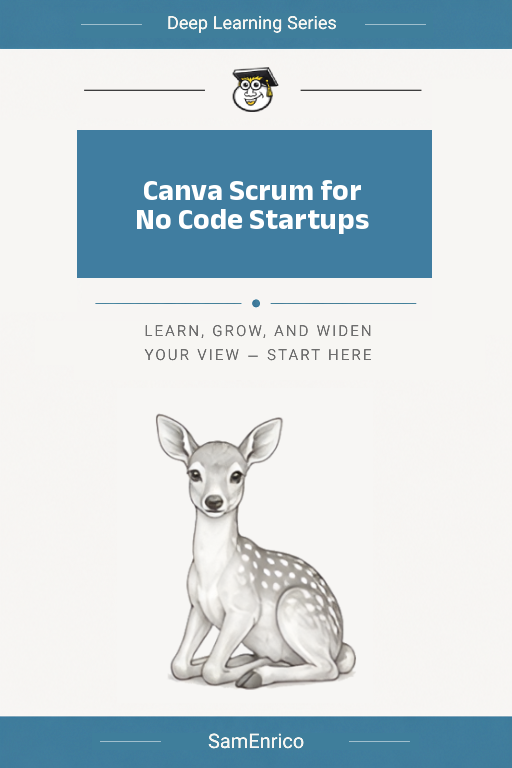
Canva Scrum for No Code Startups eBook
Build visual design tools using Canva's no-code sc
Build visual design tools using Canva's no-code scrum approach, treating template libraries and asset management as product backlog items for startup growth.
Formats
Free sample
Chapter 1: The 12-Hour Black Hole--–- You have spent three hours making a single flyer. You have changed the font seven times. You have watched a You Tube tutorial about kerning. You have reopened the same Canva tab fourteen times. You still hate the result.
And tomorrow morning, you need to do it all over again for a different platform with different dimensions, different copy, and a different vibe. This is not a design problem. This is a process problem. And it is quietly killing your startup.The Confession Every Founder Makes Let me tell you something that no founder admits in public. I have interviewed over two hundred no-code startup founders in the past three years.
I have sat across from solopreneurs who built six-figure businesses, side hustlers who quit their jobs, and marketing teams of one who somehow keep the lights on. Every single one of them, without exception, has confessed the same secret shame.They spend more time in Canva than they spend on strategy.Not because they love design. Not because they are perfectionists. But because they have no system. They open Canva with a vague goal—"I need social media content for this week"—and then they wander through templates, colors, fonts, and stock photos like a tourist lost in a foreign city without a map.
They make decisions based on what looks nice in the moment, not what serves a business objective. They resize the same graphic six times for six platforms because they do not know how to automate it. They keep forty-seven versions of their logo in their assets folder because no one ever told them to delete anything.The average solo founder spends twelve hours per week on Canva. Twelve hours. That is one and a half full working days.
Over a year, that is seventy-eight full days. Over three years, that is more than half a year of your life spent dragging text boxes and changing font sizes.And for what? For inconsistent, forgettable, low-converting visuals that look like they were made by someone who just downloaded the app.This chapter is an intervention. By the time you finish reading it, you will understand exactly how much time you are losing, why your current approach is failing, and what a better way looks like. You will complete a fifteen-minute audit of your design chaos.
And you will make a commitment to stop treating Canva like a toy and start treating it like the engine of your growth.The Paradox That Traps Smart Founders Here is the paradox that no one talks about. No-code tools were supposed to make entrepreneurship easier. Canva, in particular, was supposed to democratize design. Anyone could make a pretty flyer. Anyone could post on Instagram.
Anyone could look professional without hiring a designer.And that promise is true. Canva is an extraordinary tool. It has over one hundred and seventy million monthly active users. Ninety-five percent of the Fortune 500 use it. It has saved businesses billions of dollars in design costs.But here is the dark side of that democratization.
Because Canva makes design easy, founders do design work constantly. They do it randomly. They do it without strategy. They do it at two in the morning when they should be sleeping, making micro-adjustments to a headline that no one will read because they have no framework for what actually works.I call this the No-Code Paradox. The easier the tool, the more likely you are to use it poorly.
The lower the barrier to entry, the less likely you are to build a system. You do not need discipline to open Canva. You need discipline to close it.Think about how you treat other business functions. You would never run a sales process without a CRM. You would never run a product launch without a roadmap.
You would never run customer support without a ticketing system. But when it comes to visual marketing—the thing that customers see before they read a single word of your copy, the thing that determines whether they scroll past or stop and engage—you fly blind.You open Canva. You pick a template that looks okay. You change the words. You export it.
You post it. You move on.That is not a strategy. That is a slot machine. And slot machines are designed to make you lose slowly over time.The Design Debt Spiral There is a concept in software engineering called technical debt. It is the cost of taking shortcuts in code.
You write something that works today but is messy and unmaintainable. Tomorrow, when you need to change it, it takes three times as long because you have to untangle the mess. Over time, the debt compounds. Eventually, the codebase is so brittle that every change breaks something else, and progress slows to a crawl.Design debt is the same thing, but for visuals. Every time you make a flyer without using your brand kit, you create debt.
Every time you use a different font because you forgot what your brand font is called, you create debt. Every time you resize an image manually instead of setting up a template, you create debt. Every time you export a PDF with misaligned elements because you were in a hurry, you create debt.That debt does not disappear. It sits in your asset library like a time bomb. Six months from now, you will open that flyer to update the date, and you will spend twenty minutes fixing the formatting before you can even change the text.Here is what design debt looks like in practice.
I worked with a Saa S startup that had been operating for eighteen months. They had three founders, no designers, and a Canva account with over two thousand designs. Two thousand. They were proud of this number. They thought it represented productivity.Then we audited their library.One hundred and forty-seven versions of their logo.
Forty-two different font pairings across their social media graphics. Sixty-three color hex codes that were "close enough" to their brand colors but not exactly right. Over eight hundred designs that had never been published. Three hundred designs that had been published once and then forgotten. And exactly zero templates that could be reused without manual adjustment.Their Time-to-Template—the minutes from opening Canva to having a finished design—was averaging ninety-two minutes.
Ninety-two minutes for a single Instagram graphic. Because every time they started, they were starting from scratch. They were rebuilding the wheel for every post, every email header, every sales deck page.That is design debt. And it was costing them forty hours per week across three people. Two thousand hours per year.
At a conservative valuation of their time, that was over one hundred thousand dollars of lost productivity.Your library probably looks the same. Not because you are lazy. Because no one ever gave you a system.The Teenager with a Birthday Invitation Let me share another observation that might sting a little. When most startups use Canva, they use it like a teenager making a birthday invitation. They pick a template that looks fun.
They change the name. They add some clip art. They export it. They send it to their friends.That is fine…
This is the end of the free sample. Get the eBook to keep going. Buy now
About this book
Details
- Author
- Mccracken Lovie
- Publisher
- SamEnrico
- Language
- English
- Genre
- Non-Fiction, Startup Guide
- Released
- 2026-06-01
- Pages (approx.)
- 144
- Available as
- eBook, Audiobook

Read better in the ZLOADR app
Your eBooks on your phone or tablet. Sign in with your SamEnrico account and start reading.
More by Mccracken Lovie
 The Pediatric AED GuideMccracken Lovie$11.99
 The Autoimmune Micronutrient GuideMccracken Lovie$11.99
 Molar Pregnancy Emotional RecoveryMccracken Lovie$11.99
 Glass Fragment DatingMccracken Lovie$11.99
 Comparison Culture At WorkMccracken Lovie$11.99
 Sudden Child Death ShockMccracken Lovie$11.99
 Dakar African Independence HubMccracken Lovie$11.99
 The Alchemist Who Unlocked the Cosmos: Robert Boyle and the Birth of Modern ChemistryMccracken Lovie$11.99
 The Poisoning Priestess: Belle Gunness and the Butcher of LaPorteMccracken Lovie$11.99
 How to Produce Scanner Circuit BoardsMccracken Lovie$11.99
 Irish Setter: Enthusiastic & ScatteredMccracken Lovie$11.99
 A Collector's Handbook to the Austin A55-Mccracken Lovie$11.99
You may also like
 MongoDB Kanban for Database StartupsZamora Loyd$12.99
 Zoom Kanban for Video StartupsBlair Ida$12.99
 Venture Debt Vs Equity RecapHermann Alba$12.99
 Venture Debt Revenue Based GuideCalloway Sidney$12.99
 Venture Debt Lien Types ExplainedSherrill Marci$12.99
 Venture Debt Interest Rate HedgingRockwell Sherly$12.99
 Venture Debt Intercreditor GuidePomeroy Bernarda$12.99
 Venture Debt for Women FoundersChilders Soon$12.99
 Venture Debt for Hardware StartupsGarris Deonna$12.99
 Venture Debt For Hardware GuideWithers Damian$12.99
 Venture Debt for Climate TechElston Ahmed$12.99
 Venture Debt for Clean TechKearns Candance$12.99