
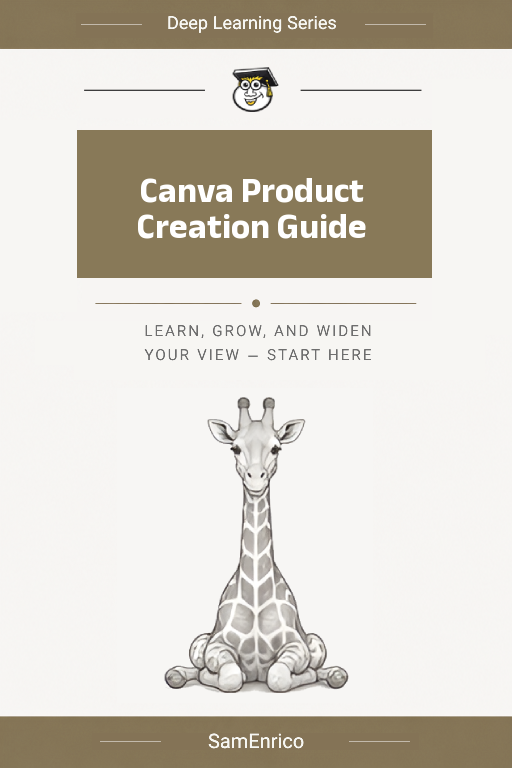
Non-FictionFirst 30 DaysDesign Tools
Canva Product Creation Guide eBook
Design professional ebooks, workbooks, and planner
Design professional ebooks, workbooks, and planners using Canva templates in under 3 days.
Formats
Free sample
Chapter 1: The 3-Day Gamble...--Let me ask you a question that most Canva tutorials are too afraid to touch.Why do ninety percent of people who open Canva for the first time never create a single product that makes money?Not because they lack talent. Not because they cannot learn the software. And certainly not because digital products are a saturated market. The real reason is painfully simple: they treat Canva like a toy instead of a production line. They open a blank canvas, scroll through thousands of templates, change a few colors, export a PDF, list it on Etsy for five dollars, and then wonder why nobody buys it.That approach is a gamble.
And you are about to learn why the three-day system turns that gamble into a guarantee.This chapter is not a pep talk. It is a complete reorientation of how you think about design, speed, and value. By the time you finish these pages, you will understand exactly why some sellers launch a single workbook that earns ten thousand dollars in a month while others struggle to sell ten copies of a planner they spent three weeks perfecting. The difference is not luck. The difference is the system you are about to learn.The Great Misconception: Why Most Canva Users Fail Walk into any online business group.
Search for “Canva” on Twitter or You Tube. What do you see? Endless tutorials about drop shadows, gradient backgrounds, and the perfect font pairing for a wedding invitation. All of that is fine if you are designing for fun. But if you are reading this book, you are not here for fun.
You are here to create products that people pay for.The first major misconception is that good design equals high sales. That is a lie that graphic designers have sold to the world for decades. The truth is that functional, clean, and readable design will outsell artistic, complex, and “beautiful” design every single time in the digital product space. Why? Because buyers are not purchasing your design skills.
They are purchasing a result. A meal planner that helps someone save three hours a week is valuable regardless of whether the fonts are perfectly kerned. A budget workbook that helps someone pay off debt is valuable even if the cover is simple.The second misconception is that you need to be an expert in Canva before you can sell. This is equally false. Some of the highest-grossing digital product sellers on Etsy and Amazon KDP cannot tell you the difference between RGB and CMYK without looking it up.
They do not need to know. They use templates, systems, and the methods you will learn in this book.The third misconception is the most dangerous: that you should design first and think about selling later. This backwards approach is responsible for thousands of abandoned projects. You will never design your way into a profitable product. You must reverse engineer from what is already selling.The Market Evidence: What Is Actually Working Right Now Let us look at the numbers.
In the last twelve months, search volume for “printable planner” on Etsy has grown by over forty percent. The term “workbook template” has exploded on creative marketplaces. And on Amazon KDP, the category of “low-content books” remains one of the fastest-growing segments for independent publishers.But here is what most guides will not tell you. The products that dominate these searches are not wildly innovative. They are not artistic masterpieces.
They are simple, functional, and built on templates that have been proven to convert. The best-selling workbooks on Etsy right now follow a predictable pattern: a clean cover, a table of contents that promises specific results, ten to twenty interior pages with fillable fields, and a call to action at the end. That is it.Consider the “2026 Organizer” phenomenon. Every year, around September, a flood of dated planners hits the market. The ones that rise to the top are rarely the most beautiful.
They are the ones that launched first, priced correctly, and offered a mix of dated and undated pages. The sellers who win are not artists. They are systems thinkers who understand that speed to market is often more valuable than perfection.The same is true for workbooks in niches like budgeting, meal prep, fitness, and mental health. The top sellers are almost always built from a small set of proven page layouts: goal-setting worksheets, habit trackers, weekly review pages, and reflection prompts. These layouts are not secret.
They are widely available. The winning differentiator is not the layout itself but the speed with which you can assemble them into a cohesive product.The 3-Day System: Why Three Days and Not Three Weeks You might be thinking: “Three days sounds rushed. Will the quality suffer?” That is a fair question, and the answer might surprise you.Quality does not suffer when you work with a system. Quality suffers when you work without clarity, change your mind repeatedly, and get lost in endless revisions. The three-day system forces you to make decisions quickly and move forward.
It prevents the perfectionism that kills ninety percent of digital product projects before they launch.Here is the breakdown of how the hours actually allocate, based on tracking dozens of successful product launches:Day One: Research, Setup, and Content Generation (4 to 6 hours)This day is not about design at all. It is about making sure you are building something that someone actually wants to buy. You will choose a niche, analyze top competitors, gather templates and assets, configure your Canva workspace, and use artificial intelligence to generate the written content that will fill your product. By the end of day one, you will have a complete blueprint and all the words you need.Day Two: Design and Assembly (8 to 10 hours)This is the longest day, and it is where most of the actual Canva work happens. You will create or customize your master template, apply branding, design your core page layouts, and then use duplication methods to scale from ten pages to fifty or more.
You will also set up clickable tables of contents and ensure your technical specifications are correct for your chosen platform. By the end of day two, you will have a finished, export-ready file.Day Three: Mockups, Listings, and Launch (3 to 5 hours)The final day is about presentation and distribution. You will create product mockups that make your design look expensive, write a product listing that converts browsers into buyers, and upload your file to your chosen marketplace. You will also set up a lead magnet to capture email addresses and plan your initial marketing steps.The total time investment is between fifteen and twenty-one hours spread across three days. That is less than a typical workweek.
And it is entirely possible even if you have a full-time job, children, or other commitments.The Real Cost of Perfectionism Let me tell you about Sarah. Not her real name, but her story is real. Sarah spent six weeks designing a beautifully illustrated gratitude journal. She learned Canva from scratch. She bought premium elements.
She agonized over every corner radius and shadow effect. When she finally launched, her journal was stunning. It also sold…
This is the end of the free sample. Get the eBook to keep going. Buy now
About this book
Details
- Author
- Woods Alfredo
- Publisher
- SamEnrico
- Language
- English
- Genre
- Non-Fiction, First 30 Days, Design Tools
- Released
- 2026-06-01
- Pages (approx.)
- 135
- Available as
- eBook, Audiobook

Read better in the ZLOADR app
Your eBooks on your phone or tablet. Sign in with your SamEnrico account and start reading.
More by Woods Alfredo
 Remote Team Interruption StandardsWoods Alfredo$11.99
 Peptide Stimulators of HGHWoods Alfredo$11.99
 Accountability Partner SystemWoods Alfredo$11.99
 Self Recording Anxiety FixWoods Alfredo$11.99
 Grief and Nature After Child LossWoods Alfredo$11.99
 Gig Platform Burnout PreventionWoods Alfredo$11.99
 French Escape Line CometWoods Alfredo$11.99
 Burnout And Overwork CultureWoods Alfredo$11.99
 The Silk and Steel of Tokyo: Hanako's Rise in Japan's Forbidden BalletWoods Alfredo$11.99
 Kali's Midnight Dance: The Dark Goddess and the Demon KingWoods Alfredo$11.99
 How to Produce Media Viewing SoftwareWoods Alfredo$11.99
 How to Start a Hobby in Baseball - softball - and roundersWoods Alfredo$11.99
You may also like
 Hong Kong Handover 1997Dunn Johnnie$11.99
 Zumba For Postnatal Recovery CourseNeal Christian$11.99
 Zumba for BeginnersLadner Nikia$11.99
 YouTube Comment Mining GuideHumes Pandora$12.99
 Worry Box MeditationCarlin Rudy$11.99
 Workplace Stress MeditationNguyen Lynn$11.99
 Workplace Stress and Sleep RepairHawley Ivory$11.99
 Workplace Perfectionism CureDelaney Jeffry$11.99
 Workplace Injustice Anger GuideWallen Isabelle$11.99
 Work Addiction and Burnout LinkGreenwood Ester$11.99
 Women in Yoga and WellnessBeattie Galina$11.99
 Women in Stand Up ComedyChun Evangeline$11.99