
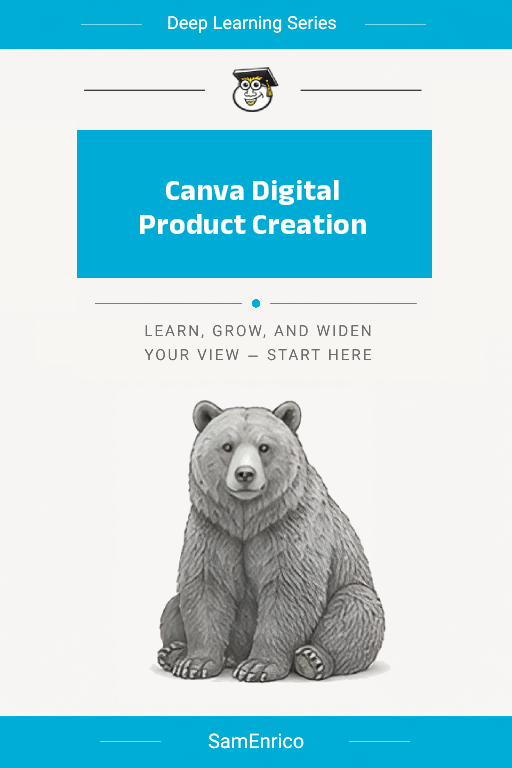
Non-FictionFirst 30 DaysDIY Design
Canva Digital Product Creation eBook
Design professional ebooks, worksheets, and templa
Design professional ebooks, worksheets, and templates using Canva without hiring a designer.
Formats
Free sample
Chapter 1: The Ugly First Draft--The first digital product I ever sold looked like it had been designed by a raccoon on caffeine.The colors clashed. The fonts were mismatched. There was a stock photo of a smiling woman holding a tablet that had absolutely nothing to do with the content. The margins were inconsistent from page to page. And somehow, despite all of this—or perhaps because of it—that ugly, amateurish little PDF made me $347 in its first seventy-two hours on sale.I tell you this not to brag, but to shatter a myth that stops more people from starting than anything else: the myth that you need to be a designer to sell digital products.You don't.What you need is a system.
A repeatable, teachable, slightly-ugly-but-it-works system that prioritizes solving problems over winning beauty contests. That is what this book delivers. And that is what this first chapter exists to drill into your brain before we touch a single Canva template.Welcome to the "Create Don't Hire" methodology.The $5,000 Question Let me ask you something honest.Have you ever stared at a blank Canva page, clicked through four hundred templates, and then closed your browser because nothing felt "right"?Have you ever looked at a designer's portfolio on Instagram—the perfect mockups, the elegant typography, the soft pastel color palettes—and thought, "I could never do that"?Have you ever paid someone $500 for a simple ebook cover because you were too afraid to try it yourself?If you answered yes to any of those, you are exactly where you need to be.The gap between "ugly homemade document" and "professional designer work" feels enormous. And for most people, that gap becomes a permanent stopping point. They tell themselves they'll learn design "someday." They bookmark tutorials they never watch.
They convince themselves that selling digital products is for people with art degrees or十年的 experience in Adobe Illustrator.Here is the truth that the designer-industrial complex does not want you to know: most successful digital products are not beautiful. They are useful.A $27 budget planner does not sell because the fonts are perfectly kerned. It sells because someone is drowning in credit card debt and needs a system to track their spending.A $15 meal planning template does not sell because the watercolor vegetables are hand-illustrated. It sells because a tired parent is exhausted from answering "What's for dinner?" every single night.A $47 social media content calendar does not sell because the color palette is on-trend. It sells because a small business owner is overwhelmed and just wants someone to tell them what to post on Tuesday.The professional designer you are afraid you cannot compete with?
They are solving an aesthetic problem. You are solving an emotional problem. Those are not the same thing. And the market pays much more reliably for emotional solutions than aesthetic ones.This is the "Create Don't Hire" mindset in action. You are not trying to become a designer.
You are trying to become a problem-solver who uses Canva as their tool. The difference is everything.The Digital Product Gold Rush (And Why You Are Not Too Late)Let me address the fear that is probably sitting in the back of your mind right now: "Isn't the market already saturated?"I hear this constantly. Every time a new online business model emerges, the chorus of "you're too late" follows close behind. It happened with blogging in 2008. It happened with Etsy in 2012.
It happened with print-on-demand in 2016. And it is happening right now with digital products.Here is what the data actually shows.According to recent marketplace reports, the global digital products market exceeded $10 billion in annual revenue. But here is the number that matters more: less than 3 percent of Etsy sellers offer digital downloads. The vast majority of sellers are still shipping physical goods—custom t-shirts, handmade jewelry, wooden signs.The digital product category is not saturated. It is under-served.And within that category, specific niches are even more under-served.
At the time I am writing this, searching Etsy for "ADHD planner" returns fewer than 2,000 results. "Keto meal prep worksheet" returns fewer than 500. "Small business tax tracker" returns fewer than 300.These are not saturated markets. These are empty shelves waiting for you to fill them.The gold rush is real. But it is not a gold rush of designers competing on beauty.
It is a gold rush of problem-solvers competing on usefulness. And that is a competition you can win with the systems in this book, regardless of your current design skills.The Trinity: Your Three-Part System Before we go any further, I want to introduce you to the framework that will power every chapter of this book. I call it The Trinity, and it is the simplest way to understand your job as a digital product creator.Canva is your hands. It handles the visual execution. Every layout, every color choice, every font pairing—Canva makes these things possible without years of training.
You do not need to know how to use the pen tool in Illustrator. You do not need to understand bezier curves. You need to know how to drag, drop, and duplicate. That is it.Chat GPT is your brain. It handles the content generation.
Every word of filler text, every journal prompt, every affirmation, every product description—AI can write the first draft faster than you can type a single sentence. Your job is not to write from scratch. Your job is to edit, refine, and add your unique voice.You are the heart. This is the most important part of The Trinity, and the one that cannot be automated. You decide what problems to solve.
You choose which niches to enter. You add the personal stories, the specific examples, the authentic voice that turns a generic template into something someone trusts. The strategy and curation are yours alone.Hands. Brain. Heart.Canva.
Chat GPT. You.This framework will reappear throughout the book. In Chapter 6, when we dive deep into AI prompts, you will see the brain at work. In Chapter 11, when we talk about selling, you will see the heart positioning the products. In Chapter 12, when we scale, you will see all three parts working together.For now, just hold this in your mind: you are not a designer.
You are the director of a three-part system.Success Metrics: Pretty vs. Profitable Here is a sentence that might upset some people: "Pretty" does not appear on any income statement.I am not saying design does not matter. Of course it matters. A product that is genuinely difficult to read or navigate will not sell well, and if it does sell, it will generate refund requests and bad reviews.But there is a massive difference between "functional and clear" and "museum-quality beautiful." And most new creators get stuck trying to jump from zero to museum-quality. They spend six hours adjusting the opacity of a single shape while ignoring the fact that they have not validated whether anyone actually wants their product.This book is going to rewire your success metrics.
From this moment forward, you will evaluate your products using three questions, in this exact order:First: Does this solve a…
This is the end of the free sample. Get the eBook to keep going. Buy now
About this book
Details
- Author
- Callahan Carli
- Publisher
- SamEnrico
- Language
- English
- Genre
- Non-Fiction, First 30 Days, DIY Design
- Released
- 2026-05-30
- Pages (approx.)
- 145
- Available as
- eBook, Audiobook

Read better in the ZLOADR app
Your eBooks on your phone or tablet. Sign in with your SamEnrico account and start reading.
More by Callahan Carli
 Group Creative Rhythm And Pace GuideCallahan Carli$11.99
 Tom Watson Duel Life StoryCallahan Carli$11.99
 Burnout Self Compassion GuideCallahan Carli$11.99
 The Webinar Lead FunnelCallahan Carli$11.99
 Feeling Overburdened Anger LinkCallahan Carli$11.99
 The Unseen Revolution: How a Teenage Hacker Changed the WorldCallahan Carli$11.99
 The Obsidian Codex: Unlocking the Secrets of the Voynich ManuscriptCallahan Carli$11.99
 How to Start a Hobby in Pole dancingCallahan Carli$11.99
 Caraway Seeds HarvestingCallahan Carli$11.99
 Payload CMS Alternative GuideCallahan Carli$12.99
 Understanding Chronic Erosive GastritisCallahan Carli$17.99
You may also like
 Hong Kong Handover 1997Dunn Johnnie$11.99
 Zumba For Postnatal Recovery CourseNeal Christian$11.99
 Zumba for BeginnersLadner Nikia$11.99
 YouTube Comment Mining GuideHumes Pandora$12.99
 Worry Box MeditationCarlin Rudy$11.99
 Workplace Stress MeditationNguyen Lynn$11.99
 Workplace Stress and Sleep RepairHawley Ivory$11.99
 Workplace Perfectionism CureDelaney Jeffry$11.99
 Workplace Injustice Anger GuideWallen Isabelle$11.99
 Work Addiction and Burnout LinkGreenwood Ester$11.99
 Women in Yoga and WellnessBeattie Galina$11.99
 Women in Stand Up ComedyChun Evangeline$11.99