

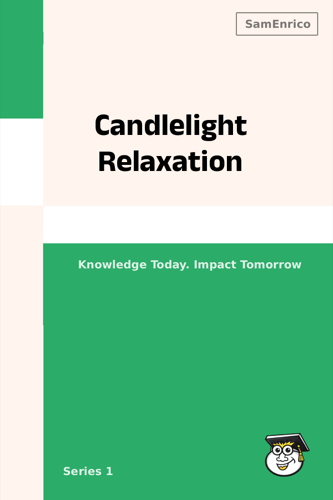
Candlelight Relaxation eBook
Focus on a single candle flame to quiet mental cha
by Vaught Ayana
Focus on a single candle flame to quiet mental chatter and enter deep calm.
Formats
Free sample
Chapter 1: The Candle That Changed Everything...--It was 2:47 AM, and I was staring at the ceiling for the fourth night in a row.Not because I wasn't tired. I was exhausted – the kind of bone-deep fatigue that makes your eyelids heavy and your limbs ache. But every time I closed my eyes, my brain interpreted it as a starting pistol for the mental Olympics.Did I send that email wrong? What did my boss mean by "let's circle back"? Remember that embarrassing thing you said in 2017?
Let's replay it in 4K. Also, your taxes. Also, your mother's disappointed tone last Tuesday. Also, what's the meaning of your existence?The voice in my head – let's call it what it is: the chatterbox – had a full schedule. It didn't care that I had a 7 AM meeting.
It didn't care that I'd tried meditation apps, breathing exercises, melatonin, white noise, blackout curtains, and even counting sheep (which, by the way, never worked – sheep just made me think about farming, which made me think about sustainability, which made me think about climate change, which made me think about death).I was an overthinker. And if you're reading this, chances are you are too.That night, something different happened. I'd lit a candle on my nightstand – a cheap vanilla-scented one from a drugstore, nothing special. I'd bought it because the packaging said "relaxing" and I was desperate. I didn't even light it with intention.
I just wanted the warm glow so I wouldn't trip over my shoes in the dark.But as I lay there, unable to sleep, my eyes drifted to the flame.And something shifted.I wasn't trying to meditate. I wasn't trying to "be present" or "observe my thoughts without judgment" or any of the other things my meditation app kept telling me to do. I was just... watching. The flame flickered.
It danced. It leaned left when the ceiling fan turned, then straightened up like it was catching its balance.For the first time in hours, my mind went quiet.Not completely silent, but quieter. The chatterbox was still there, but it had lowered its voice to a mumble. And in that small space of quiet, I felt something I hadn't felt in years: relief.That was the night I discovered what this entire book is about. Not meditation.
Not mindfulness, at least not in the way those words are usually used. Something simpler. Something older. Something that uses the most ancient tool in human history – fire – to do what modern techniques often fail to accomplish: shut down the voice in your head.This chapter will explain why a single candle flame works better than almost anything else for overthinkers. We'll explore the neuroscience of mental chatter, the evolutionary hardwiring that makes fire a natural calm-inducer, and why you've probably failed at meditation for reasons that are not your fault.
By the end of this chapter, you'll have a new understanding of your own mind – and you'll have experienced your first 60 seconds of candlelight relaxation.The Problem: Your Brain Won't Shut Up (And It's Not a Character Flaw)Let's start with a radical reframe: your racing mind is not a sign of weakness. It's not a moral failing. It's not evidence that you're "too anxious" or "broken" or "need to get your act together."Your racing mind is a sign that your brain is doing exactly what it evolved to do.Here's what's actually happening inside your skull. Neuroscientists have identified a network of brain regions called the Default Mode Network, or DMN. Think of the DMN as your brain's idle setting – what it does when you're not focused on a specific task.
When you're washing dishes, waiting in line, or lying in bed at 2 AM, your DMN lights up like a Christmas tree.And what does the DMN do? It rehearses the past. It simulates the future. It runs through social scenarios. It generates self-referential thoughts – thoughts about you, your relationships, your status, your mistakes, your fears.
In other words, it produces mental chatter.The DMN is not a bug. It's a feature. Your ancestors survived because their DMN helped them remember which berries made them sick, anticipate where predators might hide, and plan for the coming winter. A quiet DMN was a dead ancestor.But here's the problem: modern life is a DMN supercharger. You're not running from sabertooth tigers; you're running from email threads.
You're not planning for winter; you're planning for a performance review. The threats are social and abstract, but your brain treats them with the same urgency as physical danger. And because there's no resolution – you can't fight an email or run from a quarterly report – your DMN stays activated. It loops. It repeats.
It escalates.Research from institutions like Harvard and Stanford has shown that the average person spends 47% of waking hours in DMN-driven mind-wandering. For overthinkers, that number can climb to 70-80%. And here's the cruel irony: the more you try to force your mind to be quiet, the louder the DMN gets. It's like trying to calm a panicked crowd by yelling "EVERYONE BE CALM."This is why traditional meditation often fails for overthinkers. And I want to say this clearly, because it might be the most important sentence in this book:If you've tried meditation and felt frustrated, anxious, or like a failure – it is not your fault.
You were using a tool designed for a different kind of mind.Why Traditional Meditation Failed You (And Why That's Okay)Let me tell you a story about a friend of mine. Let's call her Sarah.Sarah is a successful attorney. She's brilliant, driven, and she thinks about everything from six different angles before breakfast. Her mind is her greatest asset – and her greatest torment. She came to me after her third failed attempt at a mindfulness app."I just can't do it," she said.
"They tell me to focus on my breath. So I focus on my breath. And then I think about breathing, and whether I'm doing it right, and whether my chest is rising too much, and oh my God now I'm thinking about my lungs, and wait – is that a normal breath or am I hyperventilating? And then I realize I've been 'breathing wrong' for ten minutes and I want to throw my phone across the room."I've heard this story hundreds of times. It's not Sarah's fault.
It's not your fault. It's the nature of the technique.Here's why: internal awareness amplifies internal chatter.When you focus on your breath, your body sensations, or your thoughts themselves, you are turning your attention inward. And what lives in that inward space? Your DMN. You're essentially poking the bear with a stick and wondering why it growls.Breath awareness works beautifully for people who already have quiet minds.
It can deepen an existing calm. But for someone whose DMN is already in overdrive, turning inward is like opening the door to a party you were trying to escape.Body scans (where you systematically pay attention to each part of your body) can be even worse. For the overthinker, a body scan becomes an invitation to monitor, judge, and worry. My left…
This is the end of the free sample. Get the eBook to keep going. Buy now
About this book
Details
- Author
- Vaught Ayana
- Publisher
- SamEnrico
- Language
- English
- Genre
- Non-Fiction, Self-Help, Trataka
- Released
- 2026-06-08
- Pages (approx.)
- 131
- Available as
- eBook, Audiobook

Read better in the ZLOADR app
Your eBooks on your phone or tablet. Sign in with your SamEnrico account and start reading.
More by Vaught Ayana
 Termination Clause AI CategorizationVaught Ayana$11.99
 Line Cook Burnout PreventionVaught Ayana$11.99
 Self Harm Urge ManagementVaught Ayana$11.99
 The Breath Cessation ExperienceVaught Ayana$11.99
 Egyptian Food GuideVaught Ayana$11.99
 Underwater Noise PollutionVaught Ayana$11.99
 Domestic Chains BrokenVaught Ayana$11.99
 Affirmations For Midlife CrisisVaught Ayana$11.99
 The Last Stand of the Bletchley Breakthrough: Alan Turing's Unfinished Code WarVaught Ayana$11.99
 The Battle of Moscow: Where Hitler's Winter Froze the Reich (1941)Vaught Ayana$11.99
 Echoes of the Night Stalker: How a Killer’s Legacy Haunted Los AngelesVaught Ayana$11.99
 The Dancer's Guide to Cajun Jig Or Cajun ONE StepVaught Ayana$11.99
You may also like
 Hong Kong Handover 1997Dunn Johnnie$11.99
 Zumba For Postnatal Recovery CourseNeal Christian$11.99
 Zumba for BeginnersLadner Nikia$11.99
 YouTube Comment Mining GuideHumes Pandora$12.99
 Worry Box MeditationCarlin Rudy$11.99
 Workplace Stress MeditationNguyen Lynn$11.99
 Workplace Stress and Sleep RepairHawley Ivory$11.99
 Workplace Perfectionism CureDelaney Jeffry$11.99
 Workplace Injustice Anger GuideWallen Isabelle$11.99
 Work Addiction and Burnout LinkGreenwood Ester$11.99
 Women in Yoga and WellnessBeattie Galina$11.99
 Women in Stand Up ComedyChun Evangeline$11.99