
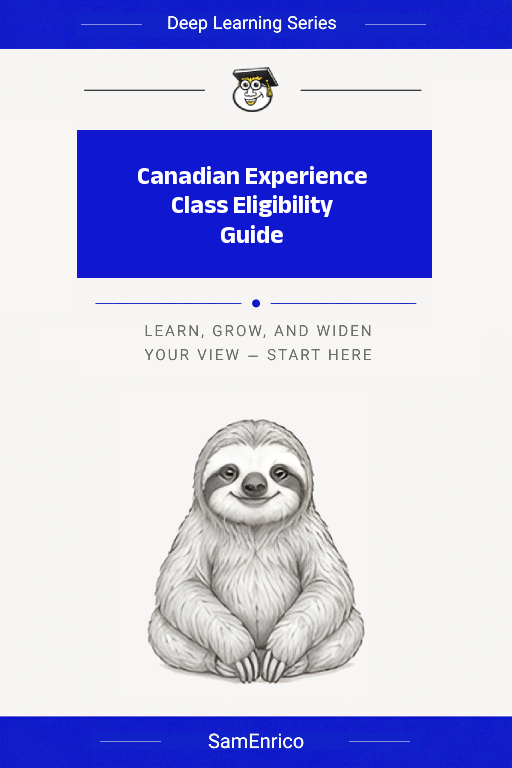
Canadian Experience Class Eligibility Guide eBook
Meet CEC requirements with one year of skilled Can
Meet CEC requirements with one year of skilled Canadian work experience after graduation, avoiding common application pitfalls that delay permanent residence.
Formats
Free sample
Chapter 1: The Three-Year Clock...--The email arrived at 11:47 PM on a Tuesday. Not during business hours, not when a lawyer could intercept it. Just a cold, automated message from IRCC with a subject line that made my stomach drop: "Application for Permanent Residence – Refusal Letter."I had been so sure. Twelve months of work. Forty hours a week.
A glowing reference letter from my manager. I had done everything right. Except I hadn't. Somewhere buried in the dense legal language of the refusal letter was the reason: my qualifying work experience fell outside the 36-month window. I had worked for two solid years, taken a year off to travel and visit family, and then applied.
Those first twelve months of work? Gone. Invisible to IRCC. The system didn't care that I had been a dedicated employee, that I had paid my taxes, that I had built a life in Canada. All it saw was a date on a calendar.I lost $1,610.
I lost eight months of waiting. And I almost lost my status in Canada.That was seven years ago. Since then, I have helped dozens of graduates navigate this exact trap. This chapter is the guide I wish I had received before I clicked "submit."The Fundamental Misconception: "I Have One Year, So I'm Ready"The most dangerous belief among international graduates is that the day they complete fifty-two weeks of full-time work, they can submit their Canadian Experience Class application and wait for permanent residence. This belief has destroyed more applications than any other single error.Here is the truth that IRCC does not emphasize enough: CEC eligibility is not just about accumulating hours.
It is about timing.The Canadian Experience Class operates on a rolling three-year window. Every day you wait to apply, your oldest work experience falls off the back of that window. Every day you delay gathering documents, you risk losing months of hard-earned eligibility. And if you take a break—whether to travel, to switch jobs, or to go back to school—you may find that your "one year of experience" has evaporated while you weren't looking.Before we go any further, let me show you exactly how the three-year window works, because if you misunderstand this single concept, nothing else in this book will save you.The Three-Year Window Explained (With Real Math)IRCC regulations state that your qualifying Canadian work experience must have been gained within the thirty-six months (three years) immediately preceding the date you submit your application. This is not a guideline.
It is a hard rule, codified in the Immigration and Refugee Protection Regulations under section 87.1(3)(c).Let me translate that from legal language into plain English: When you click "submit" on your e-APR, IRCC looks back exactly thirty-six months from that date. Any work that happened before that thirty-six-month mark does not count. It does not matter how skilled it was, how many hours you worked, or how much you were paid. If the start date of your employment falls outside that window, that period of work is invisible to the officer reviewing your file.Example A: The Perfect Timeline Maria graduates on June 1, 2024. She starts working on July 1, 2024, at a qualifying TEER 2 job.
She works full-time (thirty hours per week) for fifty-two consecutive weeks, ending on June 30, 2025. She gathers all her documents and submits her application on August 15, 2025.Here is how the three-year window applies: IRCC looks back from August 15, 2025, to August 15, 2022. Maria's work from July 1, 2024, to June 30, 2025, falls entirely within that window. She has twelve calendar months of experience. Her application is eligible on timing.Example B: The Gap That Kills Carlos graduates on June 1, 2022.
He works from July 1, 2022, to June 30, 2024—two full years of qualifying experience. Then he takes a one-year sabbatical to travel and visit family, from July 1, 2024, to June 30, 2025. He returns to Canada, submits his application on August 15, 2025.Now let us apply the three-year window: IRCC looks back from August 15, 2025, to August 15, 2022. Carlos's work from July 1, 2022, to June 30, 2023, falls inside the window (just barely—the first year). His work from July 1, 2023, to June 30, 2024?
That falls partially outside the window, because the window only extends back to August 15, 2022. Wait—let me recalculate carefully.Actually, let me be precise. From August 15, 2025, back thirty-six months is August 15, 2022. Carlos worked from July 1, 2022, to June 30, 2024. That means:July 1, 2022, to August 14, 2022: This falls outside the window (before August 15, 2022).
Those six weeks are lost.August 15, 2022, to June 30, 2024: This falls inside the window.But here is the killer: Carlos only has one year of experience inside the window? No—he has from August 15, 2022, to June 30, 2024, which is nearly twenty-three months. That should be enough. So why did I say he lost experience? Because the example above is flawed.
Let me give you a better example.Example C: The True Trap Priya graduates on June 1, 2021. She works from July 1, 2021, to June 30, 2022—twelve months exactly. Then she returns to school for a one-year graduate certificate program from September 1, 2022, to August 31, 2023. She graduates, starts a new job on October 1, 2023, and works until September 30, 2024—another twelve months. She submits her application on January 15, 2025.Now apply the three-year window: IRCC looks back from January 15, 2025, to January 15, 2022.Priya's first job (July 1, 2021, to June 30, 2022): Only the portion from January 15, 2022, to June 30, 2022, counts.
That is five and a half months.Priya's second job (October 1, 2023, to September 30, 2024): The entire period falls inside the window. That is twelve months.Priya has twelve months from the second job, plus five and a half months from the first job. She has more than enough hours. But if her second job had only been six months, she would have been in serious trouble.The lesson is brutal: Gaps in your employment history can kill your eligibility, because the three-year window is always moving forward. Every month you wait to apply, the oldest month of your work experience disappears.The 1,560-Hour Myth vs.
The Twelve-Month Reality You will hear many people say that CEC requires "1,560 hours of work." This is true, but it is dangerously incomplete.Let me state the complete rule clearly: IRCC requires (a) a minimum of 1,560 hours of paid skilled work experience, AND (b) a minimum of twelve calendar months of work experience in Canada. Both conditions must be met. One without the other will get your application refused.Why both matter:The hour requirement ensures you have worked enough total time. At thirty hours per week (the maximum IRCC counts for full-time equivalence), 1,560 hours equals exactly fifty-two weeks.The calendar month requirement ensures you have spread that work over at least twelve distinct months. You cannot work sixty hours per week for six months and claim you have "one year of experience" because you have 1,560 hours.
IRCC explicitly prohibits this.The ten-month trap in detail:Imagine you work forty hours per week for ten months. That is 1,600 hours—forty hours above the minimum. You might think you qualify. But you do not. Why?
Because you have only ten calendar months of work experience. IRCC will count your hours (you have enough), then check your calendar months (you do not have enough), and refuse your application. No appeal. No exception.I have seen this happen to software engineers earning six-figure salaries who thought…
This is the end of the free sample. Get the eBook to keep going. Buy now
About this book
Details
- Author
- Mcclelland Georgeanna
- Publisher
- SamEnrico
- Language
- English
- Genre
- Non-Fiction, Student's Shortcut
- Released
- 2026-06-01
- Pages (approx.)
- 145
- Available as
- eBook, Audiobook

Read better in the ZLOADR app
Your eBooks on your phone or tablet. Sign in with your SamEnrico account and start reading.
More by Mcclelland Georgeanna
 Distributed Practice Over MassingMcclelland Georgeanna$11.99
 The Take Home Exam GuideMcclelland Georgeanna$11.99
 King Beyond Civil RightsMcclelland Georgeanna$11.99
 Sheppard Case Reinvestigation 2000Mcclelland Georgeanna$11.99
 Pet Loss Post Traumatic GrowthMcclelland Georgeanna$11.99
 Bad News Delivery GuideMcclelland Georgeanna$11.99
 Morning Routine for Early BirdsMcclelland Georgeanna$11.99
 Goal Setting For High AchieversMcclelland Georgeanna$11.99
 The Opium King and the Hangman's Noose: The Trial of the Hong Kong TriadMcclelland Georgeanna$11.99
 The Golden Theorem: Love and Logic in the Court of TimbuktuMcclelland Georgeanna$11.99
 How to Produce Vehicle Battery ChargersMcclelland Georgeanna$11.99
 A Collector's Handbook to the Lancia Fulvia 1.6 Sport (Second Series)Mcclelland Georgeanna$11.99
You may also like
 Hong Kong Handover 1997Dunn Johnnie$11.99
 Zumba For Postnatal Recovery CourseNeal Christian$11.99
 Zumba for BeginnersLadner Nikia$11.99
 YouTube Comment Mining GuideHumes Pandora$12.99
 Worry Box MeditationCarlin Rudy$11.99
 Workplace Stress MeditationNguyen Lynn$11.99
 Workplace Stress and Sleep RepairHawley Ivory$11.99
 Workplace Perfectionism CureDelaney Jeffry$11.99
 Workplace Injustice Anger GuideWallen Isabelle$11.99
 Work Addiction and Burnout LinkGreenwood Ester$11.99
 Women in Yoga and WellnessBeattie Galina$11.99
 Women in Stand Up ComedyChun Evangeline$11.99