
Non-FictionBusiness BriefCanada
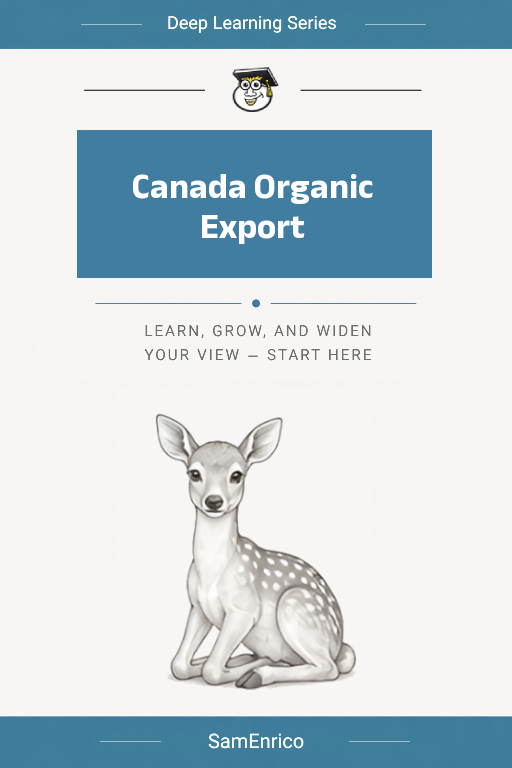
Canada Organic Export eBook
Certify organic exports with Canada Organic Regime
Certify organic exports with Canada Organic Regime for access to Canadian market.
Formats
Free sample
Chapter 1: The $47,000 Mistake--–- The first time I saw an organic shipment rejected at the Canadian border, I was standing on the dock at the Pacific Highway crossing in Surrey, British Columbia. It was February, cold enough that my pen had stopped working, and the CFIA inspector—a woman named Diane who had been doing this job since before the Canada Organic Regime existed—was holding a clipboard with 47 lines of non-compliance checked off. The exporter, a third-generation blueberry farmer from Washington State, had been shipping organic blueberries to Canada for eleven years without a single problem. His USDA Organic certificate was current. His Canadian importer had been using the same broker for a decade.
Everything looked fine on paper.But Diane had found hydroponic propagation trays in the grower's greenhouse during a routine verification inspection three weeks earlier. Not even for blueberries—the trays were for tomato seedlings, a different crop entirely. Under the Canada Organic Regime, that didn't matter. The presence of any hydroponic system on a certified organic operation, even for a non-organic crop, triggers a full investigation. The farmer had assumed, because he wasn't selling tomatoes, that the rules didn't apply.
He was wrong.That container of blueberries—sixty thousand pounds, retail value approximately 347,000at Canadianmarketprices—wasnotallowedtoenterasorganic.Thefarmerhadtwochoices:sellitasconventionalata47percentdiscount,orpaytoshipitbackto Washington.Hetookthediscount.Thedifferencebetweenorganicandconventionalpricingonthatsingleshipmentwas347,000 at Canadian market prices—was not allowed to enter as organic. The farmer had two choices: sell it as conventional at a 47 percent discount, or pay to ship it back to Washington. He took the discount. The difference between organic and conventional pricing on that single shipment was 347,000at Canadianmarketprices—wasnotallowedtoenterasorganic.Thefarmerhadtwochoices:sellitasconventionalata47percentdiscount,orpaytoshipitbackto Washington.Hetookthediscount.Thedifferencebetweenorganicandconventionalpricingonthatsingleshipmentwas47,000. That was the cost of not understanding the Canada Organic Regime.This book exists to ensure that you never make that kind of mistake.The Canada Organic Regime is not a suggestion.
It is not a guideline. It is a mandatory regulatory framework enforced by the Canadian Food Inspection Agency, and it contains rules that differ significantly from the organic standards of every other major trading partner. If you are currently exporting organic products to Canada, or plan to, you are legally obligated to comply with Part 13 of the Safe Food for Canadians Regulations. Ignorance is not a defense. Assumptions about equivalency are not a defense.
Your USDA certificate, your EU organic seal, your Japanese JAS mark—none of these guarantee border clearance.In this chapter, I will show you exactly why the Canadian market is worth the effort, how the regulatory system works, and—most importantly—how to determine whether your operation is already compliant or facing a $47,000 surprise at the border.The Size of the Prize: Why Canada Demands Your Attention Let's start with the numbers, because numbers don't lie. The Canadian organic market was valued at CAD 6.4billionin2023,representingsteadyyear−over−yeargrowthofapproximately8to10percentannually.Toputthatinperspective,Canada′sorganicmarketislargerthantheorganicmarketsof Germany,France,andthe United Kingdomcombinedonaper−capitabasis.Canadianconsumersspendanaverageof6.4 billion in 2023, representing steady year-over-year growth of approximately 8 to 10 percent annually. To put that in perspective, Canada's organic market is larger than the organic markets of Germany, France, and the United Kingdom combined on a per-capita basis. Canadian consumers spend an average of 6.4billionin2023,representingsteadyyear−over−yeargrowthofapproximately8to10percentannually.Toputthatinperspective,Canada′sorganicmarketislargerthantheorganicmarketsof Germany,France,andthe United Kingdomcombinedonaper−capitabasis.Canadianconsumersspendanaverageof175 per person per year on organic products, compared to 146inthe United Statesand146 in the United States and 146inthe United Statesand89 in the European Union.But the real opportunity is not just the size of the market—it is the gap between supply and demand. Canada currently imports approximately 60 percent of its organic produce.
For certain categories, the import dependency is even higher. Organic grains: 75 percent imported. Organic soybeans: 85 percent imported. Organic tropical fruits: nearly 100 percent imported. Canadian grocery chains, particularly Loblaws, Sobeys, and Metro, are actively seeking reliable international suppliers because domestic production cannot keep pace with consumer demand.Here is what that means in dollars and cents.
A 20-foot container of organic wheat from the Canadian Prairies sells domestically for approximately 18,000.Thesamecontaineroforganicwheatimportedfromthe United States,underthe US−Canada Organic Equivalency Arrangement,commands18,000. The same container of organic wheat imported from the United States, under the US-Canada Organic Equivalency Arrangement, commands 18,000.Thesamecontaineroforganicwheatimportedfromthe United States,underthe US−Canada Organic Equivalency Arrangement,commands24,000 at the same Canadian mill because of the perceived quality differential. A container of organic quinoa from Peru, which requires full COR certification, can sell for $42,000 in Toronto—a 30 percent premium over non-organic quinoa and a 15 percent premium over organic quinoa sold in the United States.The price premium exists because Canadian retailers know that COR certification is more stringent than USDA NOP certification in several key areas. They market that difference to consumers. And consumers pay for it.I have worked with exporters from thirty-seven countries over the past fifteen years.
The ones who succeed in Canada do not treat COR as a compliance burden. They treat it as a competitive advantage. They include their COR certificate in their marketing materials. They put the Canada Organic Legend on their packaging alongside their domestic organic seal. They charge more because they can prove they met a higher standard.The ones who fail treat COR as an afterthought.
They assume their domestic certification is enough. They discover at the border that it is not.The Regulatory Framework: What You Are Actually Required to Do The Canada Organic Regime is established under Part 13 of the Safe Food for Canadians Regulations, which came into force on January 15, 2019, replacing the previous Organic Products Regulations. If you are currently exporting organic products to Canada, or plan to, you must comply with one of two pathways.The first pathway is equivalency. If your country has a formal equivalency arrangement with Canada, your domestic organic certification is recognized as equivalent to COR, provided you meet specific critical variances. As of the publication of this book, equivalency arrangements exist for the following countries and blocs:The United States (under the US-Canada Organic Equivalency Arrangement, or USCOEA)The European Union (27 member states)Japan Switzerland The United Kingdom Costa Rica Taiwan Thirty-one additional countries with bilateral agreements If you are exporting from an equivalency country, you do not need to obtain COR certification.
However—and this is where many exporters make their first mistake—you must still comply with the critical variances. These are specific rules where the Canadian standard differs from your domestic standard. Chapter 3 of this book covers the USCOEA critical variances in exhaustive detail. Chapter 4 covers the EU, Japan, and other equivalency arrangements. For now, understand this: equivalency does not mean identical.
It means close enough, with exceptions.The second pathway is full compliance. If your country does not have an equivalency arrangement with Canada, you must obtain COR certification directly. This applies to exporters from China, India, Brazil, Mexico (outside the USCOEA), most of Southeast Asia, most of Africa, and the Middle East. Full compliance means meeting every requirement of the Canadian Organic Standards (CAN/CGSB-32.310 and 32.311) without exception. Your domestic organic certification—even if it is IFOAM-accredited—is not sufficient.Chapters 5 and 6 of this book walk you through the full compliance pathway step by step.
The process takes three to six months, costs between USD 3,000and3,000 and 3,000and15,000 depending on your location and crop complexity…
This is the end of the free sample. Get the eBook to keep going. Buy now
About this book
Details
- Author
- Jolley Cherry
- Publisher
- SamEnrico
- Language
- English
- Genre
- Non-Fiction, Business Brief, Canada
- Released
- 2026-05-30
- Pages (approx.)
- 153
- Available as
- eBook, Audiobook

Read better in the ZLOADR app
Your eBooks on your phone or tablet. Sign in with your SamEnrico account and start reading.
More by Jolley Cherry
 Visa Hurdles to Venture CapitalJolley Cherry$11.99
 Phone Addiction Break GuideJolley Cherry$11.99
 Angela Davis Prison AbolitionJolley Cherry$11.99
 Zen Garden Sand RakingJolley Cherry$11.99
 Screen Free Bedtime MeditationJolley Cherry$11.99
 Dream Incubation for Academic ExamsJolley Cherry$11.99
 Chronic Pain Emotional NumbnessJolley Cherry$11.99
 Plan Prep Cook MethodJolley Cherry$11.99
 The Veiled Brush: How a Saudi Artist Captured a Queen’s SoulJolley Cherry$11.99
 The Last Library of Alexandria: Lost Voices of the Ancient WorldJolley Cherry$11.99
 How to Produce Vehicle Parts and AccessoriesJolley Cherry$11.99
 Joint Venture and Teaming Agreement GuideJolley Cherry$12.99
You may also like
 Hong Kong Handover 1997Dunn Johnnie$11.99
 Zumba For Postnatal Recovery CourseNeal Christian$11.99
 Zumba for BeginnersLadner Nikia$11.99
 YouTube Comment Mining GuideHumes Pandora$12.99
 Worry Box MeditationCarlin Rudy$11.99
 Workplace Stress MeditationNguyen Lynn$11.99
 Workplace Stress and Sleep RepairHawley Ivory$11.99
 Workplace Perfectionism CureDelaney Jeffry$11.99
 Workplace Injustice Anger GuideWallen Isabelle$11.99
 Work Addiction and Burnout LinkGreenwood Ester$11.99
 Women in Yoga and WellnessBeattie Galina$11.99
 Women in Stand Up ComedyChun Evangeline$11.99