
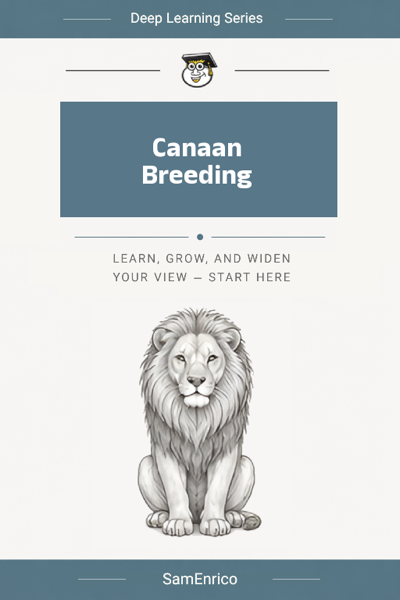
Non-FictionInformativeEducational
Canaan Breeding eBook
A Coursebook on Canaan Breeding
A Coursebook on Canaan Breeding
Formats
Free sample
Chapter 1: The Desert Forge...--–- Before the first kibble was manufactured, before the first conformation ring was laid out with white rope, before the first breed standard was written on paper—there was the desert. The Canaan Dog did not emerge from a drawing board or a Victorian gentleman’s fancy. It was not sculpted by generations of breeders chasing a specific ear set or a particular angle of stifle. The Canaan Dog was forged in the Negev, a landscape that kills the weak without hesitation and rewards only the shrewd, the resilient, and the efficient. To understand how to breed this animal, you must first understand what bred it.
That understanding begins not with a pedigree chart but with a single, uncomfortable truth: the Canaan Dog is not a product of human intention. It is a product of survival. And survival, unlike a ribbon, leaves no room for error.Every living Canaan Dog carries in its bones a lineage that stretches back not centuries but millennia. Cave paintings in the Sinai Peninsula depict dogs with erect ears, curled tails, and a square silhouette—unmistakably the ancestors of the animal we know today. Archaeological digs at ancient Israelite settlements have yielded canine skeletons dating to 2000 BCE, their morphology so consistent with the modern Canaan Dog that a breeder from the twenty-first century would recognize them instantly.
This is not hyperbole. The Canaan Dog is the only breed in the American Kennel Club that has no known point of origin in human selective breeding. Every other breed can point to a founder: a specific person, a specific kennel, a specific decade when the breed was "created." The Canaan Dog has none of that. It was here before we thought to name it. It survived because it was useful enough that humans tolerated its presence and independent enough that humans never fully controlled it.This chapter is not a history lesson for its own sake.
It is a blueprint. Every decision you will make as a breeder—every mating, every health test, every placement of a puppy in a new home—will be judged against the standard that the desert set. The question is not whether you will breed Canaan Dogs. The question is whether you will breed them as the desert made them or as humans wish they had made them. The difference between those two paths is the difference between preserving a breed and slowly, lovingly, destroying it.The Pariah Archetype: A Word That Deserves Respect Let us address the term directly.
The Canaan Dog is classified as a "pariah dog." The word makes many people uncomfortable. It conjures images of outcasts, of strays, of animals living on the margins of society. That discomfort comes from a misunderstanding of what the term means in canine biology. A pariah dog is not a stray. A stray is a domesticated animal that has been lost or abandoned.
A pariah dog is something else entirely: a population of dogs that lives in close proximity to human settlements without being fully domesticated in the behavioral sense. Pariah dogs are semi-wild. They scavenge from human refuse. They sleep in the shadows of human buildings. They tolerate human presence but do not seek it out in the way a Labrador or a Golden Retriever does.
And critically, they are shaped not by human breeding decisions but by the brutal arithmetic of natural selection.The Canaan Dog is the classic pariah archetype. Its ancestors lived on the edges of Bedouin camps, eating scraps and controlling rodent populations. The Bedouin did not breed them. They did not keep written pedigrees or select for coat color. What they did was tolerate the dogs that were useful and drive away the dogs that were dangerous.
A dog that bit a child would be killed. A dog that guarded the camp and alerted to strangers would be allowed to stay. A dog that could survive on minimal food during lean times would live long enough to reproduce. A dog that required constant care would not. Over thousands of generations, this process produced an animal that is not quite wild and not quite domesticated—an animal that sits exactly at the intersection of usefulness and independence.This is not a weakness.
It is a superpower.Consider what the desert asked of these dogs. Summer temperatures in the Negev regularly exceed 110 degrees Fahrenheit. Winter nights can drop below freezing. Water is scarce. Food is intermittent.
Predators—wolves, hyenas, leopards—are present. In this environment, there is no room for inefficiency. A coat that is too short will not insulate against the cold. A coat that is too long will cause overheating. Ears that are floppy will trap moisture and lead to chronic infection.
A body that is too long will strain the spine during sudden turns. A body that is too short will lack the leverage to run at speed. The desert does not care about your opinion. The desert simply kills what does not work.The result is a dog that is, from a purely engineering perspective, nearly perfect for its environment. The double coat: a harsh, straight outer layer that repels dirt and moisture, and a soft, dense undercoat that provides insulation.
The coat sheds dirt naturally; a Canaan Dog can roll in mud and be clean within hours once the mud dries and falls off. There is no doggy odor because the coat does not trap oils against the skin. The erect ears: they funnel sound toward the eardrum, providing directional hearing that allows the dog to locate a rodent from fifty yards. They also allow air circulation, which keeps the ear canal dry and infection-free. The square proportions: the height at the shoulder is roughly equal to the length of the body from the point of shoulder to the point of buttock.
This square shape provides agility and balance, allowing the dog to change direction instantly while running at full speed. The curled tail: it serves as a counterbalance during sharp turns and can be tucked tightly against the body to conserve heat during cold desert nights.None of these features was designed. All of them were tested. The dogs that lacked them died before reproducing. The dogs that had them lived.
That is natural selection in its purest form.Natural Selection Versus Artificial Selection: The Great Divergence To breed Canaan Dogs ethically, you must understand the fundamental difference between the force that created this breed and the force that you will apply as a breeder. That difference is the difference between a river carving a canyon over millennia and a sculptor chipping away at a block of stone. Both processes shape material. But they shape it in radically different ways.Natural selection is slow, ruthless, and holistic. It does not select for a single trait.
It selects for the entire organism's ability to survive and reproduce in a specific environment. A dog with perfect ears but weak hips will not survive long enough to breed. A dog with a flawless coat but a poor immune system will die of disease before passing on its genes. Natural selection cares about everything because everything matters to survival. There are…
This is the end of the free sample. Get the eBook to keep going. Buy now
About this book
Details
- Author
- Greiner Loree
- Publisher
- SamEnrico
- Language
- English
- Genre
- Non-Fiction, Informative, Educational
- Released
- 2026-06-02
- Pages (approx.)
- 135
- Available as
- eBook, Audiobook

Read better in the ZLOADR app
Your eBooks on your phone or tablet. Sign in with your SamEnrico account and start reading.
More by Greiner Loree
 Sales Creative Thinking GuideGreiner Loree$11.99
 Mindful Eating IntroductionGreiner Loree$11.99
 The Blue Zone Bean ProtocolGreiner Loree$11.99
 Probiotics for IntoleranceGreiner Loree$11.99
 Traumatic Grief Recovery GuideGreiner Loree$11.99
 The Alehouse of Archimedes: Brewing the Mathematics of AntiquityGreiner Loree$11.99
 EDI Integration for ProcurementGreiner Loree$12.99
 Vendor Payment AI GuideGreiner Loree$12.99
 How to Start a Cider Making Machinery Business (Beginners Guide)Greiner Loree$11.99
 Understanding Stern–lubinsky–durrie SyndromeGreiner Loree$17.99
You may also like
 Hong Kong Handover 1997Dunn Johnnie$11.99
 Zumba For Postnatal Recovery CourseNeal Christian$11.99
 Zumba for BeginnersLadner Nikia$11.99
 YouTube Comment Mining GuideHumes Pandora$12.99
 Worry Box MeditationCarlin Rudy$11.99
 Workplace Stress MeditationNguyen Lynn$11.99
 Workplace Stress and Sleep RepairHawley Ivory$11.99
 Workplace Perfectionism CureDelaney Jeffry$11.99
 Workplace Injustice Anger GuideWallen Isabelle$11.99
 Work Addiction and Burnout LinkGreenwood Ester$11.99
 Women in Yoga and WellnessBeattie Galina$11.99
 Women in Stand Up ComedyChun Evangeline$11.99