
Non-FictionSelf-HelpResource Navigation
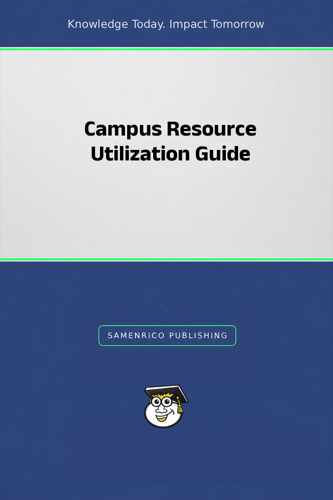
Campus Resource Utilization Guide eBook
Find and use tutoring, counseling, and academic co
by Reddy Quinn
Find and use tutoring, counseling, and academic coaching services before crises hit.
Formats
Free sample
Chapter 1: The Silent Crash...--–- Most students do not fail college in a single dramatic moment. There is no orchestra playing tense music in the background. No professor dramatically hands back a paper with a failing grade scrawled in red ink while lightning strikes outside the window. Failure, for the vast majority of students, arrives like rust on a neglected bicycle: slowly, quietly, invisibly, until one day you look down and realize the thing you were riding has been falling apart for weeks, and you simply did not notice.This chapter is about that moment before the moment. It is about the week three quiz you bombed and told yourself didn't matter.
It is about the morning you woke up too tired to go to class and stayed in bed, and then did the same thing the next day, and then the next. It is about the email from your professor that you have been staring at for forty-five minutes, trying to summon the courage to open it. Most students who drop out of college do not plan to drop out. They plan to catch up. They plan to try harder tomorrow.
They plan to go to office hours next week. And then tomorrow becomes next week becomes midterms becomes a letter from the registrar saying they have been academically withdrawn.The tragedy of this story is not that it is inevitable. The tragedy is that it is almost entirely preventable. And the first step toward prevention is understanding a simple, brutal truth: the myth of the "natural student" is a lie, and believing that lie is the most expensive mistake you will ever make.The Myth of the Natural Student Every campus has a few students who seem to glide through college without visible effort. They show up to class five minutes late, ask a question that makes the professor smile, and then casually mention they are double-majoring and running a student organization and somehow still have time for brunch on Sundays.
These students appear to possess some innate academic superpower—a natural gift for learning that the rest of us simply lack.This is an illusion, and a particularly cruel one at that.What looks like natural ability is almost always a combination of three things that have nothing to do with innate intelligence. First, prior exposure: many of these students took advanced placement courses in high school or had parents who were professors or grew up in households where academic language was spoken at the dinner table. They are not smarter than you. They have simply seen the material before. Second, hidden support systems: you do not see the private tutor they meet with every Tuesday, the older sibling who proofreads their papers, or the study group that has been meeting since freshman orientation.
Third, and most importantly, they have mastered what sociologists call the Hidden Curriculum—the unwritten rules of college that no one explains to you because everyone assumes you already know them.The Hidden Curriculum is a vast and invisible architecture of expectations that governs academic life. It includes how to email a professor without sounding demanding or clueless. It includes how to find office hours when the location is listed only as "by appointment." It includes how to interpret a syllabus that lists fifteen different grading categories and three different late policies. It includes knowing that you can ask for an extension before the deadline, not after. It includes understanding that your academic advisor is not going to chase you down—you have to go to them.
It includes knowing that the writing center exists, that it is free, and that using it does not mean you are a bad writer.The natural student does not exist. There are only students who have learned the Hidden Curriculum and students who have not. And the cruelest part of the hidden curriculum is that it hides itself: if you do not know the rules, you do not even know that you do not know them. You just feel lost, confused, and increasingly convinced that everyone else received a manual that somehow got lost in the mail.The Ambulance at the Bottom of the Cliff Here is a metaphor that will appear exactly twice in this book—once now, and once in Chapter Nine, because it is useful but not something we need to beat to death. Imagine you are standing at the edge of a cliff.
At the bottom of the cliff is an ambulance. Its lights are flashing, its engine is running, and a team of paramedics is standing by, ready to treat anyone who falls. Now consider two different approaches to safety.The reactive approach says: the ambulance is there, so I am safe. If I fall, someone will rescue me. I will wait until I am hurt, and then I will call for help.
This is how most students approach campus resources. They wait until they are failing a class to find a tutor. They wait until they are having panic attacks to visit counseling. They wait until they have missed three deadlines to talk to their academic advisor. They are not wrong that the ambulance exists.
But they are wrong about what it feels like to hit the ground.The proactive approach says: an ambulance at the bottom of the cliff is a failure of imagination. I do not want to fall at all. So I will build a fence. I will learn to recognize the loose gravel near the edge. I will practice walking on stable ground.
I will ask someone who has made this walk before to show me the safe path. This is not because I am weak or fearful. It is because I understand that the goal is not to survive a crash. The goal is to never crash in the first place.Academic preventive medicine is the fence at the top of the cliff. It is the act of seeking help before you need it, of building skills before they are tested, of creating systems that catch you before you fall.
And the single most important thing you can do right now—before you finish this chapter, before you close this book, before you tell yourself you will do it tomorrow—is to identify where your cliff actually is.The Self-Audit: Finding Your Three Cracks Every student has a unique constellation of vulnerabilities. Some students crumble under the pressure of large writing projects. Some students freeze during exams, their minds going blank despite hours of studying. Some students lose track of deadlines entirely, swimming through a fog of due dates they cannot seem to organize. Some students struggle to ask for help, paralyzed by the fear that asking will reveal them as frauds.
Some students have mastered the academic side of college but are drowning socially, isolated and alone in a sea of strangers.None of these vulnerabilities are character flaws. They are specific, identifiable, solvable problems. But you cannot solve a problem you have not named.The Self-Audit is a tool for naming your vulnerabilities. It is not a psychological evaluation or a test of your worth as a student. It is simply a checklist—a set…
This is the end of the free sample. Get the eBook to keep going. Buy now
About this book
Details
- Author
- Reddy Quinn
- Publisher
- SamEnrico
- Language
- English
- Genre
- Non-Fiction, Self-Help, Resource Navigation
- Released
- 2026-06-07
- Pages (approx.)
- 150
- Available as
- eBook, Audiobook

Read better in the ZLOADR app
Your eBooks on your phone or tablet. Sign in with your SamEnrico account and start reading.
More by Reddy Quinn
 Zumba Aqua Fitness GuideReddy Quinn$11.99
 Letter To Future Self WorkbookReddy Quinn$11.99
 Highway 18 MysteryReddy Quinn$11.99
 The ED and Prostate Cancer GuideReddy Quinn$11.99
 The Ballot That Broke a Kingdom: The 15th-Century Election That Sparked a RevolutionReddy Quinn$11.99
 Customer Facing Promotion CaseReddy Quinn$12.99
 BOP Ecommerce Product GuideReddy Quinn$12.99
 Understanding Van De Berghe–dequeker SyndromeReddy Quinn$17.99
 How to Become a Locomotive InspectorReddy Quinn$11.99
 IT Support TechnicianReddy Quinn$11.99
You may also like
 Hong Kong Handover 1997Dunn Johnnie$11.99
 Zumba For Postnatal Recovery CourseNeal Christian$11.99
 Zumba for BeginnersLadner Nikia$11.99
 YouTube Comment Mining GuideHumes Pandora$12.99
 Worry Box MeditationCarlin Rudy$11.99
 Workplace Stress MeditationNguyen Lynn$11.99
 Workplace Stress and Sleep RepairHawley Ivory$11.99
 Workplace Perfectionism CureDelaney Jeffry$11.99
 Workplace Injustice Anger GuideWallen Isabelle$11.99
 Work Addiction and Burnout LinkGreenwood Ester$11.99
 Women in Yoga and WellnessBeattie Galina$11.99
 Women in Stand Up ComedyChun Evangeline$11.99