
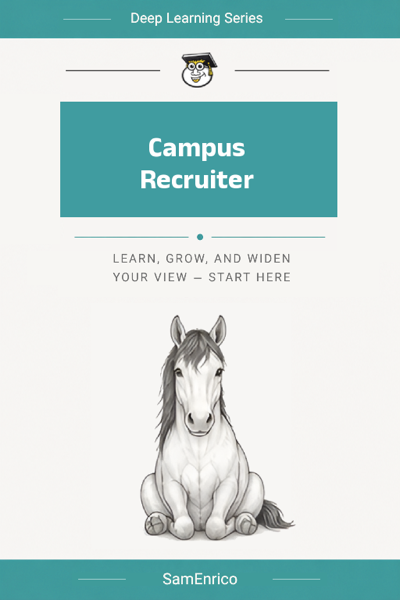
Non-FictionInformativeEducational
Campus Recruiter eBook
A Coursebook on Campus Recruiter
by Ogden Tempie
A Coursebook on Campus Recruiter
Formats
Free sample
Chapter 1: The Four Hats--–- The first time I watched a campus recruiter fail, it was spectacular. Not the kind of failure that comes from a bad hiring decision—though that happened too—but the kind where you could see the wheels falling off in real time, in front of two hundred students.The recruiter, let's call her Sarah, had flown in from corporate headquarters. She had a perfectly branded booth, a table full of high-quality swag (the good stuff, not the cheap pens), and a Power Point presentation that had been approved by three layers of leadership. She was polished, well-spoken, and utterly unprepared for what happened next.Within the first hour of the career fair, three students asked her questions she couldn't answer. Not trick questions—legitimate ones.
"What does the first ninety days actually look like for a new hire?" asked a nervous civil engineering major. "How many of your interns from last year got full-time offers?" asked a business student who had been burned before by a company that used interns as cheap labor. "Can you tell me about someone who started in this role and then moved into product management?" asked a career-switcher who had done her homework.Sarah deflected. She gave corporate answers. She talked about "culture" and "values" and "exciting opportunities." The students smiled, took a sticker, and walked to the next booth.By the end of the day, she had collected forty-seven resumes.
Thirty-one of them were from students who had also applied to three other companies at the same fair. Six of them were from students who later told their career services office that Sarah's company "seemed nice but vague." Three of them actually got interviews. One accepted the offer.That one hire cost the company approximately $18,000 in recruiter time, travel expenses, swag, and platform fees. They spent eighteen thousand dollars to hire one person who stayed for fourteen months before leaving for a competitor.Sarah wasn't lazy. She wasn't incompetent.
She was just doing campus recruiting the way she had been taught—which was to say, the way everyone did it. And that was precisely the problem.This book exists because that approach is broken. And the first step to fixing it is understanding that you are not just a recruiter. You are four different professionals sharing one job description, and if you don't know which hat to wear at which moment, you will fail the way Sarah failed.The Four Hats You Didn't Sign Up For (But Wear Anyway)Let's be honest about what brought you here. Maybe you're an HR generalist who got handed campus recruiting as an "additional duty." Maybe you're a hiring manager who volunteered to help at a career fair and suddenly became the de facto expert.
Or maybe you're one of the dedicated few whose official title actually says "Campus Recruiter," and you're looking for a framework that goes beyond the usual platitudes.Whatever your path, the job you're doing is not the job you were trained for. Campus recruiting, as it exists in most organizations, is a Frankenstein monster of responsibilities pulled from four distinct disciplines. You are expected to be:Hat #1: The Brand Ambassador This is the hat you wear in public. At career fairs, information sessions, and networking events, you are the human embodiment of your employer's brand. Students don't read annual reports or Glassdoor reviews with a critical eye—they talk to you, and they form an opinion in the first thirty seconds.
If you're bored, they think the company is boring. If you're evasive, they think the company is hiding something. If you're excited, they might stick around long enough to ask a real question.But here's the catch: brand ambassadorship isn't about cheerleading. The students who matter—the ones you actually want to hire—can smell performative enthusiasm from across the room. They've sat through dozens of info sessions.
They've heard "we're a family" and "we work hard and play hard" so many times that those phrases have become meaningless noise. Effective brand ambassadorship requires you to be specific, honest, and sometimes even self-critical.Hat #2: The Hiring Manager Partner This is the hat you wear in internal meetings, and it's the one that causes the most friction. Hiring managers—the people who will actually supervise the students you recruit—often have unrealistic expectations. They want candidates with three years of experience for an entry-level role. They want Ivy League graduates but aren't willing to pay Ivy League salaries.
They want "cultural fit" but can't define what that means.Your job is to translate their needs into something actionable. That means asking uncomfortable questions before you ever set foot on campus: What does success look like in the first six months? What skills are genuinely required versus nice to have? What kind of supervision style does this manager actually practice? If you don't answer these questions upfront, you will spend the next three months sending candidates who look good on paper but fail in practice.Hat #3: The Candidate Coach This is the hat you wear during the recruiting process itself, and it's the one most recruiters neglect.
When a student applies to your company, they are not just a resume and a transcript. They are a human being who is likely navigating this process for the first time. They don't know what a "behavioral interview" is, let alone how to prepare for one. They don't know whether to send a thank-you note or how to negotiate an offer. They are terrified, and they are looking to you for signals.Being a candidate coach doesn't mean giving away answers or lowering standards.
It means providing transparency: telling students what to expect, how to prepare, and when they will hear back. It means giving feedback when you reject someone, even if that feedback is uncomfortable to deliver. And it means recognizing that every student you interact with—whether you hire them or not—will tell other students about their experience. A reputation for being helpful, even in rejection, is worth more than any recruiting budget.Hat #4: The Data Analyst This is the hat you wear when no one is watching, and it's the one that will save your career. Campus recruiting produces enormous amounts of data: applications, conversion rates, offer acceptance rates, time-to-fill, cost-per-hire, quality-of-hire, diversity metrics, and more.
Most recruiters collect this data because they're told to, then file it away and never look at it again. That's a mistake.The data tells you where your process is working and where it's falling apart. If you have a high application rate but a low interview conversion rate, your screening criteria are too strict or your job description is misleading. If you have a high offer acceptance rate but low retention after one year, you're hiring the wrong people or onboarding them poorly. If your diversity numbers drop off between the application and interview stages, you have a bias problem that needs immediate attention.
The data won't solve these problems on its own, but it will tell you where to look.The Campus Ecosystem: Why One Size Fits None Before we go any further, we need to talk about where you're recruiting.…
This is the end of the free sample. Get the eBook to keep going. Buy now
About this book
Details
- Author
- Ogden Tempie
- Publisher
- SamEnrico
- Language
- English
- Genre
- Non-Fiction, Informative, Educational
- Released
- 2026-06-02
- Pages (approx.)
- 143
- Available as
- eBook, Audiobook

Read better in the ZLOADR app
Your eBooks on your phone or tablet. Sign in with your SamEnrico account and start reading.
More by Ogden Tempie
 Maternity Leave GapOgden Tempie$11.99
 Stress Posture And PainOgden Tempie$11.99
 Elizabeth Christmas Celebration BanOgden Tempie$11.99
 Belonging Longevity Factor GuideOgden Tempie$11.99
 The Team Motivation PlaybookOgden Tempie$11.99
 Splendid Little War: The U.S. Navy's Lightning Strike at Manila BayOgden Tempie$11.99
 Event Marketing Facebook AdsOgden Tempie$12.99
 Development Impact BondOgden Tempie$12.99
 The Breeder's Guide to Banker HorsesOgden Tempie$11.99
 How to Start a Beams Business (Beginners Guide)Ogden Tempie$11.99
You may also like
 Hong Kong Handover 1997Dunn Johnnie$11.99
 Zumba For Postnatal Recovery CourseNeal Christian$11.99
 Zumba for BeginnersLadner Nikia$11.99
 YouTube Comment Mining GuideHumes Pandora$12.99
 Worry Box MeditationCarlin Rudy$11.99
 Workplace Stress MeditationNguyen Lynn$11.99
 Workplace Stress and Sleep RepairHawley Ivory$11.99
 Workplace Perfectionism CureDelaney Jeffry$11.99
 Workplace Injustice Anger GuideWallen Isabelle$11.99
 Work Addiction and Burnout LinkGreenwood Ester$11.99
 Women in Yoga and WellnessBeattie Galina$11.99
 Women in Stand Up ComedyChun Evangeline$11.99