
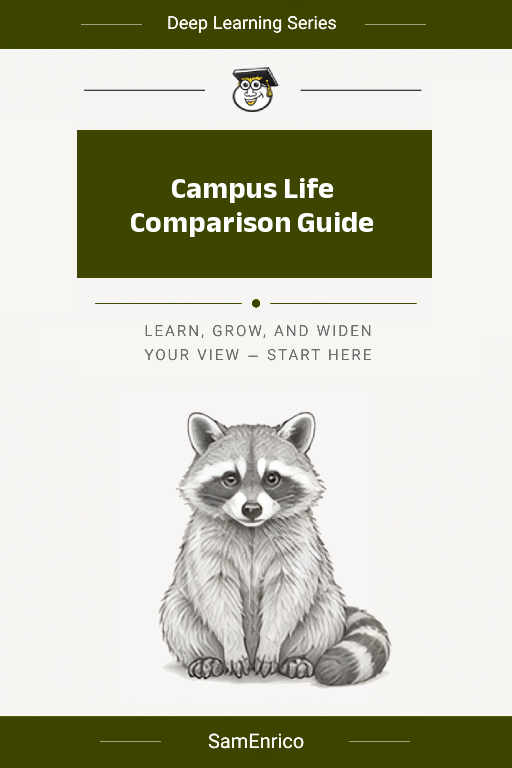
Campus Life Comparison Guide eBook
Experience US residential campuses, UK city univer
Experience US residential campuses, UK city universities, and Australian outdoor lifestyles, matching your ideal social environment.
Formats
Free sample
Chapter 1: The Dorm Delusion...--–- Maria had done everything right. She had a 4.2 GPA, near-perfect SAT scores, a carefully crafted personal statement about her summer volunteering in Guatemala, and five glowing recommendation letters. She had spent eighteen months researching university rankings, comparing acceptance rates, and calculating return on investment. She had chosen the United States because it had the best engineering programs in the world, and she had chosen a large public university in the Midwest because it was affordable and had a strong co-op program. By every objective measure, she had made the perfect decision.Forty-three days into her first semester, Maria sat on the floor of a shared dormitory bathroom at two in the morning, knees pulled to her chest, crying so quietly that her roommate—who was hosting six people in their shared room for a pre-game gathering—would not hear her over the bass of someone's portable speaker.
She had not spoken a full sentence to another human being in seventy-two hours. Not because she could not speak English—she was fluent in three languages—but because she had no one to speak to.The problem was not the university's rankings. The problem was not the cost. The problem was not the quality of the engineering program, which was excellent. The problem was that Maria was an introvert who had chosen a university where the entire social ecosystem was built for extroverts, and no one had warned her that this was even a consideration.Three thousand miles away, in the opposite direction, a young man named James had the inverse experience.
James was an extrovert who had chosen a prestigious liberal arts college in rural New England because his parents believed smaller class sizes meant a better education. By October of his first year, he had alienated most of his classmates by being too loud at mandatory dorm meetings, had been asked to leave two study groups for talking too much, and was seriously considering transferring to a large state school where, as he put it, "there are enough people that my personality type is normal." His grades were fine. His mental health was not. And like Maria, no one had warned him that the social architecture of his campus would either amplify or suffocate his natural tendencies.This is the central argument of this book, and it is simple enough to fit on a single line: You are not choosing a university. You are choosing a social ecosystem.
And if you choose the wrong one, no ranking, no scholarship, and no prestigious degree will save you from two to four years of loneliness, anxiety, or exhaustion.For the past thirty years, the international student advising industry has focused almost exclusively on two variables: academic prestige and cost. Parents and students alike obsess over QS World University Rankings, US News & World Report, the Times Higher Education rankings, and any other league table that promises to reduce the complexity of higher education to a single number. They calculate tuition, room and board, exchange rates, and post-graduation earning potential with the precision of a hedge fund manager. And then they arrive on campus and discover that none of this preparation helped them answer the only question that actually determines their daily happiness: Where do I eat lunch? With whom?
And do I actually want to be around those people?This book exists to answer that question. And it does so by introducing a framework that has never been applied systematically to university selection: the concept of the "third place."The Third Place: Why Your Campus Is Not Your Home or Your Classroom The sociologist Ray Oldenburg, in his 1989 book The Great Good Place, introduced a concept that has since become foundational in urban planning and community psychology. Oldenburg argued that human beings need three types of spaces to thrive. The first place is home—the private, domestic sphere where we rest and recharge in relative solitude or with family. The second place is work or the classroom—the structured, productive sphere where we perform roles, meet obligations, and pursue achievement.
The third place is everything else: the coffee shop, the pub, the barbershop, the community center, the park bench. It is the informal, unscripted, voluntary social space where we go not because we have to but because we want to. Third places, Oldenburg argued, are the "anchors of community life" and the essential infrastructure of human happiness.Here is the observation that drives this entire book: For the three or four years you spend at university, your campus—or its absence—becomes your dominant third place. Unlike your hometown, where third places are distributed across a neighborhood or city, your university will concentrate nearly all of your social life into a single environment. If you live in a US residential campus, your third place is the dorm common room, the dining hall, the quad, the student union, the library, and the fraternity house—all within a half-mile radius.
If you study at a UK city university, your third places are scattered: the pub on the corner, the park across town, the museum membership you bought, the society meeting room in a building you have to take the Tube to find. If you attend an Australian university, your third places might be the campus lawn, the beach fifteen minutes away, the bushwalking trail, the barbecue area at a friend's flat.Each of these configurations makes different demands on your personality, your energy levels, your social skills, and your tolerance for ambiguity. There is no universally "better" configuration. There is only the configuration that fits you.This chapter will introduce the three national archetypes that structure the rest of the book: the US Bubble, the UK City Crawl, and the Australian Outdoor Canvas. But before we dive into those archetypes, we need to establish a shared vocabulary for talking about your own social needs and tendencies.
Because the first and most important step in choosing a social ecosystem is understanding yourself.The Social Learning Style Quiz: Who Are You in Social Spaces?Take out a piece of paper or open a note on your phone. For each of the following ten items, rate yourself from 1 (strongly disagree) to 5 (strongly agree). Do not overthink. Your first instinct is usually correct.Section A: Energy and Social Density I feel energized after being around a large group of people (a party, a crowded dining hall, a busy coffee shop).I need at least two hours of completely alone time every day to feel balanced.I prefer small gatherings of three or four people over large parties.I am comfortable walking into a room where I know no one and introducing myself to strangers.Section B: Structure and Spontaneity5. I like having a clear plan for social events (who, when, where, what to bring).6.
I am happy to show up to a social space and see what happens.7. I prefer activities that have a shared focus (board games, sports, watching a movie) over unstructured hanging out.Section C: Nature and Physical Activity8. I feel significantly better after spending time outside—walking, hiking, sitting in a park, being near water.9. I would rather be physically active…
This is the end of the free sample. Get the eBook to keep going. Buy now
About this book
Details
- Author
- Erwin Kendall
- Publisher
- SamEnrico
- Language
- English
- Genre
- Non-Fiction, Student's Shortcut
- Released
- 2026-06-01
- Pages (approx.)
- 156
- Available as
- eBook, Audiobook

Read better in the ZLOADR app
Your eBooks on your phone or tablet. Sign in with your SamEnrico account and start reading.
More by Erwin Kendall
 Design Thinking for Legal OperationsErwin Kendall$11.99
 Cleopatra Sister AssassinationErwin Kendall$11.99
 Five Whys TechniqueErwin Kendall$11.99
 Senior Hospital DischargeErwin Kendall$11.99
 NVC for Diplomats GuideErwin Kendall$11.99
 The Step Six Defect RemovalErwin Kendall$11.99
 Nurse Shift Work Sleep GuideErwin Kendall$11.99
 Mom Time Management GuideErwin Kendall$11.99
 The Siege of Kandahar: Shah Abbas' MasterstrokeErwin Kendall$11.99
 The Breaking of the Protestant Crescent: The Battle of White Mountain and the Catholic ResurgenceErwin Kendall$11.99
 A Collector's Handbook to the Horch Type 850Erwin Kendall$11.99
 Service Providers Guide to Pediatric CardiologyErwin Kendall$11.99
You may also like
 Hong Kong Handover 1997Dunn Johnnie$11.99
 Zumba For Postnatal Recovery CourseNeal Christian$11.99
 Zumba for BeginnersLadner Nikia$11.99
 YouTube Comment Mining GuideHumes Pandora$12.99
 Worry Box MeditationCarlin Rudy$11.99
 Workplace Stress MeditationNguyen Lynn$11.99
 Workplace Stress and Sleep RepairHawley Ivory$11.99
 Workplace Perfectionism CureDelaney Jeffry$11.99
 Workplace Injustice Anger GuideWallen Isabelle$11.99
 Work Addiction and Burnout LinkGreenwood Ester$11.99
 Women in Yoga and WellnessBeattie Galina$11.99
 Women in Stand Up ComedyChun Evangeline$11.99