
Non-FictionInformativeEducational
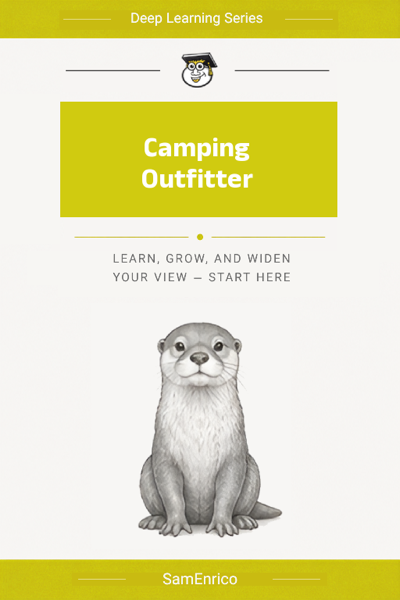
Camping Outfitter eBook
A Coursebook on Camping Outfitter
A Coursebook on Camping Outfitter
Formats
Free sample
Chapter 1: The Day Everything Changed...--–- The rain started at 4:17 PM. I remember the exact time because I had just checked my watch, calculating how many more miles we needed to cover before setting up camp. Six clients behind me—two of them children, ages nine and eleven—depended on every decision I made. At 4:18 PM, the trail turned to running water. At 4:22 PM, the first tree fell across our path two hundred yards ahead, dismantled by a microburst I should have seen coming.
At 4:31 PM, with lightning splitting the sky every three seconds, I realized something that would change my entire approach to the outdoors forever: I had no idea what I was doing.Not in the sense of incompetence. I had been camping for fifteen years. I owned the right gear. I had read the books—the thick ones with beautiful photographs of mountain lakes and perfectly arranged tents. I could tie a bowline in under ten seconds and start a fire with a single match in the rain.
I was, by any recreational measure, an expert.But in that moment, responsible for a panicked mother, a crying child, a father who kept asking "should we turn back?" with a tremor in his voice, and two seasoned backpackers who had quietly stopped trusting my leadership, I understood the gap between being a competent camper and being a competent outfitter. That gap is wider than the Grand Canyon. And almost nothing in the camping literature prepares you to cross it.This book exists because of that afternoon. It exists because for the next three hours, we huddled under a tarp I had pitched poorly, shivered through a cold front that dropped the temperature twenty-two degrees, and listened to thunder that sounded like artillery. We survived.
But survival is not the standard. Any idiot can survive with enough luck. The standard—the professional standard—is control. Not control over nature, which is a fool's errand. Control over systems.
Control over preparation. Control over the hundreds of small decisions that turn a potential disaster into an inconvenience.By the time you finish this book, you will understand the difference between a camper and an outfitter. More importantly, you will become the person your group looks to when everything goes wrong—not because you are fearless, but because you have a system.The Five Systems That Separate Amateurs from Outfitters Every camping failure I have ever witnessed—and I have witnessed dozens, from lost hikers to broken ankles to bear encounters that ended poorly—can be traced back to a failure in one of five systems. Not bad luck. Not the weather.
Not faulty equipment. A system failure.Let me be explicit about what I mean by a "system." A system is a repeatable process that produces reliable outcomes regardless of the specific circumstances. A checklist is a system. A decision tree is a system. A daily routine is a system.
Systems are the opposite of intuition. They work when you are tired, scared, hungry, or cold. Intuition does not.Here are the five systems that will form the backbone of this book and, if you internalize them, the backbone of your career as an outfitter:System One: The Planning System (Pre-Trip)Ninety percent of successful trips are planned before anyone puts on a backpack. The planning system includes route selection based on group ability, weather forecasting, permit acquisition, food calculation, gear auditing, and medical screening. Most recreational campers spend two hours planning a five-day trip.
A professional outfitter spends twenty hours. This difference is not about anxiety. It is about anticipating the two hundred things that could go wrong and having a pre-decision for each.In the opening story, my planning system failed because I had not built a true Risk Management Plan. I knew the weather forecast—scattered thunderstorms, typical for summer in the Rockies. But I had not identified my evacuation triggers (when do we turn back?
at what lightning frequency? at what creek depth?), my communication protocols (how do we call for help if phones fail?), or my client screening (did anyone have a heart condition? was anyone secretly terrified of lightning?). These are not details. These are the plan.System Two: The Gear System (Personal & Group)Recreational campers obsess over gear brands.
Professional outfitters obsess over gear systems. The difference is subtle but crucial. A brand is a label. A system is an interlocking set of tools designed to work together, with redundancies for failure modes, and a maintenance schedule that ensures everything functions when needed.Most campers own a sleeping bag rated for temperatures they will never encounter, a backpack that does not fit properly, and a stove they have never serviced. Most outfitters own gear they have tested, repaired, and used in conditions worse than they expect.
The gear system is not about spending more money. It is about spending more attention.System Three: The Safety System (Risk + First Aid)This is where the gap between recreational and professional camping becomes a chasm. A recreational camper carries a first aid kit purchased from a big box store. A professional outfitter carries a trauma kit they have assembled themselves, knows how to use every item in it, has practiced evacuation scenarios, and maintains current wilderness first responder certification.The safety system includes not just medical response but risk anticipation: weather reading, terrain assessment, group health monitoring, and environmental hazard identification. It includes decision trees for evacuation, communication protocols for emergencies, and a legal understanding of liability, waivers, and duty of care.In the opening story, my first aid kit was adequate for blisters and ibuprofen.
It was not adequate for a lightning strike, a panic attack, or a parent who slipped on wet rock and could not bear weight. That kit failure was a system failure.System Four: The People System (Leadership + Morale)Technical skills get you into the backcountry. People skills get you out. This is the most under-taught, under-practiced, and under-appreciated system in all of camping literature. The ability to read group morale, manage conflict, pace activities to different fitness levels, and communicate decisions under stress is more important than any knot you will ever tie.The people system includes situational leadership (when to tell, when to sell, when to participate, when to delegate), group development facilitation (forming, storming, norming, performing), and special population strategies (children, elderly, anxious beginners, veterans with PTSD, clients with dietary or mobility restrictions).In the opening story, my leadership failure was catastrophic.
I did not adapt my style to the group's rising panic. I kept telling them everything was fine when clearly it was not. I did not delegate tasks to calm the nervous father. I did not use humor or distraction to settle the crying child. I stood there, technically competent and interpersonally useless, while my group fell apart.System Five: The Recovery System (Post-Trip)The best outfitters learn more from each trip than their clients do.
The recovery system includes gear decommissioning (cleaning, drying, repairing, retiring), incident reporting (writing up what went wrong and why, for your own learning and for legal documentation), client feedback collection, and personal after-action review.Most campers throw their gear in a…
This is the end of the free sample. Get the eBook to keep going. Buy now
About this book
Details
- Author
- Parry Pricilla
- Publisher
- SamEnrico
- Language
- English
- Genre
- Non-Fiction, Informative, Educational
- Released
- 2026-05-09
- Pages (approx.)
- 150
- Available as
- eBook, Audiobook

Read better in the ZLOADR app
Your eBooks on your phone or tablet. Sign in with your SamEnrico account and start reading.
More by Parry Pricilla
 Bariatric Surgery Employment Rights HandbookParry Pricilla$11.99
 Heist Motive Beyond MoneyParry Pricilla$11.99
 LBO Tech Sector GuideParry Pricilla$11.99
 Working Capital Adjustments GuideParry Pricilla$11.99
 Gluten Free Budget Shopping GuideParry Pricilla$11.99
 The Diamond Heist: How a $500 Million Jewelry Sale Exposed the Dark Side of LuxuryParry Pricilla$11.99
 The Call That Split the World: How a Single Phone Call Redefined Global PoliticsParry Pricilla$11.99
 Understanding Catel–manzke SyndromeParry Pricilla$17.99
 How to Start a Potato Crisp Business (Beginners Guide)Parry Pricilla$11.99
 AI Financial Anomaly InvestigationParry Pricilla$12.99
 Preliminary Data Proposal SectionParry Pricilla$12.99
You may also like
 Hong Kong Handover 1997Dunn Johnnie$11.99
 Zumba For Postnatal Recovery CourseNeal Christian$11.99
 Zumba for BeginnersLadner Nikia$11.99
 YouTube Comment Mining GuideHumes Pandora$12.99
 Worry Box MeditationCarlin Rudy$11.99
 Workplace Stress MeditationNguyen Lynn$11.99
 Workplace Stress and Sleep RepairHawley Ivory$11.99
 Workplace Perfectionism CureDelaney Jeffry$11.99
 Workplace Injustice Anger GuideWallen Isabelle$11.99
 Work Addiction and Burnout LinkGreenwood Ester$11.99
 Women in Yoga and WellnessBeattie Galina$11.99
 Women in Stand Up ComedyChun Evangeline$11.99