
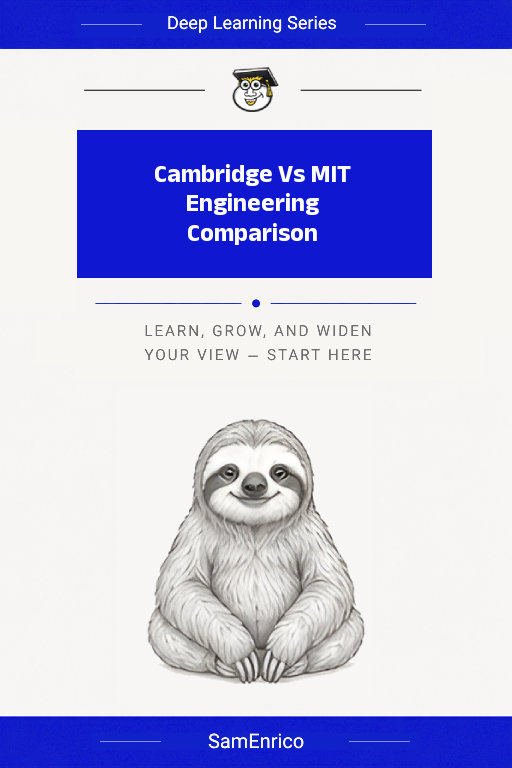
Cambridge Vs MIT Engineering Comparison eBook
Compare theoretical focus in UK vs hands on projec
Compare theoretical focus in UK vs hands on projects and research funding in US engineering.
Formats
Free sample
Chapter 1: The Two Students--The morning light filtered through the tall, arched windows of Cambridge's Engineering Department, illuminating chalk dust that floated like snow over a blackboard covered in partial differential equations. James Chen, a third-year undergraduate, stared at the board with something approaching affection. He had been working on this particular derivation for three hours, and the elegance of the solution was finally revealing itself—a perfect marriage of mathematics and physics that explained how heat would dissipate through a turbine blade. He hadn't touched a physical object in weeks. He didn't need to.
The equations contained everything that mattered.Three thousand miles away, in a basement lab at MIT's Building 35, Emily Rodriguez was bleeding.Not seriously. A soldering iron had slipped, and she had nicked her finger on a protruding wire. She sucked the wound absently while staring at the mess of wires, sensors, and circuit boards spread across her workbench. The autonomous delivery drone she was building for her 2.007 final project had failed three times that morning. The first failure was a power distribution issue.
The second was a software bug in the flight controller. The third—the third was a mystery, and it was driving her insane. She had been in the lab for nineteen hours. Her roommate had texted asking if she was still alive. She hadn't replied.She picked up her soldering iron and went back to work.Neither James nor Emily knew the other existed.
But their parallel journeys—one in the hallowed theoretical halls of Cambridge, the other in the chaotic maker spaces of MIT—represented two fundamentally different answers to the same question: What does it mean to be an engineer?This book is about those two answers.The Question Nobody Asks Until It's Too Late Every year, tens of thousands of bright, ambitious students apply to the world's top engineering programs. They pore over rankings, compare acceptance rates, calculate return on investment, and stress about campus culture. But almost none of them ask the question that matters most—not because they aren't smart, but because they don't know the question exists.The question is not: Which school is better?The question is: What kind of engineer do you want to become?This distinction seems subtle, but it is everything. The difference between Cambridge and MIT is not a difference in quality. Both institutions are exceptional.
Both produce graduates who go on to change the world. The difference is philosophical, pedagogical, and deeply personal. Cambridge trains engineers to think—to derive first principles, to model complex systems, to find elegance in abstraction. MIT trains engineers to make—to prototype, to iterate, to ship products that work in a messy, physical world.Neither approach is inherently superior. But choosing the wrong one for your brain, your goals, and your circumstances can be a disaster.Consider James.
By the time he finishes his Cambridge MEng, he will have completed thousands of derivation problems, written dozens of proofs, and spent countless hours in supervision sessions arguing about the mathematical foundations of fluid mechanics. He will have built almost nothing with his hands. His first industry job—at a quantitative hedge fund, as it happens—will value his ability to model complex systems under uncertainty. He will thrive.Consider Emily. By the time she finishes her MIT SB, she will have built a drone, a prosthetic device, a solar-powered water pump, and a robot that plays chess.
She will have struggled through courses where the only instruction was "make something that works." Her mathematical derivations will be sloppy by Cambridge standards, but her ability to take a vague requirement and deliver a functional prototype will make her invaluable at the hardware startup that hires her.Now consider the student who goes to Cambridge but wants to build hardware startups. Or the student who goes to MIT but dreams of becoming a theoretical physicist. Those students will survive—both schools are rigorous and prestigious—but they will fight the current every step of the way. They will spend their evenings teaching themselves what their institution de-emphasizes. They will graduate with gaps they must fill on their own.This book exists to prevent that mismatch.The Genesis of Two Philosophies To understand why Cambridge and MIT differ so dramatically, you must go back to their origins.
The seeds of their modern philosophies were planted centuries or decades apart, in response to very different industrial and cultural pressures.Cambridge: The Mathematical Tripos Legacy Cambridge University was founded in 1209, making it the second-oldest university in the English-speaking world. Its engineering department—formally established in 1875—emerged from a tradition that prized mathematics as the foundation of all scientific knowledge. That tradition was embodied in something called the Mathematical Tripos.The Tripos was, and in modified form still is, a brutal examination system. For generations, the top mathematics students at Cambridge competed in days-long exams that tested not just knowledge but endurance, creativity, and the ability to produce elegant proofs under extreme pressure. The legend of the "Senior Wrangler"—the student with the highest score—became part of Cambridge's cultural mythology.
To succeed in the Tripos was to prove that you possessed a first-rate mind, capable of grappling with the most abstract problems imaginable.When engineering was added to Cambridge's curriculum, it was inevitably shaped by this mathematical culture. Engineering was not seen as a trade or a craft. It was seen as applied mathematics—a field where the deepest insights came from equations, not from prototypes. The first engineering students at Cambridge spent most of their time in lecture halls and libraries, not in workshops. Theory came first.
Application was almost an afterthought.This orientation persists to this day. A Cambridge engineering student will take two full years of core mathematics and physical sciences before specializing. Courses with titles like "Mathematical Methods in Engineering" and "Continuum Mechanics" dominate the early curriculum. The assumption is that if you truly understand the mathematical principles underlying a physical system, you can solve any problem that system presents—even ones no one has encountered before.MIT: Mens et Manus The Massachusetts Institute of Technology was founded in 1861, on the eve of the American Civil War. Its mission was radically different from Cambridge's.
The Industrial Revolution was transforming the United States, and there was desperate need for engineers who could build things—factories, bridges, railroads, machines that worked reliably at scale. MIT was created to meet that need.Its founders adopted a motto: mens et manus—mind and hand. This was not a mere slogan. It was a declaration of war against purely theoretical education. MIT students were expected to spend as much time in workshops and laboratories as in lecture halls.
They learned by doing, by failing, by rebuilding. The goal was not to produce mathematicians who happened to know some engineering. It was to produce practitioners who could solve real problems in the real world.The philosophy was controversial. Elite opinion on the American East Coast tended to favor classical education—Greek, Latin, philosophy, pure mathematics—over practical training. MIT was dismissed by some as a "trade school for mechanics." But the Industrial Revolution did not care about elite opinion.
MIT's graduates were in high demand, and the institution grew rapidly.World War II transformed MIT into something even larger. The…
This is the end of the free sample. Get the eBook to keep going. Buy now
About this book
Details
- Author
- Logsdon Shayna
- Publisher
- SamEnrico
- Language
- English
- Genre
- Non-Fiction, Student's Shortcut
- Released
- 2026-05-28
- Pages (approx.)
- 154
- Available as
- eBook, Audiobook

Read better in the ZLOADR app
Your eBooks on your phone or tablet. Sign in with your SamEnrico account and start reading.
More by Logsdon Shayna
 The Interruption Log TemplateLogsdon Shayna$11.99
 Senior Spirituality EsteemLogsdon Shayna$11.99
 Loneliness Running Club GuideLogsdon Shayna$11.99
 Mental Health Day RequestLogsdon Shayna$11.99
 Jungian Recurring Dream GuideLogsdon Shayna$11.99
 Antwerp Heist Appeal ProcessLogsdon Shayna$11.99
 Eco Anxiety HypnosisLogsdon Shayna$11.99
 Preventing Sales BurnoutLogsdon Shayna$11.99
 Ovarian Cancer WhisperLogsdon Shayna$11.99
 The Last Waltz: The Queen Who Danced with DeathLogsdon Shayna$11.99
 The Silk Road's Digital Heist: How a Shadow Empire FellLogsdon Shayna$11.99
 The Lost Kingdom of Yap: Stone Money and Forgotten IslandsLogsdon Shayna$11.99
You may also like
 Hong Kong Handover 1997Dunn Johnnie$11.99
 Zumba For Postnatal Recovery CourseNeal Christian$11.99
 Zumba for BeginnersLadner Nikia$11.99
 YouTube Comment Mining GuideHumes Pandora$12.99
 Worry Box MeditationCarlin Rudy$11.99
 Workplace Stress MeditationNguyen Lynn$11.99
 Workplace Stress and Sleep RepairHawley Ivory$11.99
 Workplace Perfectionism CureDelaney Jeffry$11.99
 Workplace Injustice Anger GuideWallen Isabelle$11.99
 Work Addiction and Burnout LinkGreenwood Ester$11.99
 Women in Yoga and WellnessBeattie Galina$11.99
 Women in Stand Up ComedyChun Evangeline$11.99