
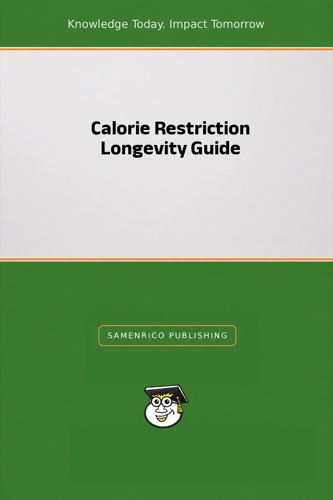
Non-FictionHealth & WellnessCalorie Restriction
Calorie Restriction Longevity Guide
Reduce daily calories by 10 20 percent without mal
by Cato Modesto
Reduce daily calories by 10 20 percent without malnutrition for lifespan extension.
Formats
About this book
Free sample
Chapter 1: The Longevity Paradox--–- On a warm June morning in 1934, a young Cornell University researcher named Clive Mc Cay made a decision that would echo through the next century of nutritional science. He took two groups of laboratory rats—genetically identical, housed in identical cages, breathing the same air—and fed them differently. One group ate freely, as rats had always eaten in the laboratory setting. The other group received one-third fewer calories, carefully measured to avoid any nutrient deficiency. The results were so astonishing that Mc Cay initially doubted his own records.
The calorie-restricted rats did not merely live longer. They aged differently. Their fur remained glossy while their well-fed littermates went grey. They maintained youthful activity levels while the control group slowed. They developed fewer spontaneous tumors, less kidney disease, and virtually none of the inflammatory conditions that claimed the well-fed rats.
By the time Mc Cay published his findings in 1935, he had documented that severe calorie restriction extended maximum lifespan by up to 40 percent. A rat that should have died at two years was still thriving at thirty months, the equivalent of a human living past 110 in robust health.–- Ninety years later, you are reading this book because that same fundamental observation has been confirmed across every species tested: yeast, worms, flies, fish, mice, rats, dogs, and non-human primates. Calorie restriction—reducing total energy intake while maintaining optimal nutrition—is the single most reproducible, evolutionarily conserved intervention for extending healthspan and lifespan in the laboratory. Yet for decades, the translation from rodent to human remained frustratingly elusive. Early enthusiasts attempted extreme 30-40 percent reductions, modeling the dramatic cuts used in the Mc Cay experiments.
They lost weight, yes. They also lost muscle, libido, and their enthusiasm for life. They were cold, irritable, and hungry. The side effects were not merely unpleasant; they were unsustainable. Most abandoned the practice within months, concluding that the price of longevity was simply too high.–- This book exists because the science has matured.
We now understand that extreme restriction is neither necessary nor desirable for human longevity. The sweet spot lies at a…
This is the end of the free sample. Get the eBook to keep going. Buy now
Contents
- Chapter 1
- Chapter 2
- Chapter 3
- Chapter 4
- Chapter 5
- Chapter 6
- Chapter 7
- Chapter 8
- Chapter 9
- Chapter 10
- Chapter 11
- Chapter 12
Details
- Author
- Cato Modesto
- Publisher
- SamEnrico
- Language
- English
- Genre
- Non-Fiction, Health & Wellness, Calorie Restriction
- Released
- 2026-06-08
- Pages (approx.)
- 156
- Available as
- eBook, Audiobook

Read better in the ZLOADR app
Your eBooks on your phone or tablet. Sign in with your SamEnrico account and start reading.
More by Cato Modesto
 Global Market Skills Migration GuideCato Modesto$11.99
 Social Anxiety for ExtrovertsCato Modesto$11.99
 Adoption Related Worthiness GuideCato Modesto$11.99
 Work Addiction Among Social WorkersCato Modesto$11.99
 The Last Pharaoh's Gambit: Cleopatra's Secret War of WitsCato Modesto$11.99
 How to Start a Chalets In Holiday Centres and Holiday Villages (provision of Short-stay Lodging In)Cato Modesto$11.99
 One Page Marketing Metrics GuideCato Modesto$12.99
 Self Storage Real Estate GuideCato Modesto$12.99
 Understanding Leiomyomatosis of Oesophagus Cataract HematuriaCato Modesto$17.99
You may also like
 Hong Kong Handover 1997Dunn Johnnie$11.99
 Zumba For Postnatal Recovery CourseNeal Christian$11.99
 Zumba for BeginnersLadner Nikia$11.99
 YouTube Comment Mining GuideHumes Pandora$12.99
 Worry Box MeditationCarlin Rudy$11.99
 Workplace Stress MeditationNguyen Lynn$11.99
 Workplace Stress and Sleep RepairHawley Ivory$11.99
 Workplace Perfectionism CureDelaney Jeffry$11.99
 Workplace Injustice Anger GuideWallen Isabelle$11.99
 Work Addiction and Burnout LinkGreenwood Ester$11.99
 Women in Yoga and WellnessBeattie Galina$11.99
 Women in Stand Up ComedyChun Evangeline$11.99