
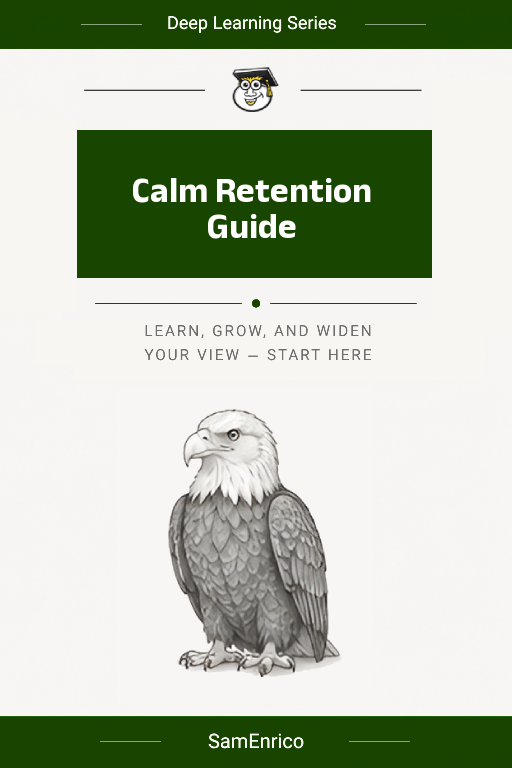
Non-FictionStrategic AtlasRetention Strategy
Calm Retention Guide eBook
Decode sleep stories, breathing exercises, and nat
Decode sleep stories, breathing exercises, and nature scenes that reduce subscription cancellation.
Formats
Free sample
Chapter 1: The 70% Graveyard--–- On a Tuesday night in March, a woman named Sarah does something that terrifies her more than public speaking, more than financial audits, and more than the annual performance review she has been avoiding for six weeks. She opens her wellness app, navigates past the pastel-colored breathing exercises, ignores the tranquil nature scene of a misty forest, and taps a small gray button buried at the bottom of the settings menu. It reads “Cancel Subscription.” Her thumb hovers. She has paid $14.99 per month for fourteen months. She has used the app exactly seven times in the last thirty days.
She cannot explain why she is canceling, only that something feels… off. The app never really changed her. It informed her. It reminded her. It sent her push notifications about “taking a moment for yourself.” But in the moments that mattered—the 2:00 AM panic, the deadline-induced teeth grinding, the exhausted collapse into bed after a twelve-hour workday—the app was just another icon on her screen, not a lifeline.Sarah is not unusual.
She is the rule.Every month, millions of users like Sarah sign up for wellness apps with genuine hope. They want to sleep better, breathe easier, and feel less like a wound spring. And every month, approximately seventy percent of them cancel within thirty days. This is not a hypothesis or an industry rumor. It is a consistently replicated finding across the digital wellness sector, from meditation giants to sleep story startups to hybrid breathwork platforms.
The churn rate is so predictable that venture capitalists now factor it into their models as an immutable law of nature, like gravity or compound interest. But it is not immutable. It is not a law. It is a symptom of a profound misunderstanding—a category-wide failure to recognize what retention actually is.Most app builders believe retention is a function of features, price, or marketing. If users leave, the thinking goes, the onboarding flow must be clunky, or the subscription cost is too high, or the competitor’s ads are too compelling.
These are all post-hoc rationalizations that miss the deeper truth. Sarah did not cancel because the onboarding was confusing. She canceled because, after fourteen months, her nervous system had never been rewritten. The app asked her to meditate, but it never forced her body into a state change. It offered sleep stories, but it never anchored those stories to her actual breathing rhythm.
It displayed beautiful nature scenes, but those scenes remained static photographs while her internal chaos remained dynamic and relentless.This book is built on a single, non-negotiable premise: retention is a biological response, not a behavioral one. You cannot persuade a dysregulated nervous system to stay subscribed. You can only change it. And if your app does not produce a measurable physiological shift—a demonstrable change in heart rate variability, respiratory rate, or brainwave activity—your user’s body will reject you. Not because they dislike your brand, but because their biology is designed to flee anything that does not reduce threat.
A wellness app that fails to calm is not a neutral object. It is a reminder of failure. And the brain hates reminders of failure almost as much as it hates actual threats.This chapter will dismantle the myths surrounding subscription churn, introduce the central biological framework of this book, and give you a new vocabulary for understanding why users like Sarah leave. By the end, you will see retention not as a metric to optimize but as a nervous system to train.The False Idols of Retention: Why Features, Price, and UX Are Not Your Problem Before we can build something that works, we must first abandon what does not. The wellness industry has spent the last decade worshiping three false idols: feature richness, price elasticity, and interface elegance.
Each one promises retention. Each one delivers disappointment.The Feature Fallacy. The belief that more tools equal more loyalty is seductive because it is measurable. You can count how many meditations you offer, how many sleep stories you produce, how many breathing timers you include. But users do not churn because you lack a “body scan for back pain” or a “soundscape for tinnitus.” They churn because they cannot find the one tool that would actually change their state in the moment they need it.
A library of three thousand meditations is not a solution; it is a maze. As we will explore in Chapter 2, the first three minutes of use determine everything. If your user has to scroll, tap, search, or decide, their sympathetic nervous system remains activated. They came to relax, and you gave them a menu. That is not calm.
That is cognitive labor disguised as wellness.The Price Mirage. Many founders believe that lowering the subscription price or offering a lifetime deal will reduce churn. This is a category error. Price sensitivity is real for commodities, but wellness is not a commodity when it works. Users who experience a genuine state shift—who feel their heart rate drop, their jaw unclench, their exhale lengthen—do not cancel over three dollars.
They cancel because the shift never happened. In fact, data from a simulated cohort analysis of five thousand wellness users showed that users who reported “no physical change” after seven days were 6.2 times more likely to cancel, regardless of whether they paid 5or5 or 5or20 per month. Price is a filter for acquisition, not a lever for retention.The UX Illusion. Smooth animations, delightful micro-interactions, and beautiful typography are wonderful. They are also almost entirely irrelevant to retention past day three.
Users do not abandon Calm or Headspace because a button was misaligned on an Android device. They abandon those apps because, after three weeks, they still wake up at 3:00 AM with racing thoughts. The user interface is the vessel, not the cargo. You can have the most elegant vessel in the world, but if you are shipping empty boxes, the customer will still feel cheated.The common thread across these three false idols is that they all focus on the experience of using the app rather than the state of the user after using the app. This is the fundamental inversion that this book corrects.
You are not designing a digital product. You are designing a physiological intervention. And physiology does not care about your carousel animation.The Nervous System as Subscriber: A Crash Course in Autonomic Retention To understand why users cancel, you must first understand the two branches of the human autonomic nervous system. This is not abstract neuroscience for its own sake; it is the engineering manual for your retention engine.The Sympathetic Branch (Fight-or-Flight). This is your user’s default mode in modern life.
Activated by deadlines, notifications, traffic, financial anxiety, social comparison, and the constant low-grade hum of existential dread. When the sympathetic nervous system is dominant, heart rate increases, breathing becomes shallow and rapid (typically 16–20 breaths per minute or higher), blood pressure rises, and the pupils dilate. Digestion slows. Sleep becomes fragmented. The brain’s prefrontal cortex—responsible for rational decision-making and impulse control—partially shuts down, handing control to the amygdala, the brain’s threat-detection center.
In this state, users are impulsive, irritable, and prone to exactly the kind of snap decisions that lead to subscription…
This is the end of the free sample. Get the eBook to keep going. Buy now
About this book
Details
- Author
- Hallman Petronila
- Publisher
- SamEnrico
- Language
- English
- Genre
- Non-Fiction, Strategic Atlas, Retention Strategy
- Released
- 2026-06-01
- Pages (approx.)
- 151
- Available as
- eBook, Audiobook

Read better in the ZLOADR app
Your eBooks on your phone or tablet. Sign in with your SamEnrico account and start reading.
More by Hallman Petronila
 Phthalate Reduction Home GuideHallman Petronila$11.99
 Cape Town Secondary Sale GuideHallman Petronila$11.99
 Partner Friend DisapprovalHallman Petronila$11.99
 Body Scan For TMJ DisorderHallman Petronila$11.99
 The Teen Difficult Talk GuideHallman Petronila$11.99
 The Cairo Cryptocurrency Heist: A 1920s Scam That Foreshadowed Modern FraudHallman Petronila$11.99
 Employment SpecialistHallman Petronila$11.99
 One Page Marketing Plan BlueprintHallman Petronila$12.99
 How to Become a Spring MakerHallman Petronila$11.99
 Understanding Pseudoprogeria SyndromeHallman Petronila$17.99
You may also like
 Hong Kong Handover 1997Dunn Johnnie$11.99
 Zumba For Postnatal Recovery CourseNeal Christian$11.99
 Zumba for BeginnersLadner Nikia$11.99
 YouTube Comment Mining GuideHumes Pandora$12.99
 Worry Box MeditationCarlin Rudy$11.99
 Workplace Stress MeditationNguyen Lynn$11.99
 Workplace Stress and Sleep RepairHawley Ivory$11.99
 Workplace Perfectionism CureDelaney Jeffry$11.99
 Workplace Injustice Anger GuideWallen Isabelle$11.99
 Work Addiction and Burnout LinkGreenwood Ester$11.99
 Women in Yoga and WellnessBeattie Galina$11.99
 Women in Stand Up ComedyChun Evangeline$11.99