
Non-FictionSelf-HelpConflict Resolution
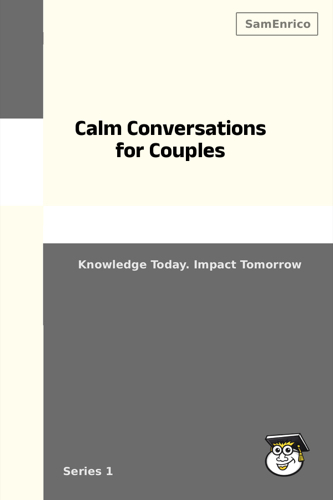
Calm Conversations for Couples eBook
Teaches de-escalation language and listening skill
by Greene Wendy
Teaches de-escalation language and listening skills for high-stress moments at home.
Formats
Free sample
Chapter 1: Your Racing Heart–- The argument started over the dishwasher. Not a broken dishwasher. Not a dirty dishwasher. A loaded dishwasher. Three plates, two bowls, four cups, a scattering of spoons.
Your partner loaded it last night but forgot to run it. You woke up to a sink full of coffee mugs and a machine full of clean-ish dishes that were, technically, still dirty because they hadn't been washed. You sighed. They heard the sigh from the bedroom. They came out defensive.
You felt your jaw tighten. They said, "What now?" You said, "Nothing." They said, "It's not nothing. You're sighing at me." You said, "I'm not sighing at you, I'm sighing at the dishwasher." They said, "So now the dishwasher is the problem?" And somewhere in the next ninety seconds, without either of you raising your voices above a normal speaking volume, you both felt it happen. The shift. The temperature drop.
The strange, sinking recognition that you were no longer talking about dishes. You were talking about respect. About effort. About who carries what. About whether you are seen or invisible in your own home.And here is the terrifying part: you cannot remember exactly how you got there.The dishwasher fight is a cliché for a reason.
It is not that couples are petty. It is that the dishwasher—the laundry, the trash, the unreturned text, the late arrival home—becomes a lightning rod for something much larger. But most couples never learn to see the lightning coming. They only feel the thunder after the fight has already detonated.This chapter is about the first three seconds. The three seconds before you speak.
The three seconds when your body decides whether you will have a calm conversation or a nuclear meltdown. Because here is the truth that no amount of "communication skills" will teach you: you cannot listen with a heart rate over 100 beats per minute. And your heart rate does not care about your intentions. It cares about survival.The Biology of Blowing Up Let us start with a question that sounds almost offensive in its simplicity: why do you keep having the same fight?Not different fights. The same fight.
The one about money that turns into the one about trust. The one about parenting that turns into the one about respect. The one about sex that turns into the one about rejection. You have had this fight forty times. Fifty times.
A hundred times. And each time, you swear you will handle it differently. Each time, you go in with good intentions. And each time, somewhere around minute two, you are saying something you regret while your partner says something they regret, and the night is ruined.The problem is not that you lack communication skills. The problem is that by the time you need those skills, your brain has already left the building.Here is what happens inside your body during the first three seconds of perceived threat.
Your amygdala—an almond-shaped cluster of neurons deep in your brain—acts as a smoke detector. It scans constantly for danger. When your partner sighs a certain way, uses a certain tone, or says a certain word that your brain has learned to associate with past pain, your amygdala sounds the alarm. In that instant, your hypothalamus activates your sympathetic nervous system. Your adrenal glands release epinephrine and norepinephrine.
Your heart rate spikes. Your breathing quickens. Your pupils dilate. Blood flows away from your digestive system and toward your large muscles. Your body is preparing to fight, flee, or freeze.This is the flooding response.
And it happens in less than one second.Here is what you lose the moment flooding begins. Your prefrontal cortex—the part of your brain responsible for logical reasoning, impulse control, empathy, and long-term planning—literally goes offline. Blood flow decreases to that region. Your brain prioritizes survival over relationship. You cannot access your "best self." You cannot access the communication techniques you read about in books or learned in therapy.
You cannot remember that you love this person. You are, for all practical purposes, a different creature.Dr. John Gottman, who spent four decades studying thousands of couples at the University of Washington, measured this phenomenon in his laboratory. He hooked couples up to heart rate monitors and asked them to discuss a point of conflict. The results were stark.
When a person's heart rate exceeded 100 beats per minute, they could not process information from their partner. They missed facial expressions. They misinterpreted tone. They could not recall what their partner had said thirty seconds earlier. And crucially, they could not self-regulate.
Once flooded, their behavior followed predictable patterns: criticism, defensiveness, contempt, stonewalling. Gottman called these the Four Horsemen of the Apocalypse for a reason. They predict divorce with over ninety percent accuracy.But here is what most people miss. Flooding does not require a loud argument. It does not require yelling.
It does not require any overt sign of conflict. A single sigh. A single word. A single glance. That is enough.Think about the last time you lost your temper over something small.
The dishwasher. The toothpaste cap. The misplaced keys. In retrospect, you knew it was small. In the moment, it felt enormous.
That is flooding. Your brain did not distinguish between a dirty dish and a physical threat. It processed both the same way.The Dirty Dish That Thinks It's a Tiger Evolution did not prepare you for marriage. Evolution prepared you for predators.Your ancient ancestors faced actual threats: saber-toothed tigers, rival tribes, starvation. When their amygdala sounded the alarm, the flooding response saved their lives.
Increased heart rate meant more oxygen to muscles. Dilated pupils meant better peripheral vision. Reduced prefrontal cortex activity meant faster reaction times. You did not need to think about whether to run from a tiger. You needed to run.The problem is that your body cannot tell the difference between a tiger and a dirty dish.To your amygdala, both are threats.
Both trigger the same cascade of stress hormones. Both shut down your prefrontal cortex. And both prepare you to fight, flee, or freeze. The only difference is that you cannot outrun your partner. You cannot fight a dirty dish.
And you cannot freeze your way to a solution.This mismatch between ancient biology and modern marriage is the source of nearly every escalated conflict. Your body thinks it is in a life-or-death situation. You are actually standing in your kitchen holding a coffee mug. But try telling that to your amygdala while your heart is pounding and your jaw is clenched. It does not listen.
It cannot listen. It is already offline.The philosopher and neuroscientist Antonio Damasio famously studied patients with damage to the part of the brain that processes emotion. These patients could describe logical solutions to problems perfectly. They could outline step-by-step plans. But they could not make decisions.
They could not act. Damasio concluded that emotion is not the enemy of reason. Emotion is the substrate of reason. You cannot make good decisions without feeling something first.This is true for conflict as well. You cannot have a calm conversation while your…
This is the end of the free sample. Get the eBook to keep going. Buy now
About this book
Details
- Author
- Greene Wendy
- Publisher
- SamEnrico
- Language
- English
- Genre
- Non-Fiction, Self-Help, Conflict Resolution
- Released
- 2026-06-07
- Pages (approx.)
- 134
- Available as
- eBook, Audiobook

Read better in the ZLOADR app
Your eBooks on your phone or tablet. Sign in with your SamEnrico account and start reading.
More by Greene Wendy
 F1 Rookie Mistakes GuideGreene Wendy$11.99
 DBT For Jealousy In RelationshipsGreene Wendy$11.99
 Assertiveness And Grief GuideGreene Wendy$11.99
 Large Family ImpactGreene Wendy$11.99
 Anger in Relationships WorkbookGreene Wendy$11.99
 South Asian Therapy Access GuideGreene Wendy$11.99
 Benzo Brain Fog RepairGreene Wendy$11.99
 The Tokyo Strangler: Japan's Postwar Serial Killer and the Birth of Victim AdvocacyGreene Wendy$11.99
 Whistlin' Dixie: The Ballad of the Midnight PlowmanGreene Wendy$11.99
 A Collector's Handbook to the Bristol 402Greene Wendy$11.99
 How to Produce Football Autographed ParaphernaliaGreene Wendy$11.99
 Stock Video Resolution and Quality StandardsGreene Wendy$12.99
You may also like
 Hong Kong Handover 1997Dunn Johnnie$11.99
 Zumba For Postnatal Recovery CourseNeal Christian$11.99
 Zumba for BeginnersLadner Nikia$11.99
 YouTube Comment Mining GuideHumes Pandora$12.99
 Worry Box MeditationCarlin Rudy$11.99
 Workplace Stress MeditationNguyen Lynn$11.99
 Workplace Stress and Sleep RepairHawley Ivory$11.99
 Workplace Perfectionism CureDelaney Jeffry$11.99
 Workplace Injustice Anger GuideWallen Isabelle$11.99
 Work Addiction and Burnout LinkGreenwood Ester$11.99
 Women in Yoga and WellnessBeattie Galina$11.99
 Women in Stand Up ComedyChun Evangeline$11.99