
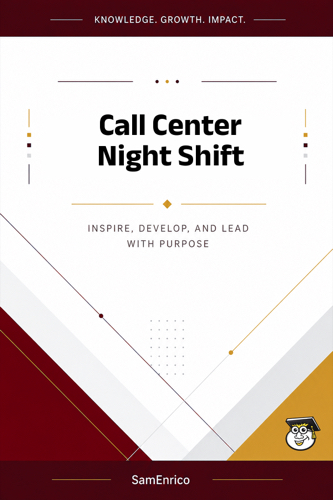
Non-FictionHealth & WellnessCall Center Health
Call Center Night Shift eBook
Sleep strategies for overnight customer service wo
by Gooch Shyla
Sleep strategies for overnight customer service workers.
Formats
Free sample
Chapter 1: The 8 AM Ceiling...--It is 8:47 AM. You have just finished a ten-hour night shift at a call center. Your eyes burn from staring at a screen. Your ears ring with the phantom echo of the last angry customer who called you every name in the book before slamming down the phone. Your lower back aches from the cheap ergonomic chair that your employer calls "standard issue" and you call a torture device.
You drive home in silence because even the radio feels like an assault on your exhausted nervous system. You walk through your front door, peel off your work clothes, brush your teeth, and lie down in a room you have carefully darkened with blackout curtains. You are exhausted. Truly, deeply, bone-tired exhausted. You close your eyes.And then nothing happens.You lie there, staring at the ceiling.
Your brain, which moments ago felt foggy and slow, now snaps awake like a rubber band. You start thinking about the call where the customer told you that you were "the dumbest person they had ever spoken to." You rehearse what you should have said. You check your phone. You get up to pee. You lie back down.
You check the time. It is now 9:30 AM. You have been trying to fall asleep for forty-three minutes. You think about the fact that you have to do this all over again tonight. Your chest tightens.
You feel a hot flash of frustration. You close your eyes harder, as if brute force could compel your brain to shut down. At 11:00 AM, you finally drift off. At 1:15 PM, a lawnmower starts up outside your window. You are awake again.
You lie there, staring at the ceiling, and you cry a little bit. Then you give up, get out of bed, and stumble through the rest of your day like a sleep-deprived zombie, only to do it all again in eight hours.If this scene feels familiar, you are not weak. You are not lazy. You are not broken. You are simply fighting a battle that your biology was never designed to win — and you have been using the wrong weapons.The Most Dangerous Lie You Have Been Told There is a pervasive, almost universal piece of advice given to night shift workers, and it goes something like this: "Just sleep during the day.
Get blackout curtains. You'll adjust." This advice is delivered by managers who have never worked a night shift in their lives, by family members who don't understand why you can't "just go to bed earlier," and by well-meaning articles that treat daytime sleep as a simple matter of discipline. It is, without exaggeration, one of the most destructive lies in the history of occupational health.Here is the truth: your body is not a machine that can be reprogrammed with a flip of a switch. It is a living ecosystem shaped by four billion years of evolution. For those four billion years, every single one of your ancestors — from the earliest single-celled organisms to your own parents — was awake during the day and asleep at night.
Sunlight meant activity, danger, food gathering, and social interaction. Darkness meant rest, repair, and safety from predators. This rhythm is not a suggestion. It is not a preference. It is etched into your DNA at the deepest possible level, governing the release of hormones, the fluctuation of your body temperature, the repair of your cells, and even the expression of your genes.This internal clock is called your circadian rhythm — from the Latin circa diem, meaning "about a day." It runs in the background of your consciousness, whether you acknowledge it or not.
And here is the thing about your circadian rhythm that most night shift advice ignores: it does not care about your work schedule. It does not care about your bills. It does not care that your manager scheduled you for the graveyard shift three weeks in a row. Your circadian rhythm is not a negotiator. It is a dictator.When you try to sleep during the day, you are not just asking your body to rest.
You are asking it to do something that goes against every evolutionary instruction it has ever received. You are asking your brain to release melatonin (the sleep hormone) when sunlight is telling it to produce cortisol (the alertness hormone). You are asking your core body temperature to drop (which is necessary for deep sleep) when your environment is warming up. You are asking your digestive system to shut down when it expects fuel. And you are asking all of this to happen while your upstairs neighbor decides that 10 AM is the perfect time to start using a hammer.The idea that you can simply "adjust" to daytime sleep with enough willpower is like saying you can learn to breathe underwater if you just try hard enough.
You might hold your breath for a minute or two. You might even develop some strategies to extend that time. But eventually, biology wins. Always.Why Call Center Workers Have It Worse Than Everyone Else Now, before you conclude that all night shift workers are doomed to a life of exhaustion, let me make a critical distinction. The advice that fails so spectacularly for call center workers actually works — marginally better — for other night shift professions.
A nurse working the night shift in a hospital walks eight to ten miles per shift. A truck driver is physically active, moving cargo, adjusting mirrors, staying alert through motion. A factory worker operates machinery that requires standing, lifting, and constant physical engagement. These professions have something that call center work does not: physical fatigue.Physical fatigue is remarkably good at promoting sleep. When your muscles are exhausted, when your body has expended real energy, the drive to sleep becomes stronger.
Your brain doesn't have to work as hard to shut down because your body is demanding rest. This is why a nurse can sometimes come home after a twelve-hour shift, shower, and fall asleep within minutes despite the circadian mismatch. Their body is genuinely spent.But you are not a nurse. You are not a truck driver. You are not a factory worker.
You are a call center agent. You sit in a chair for eight to ten hours. Your physical exertion is limited to typing, clicking a mouse, and occasionally reaching for a water bottle. Your exhaustion is not muscular — it is neurological and emotional. And neurological exhaustion does not respond to sleep the same way physical exhaustion does.Let me explain what is actually happening inside your brain during a call center shift.The Hidden Physiology of Phone-Based Exhaustion Every time that phone rings, your brain does something remarkable and terrible.
It prepares for a threat. Despite the fact that you are sitting in a climate-controlled office wearing a headset, your brain does not distinguish between a verbal attack from a customer and a physical attack from a predator. The same ancient threat-detection system — the amygdala — fires up. Your sympathetic nervous system activates. Cortisol floods your system.
Your heart rate increases. Your breathing becomes shallower. Your muscles tense. You are, biologically speaking, preparing to fight or flee.But you cannot fight.…
This is the end of the free sample. Get the eBook to keep going. Buy now
About this book
Details
- Author
- Gooch Shyla
- Publisher
- SamEnrico
- Language
- English
- Genre
- Non-Fiction, Health & Wellness, Call Center Health
- Released
- 2026-06-07
- Pages (approx.)
- 140
- Available as
- eBook, Audiobook

Read better in the ZLOADR app
Your eBooks on your phone or tablet. Sign in with your SamEnrico account and start reading.
More by Gooch Shyla
 Parenting With PurposeGooch Shyla$11.99
 Lung Cancer Screening and CessationGooch Shyla$11.99
 Design Thinking for Grant WritingGooch Shyla$11.99
 Radical Candor GuideGooch Shyla$11.99
 The Step Eight List GuideGooch Shyla$11.99
 Teen Parent Time ManagementGooch Shyla$11.99
 NVC Empathy Buddy SystemGooch Shyla$11.99
 The Siege of Perekop: The Cossacks' Last Stand Against the TsarGooch Shyla$11.99
 Rebuilding Paradise: The Social Media Architect Who Redesigned ChristchurchGooch Shyla$11.99
 A Collector's Handbook to the Hotchkiss Am2Gooch Shyla$11.99
 Academic Grading Scales DecodedGooch Shyla$12.99
 Portfolio Career for Semi RetirementGooch Shyla$12.99
You may also like
 Hong Kong Handover 1997Dunn Johnnie$11.99
 Zumba For Postnatal Recovery CourseNeal Christian$11.99
 Zumba for BeginnersLadner Nikia$11.99
 YouTube Comment Mining GuideHumes Pandora$12.99
 Worry Box MeditationCarlin Rudy$11.99
 Workplace Stress MeditationNguyen Lynn$11.99
 Workplace Stress and Sleep RepairHawley Ivory$11.99
 Workplace Perfectionism CureDelaney Jeffry$11.99
 Workplace Injustice Anger GuideWallen Isabelle$11.99
 Work Addiction and Burnout LinkGreenwood Ester$11.99
 Women in Yoga and WellnessBeattie Galina$11.99
 Women in Stand Up ComedyChun Evangeline$11.99