
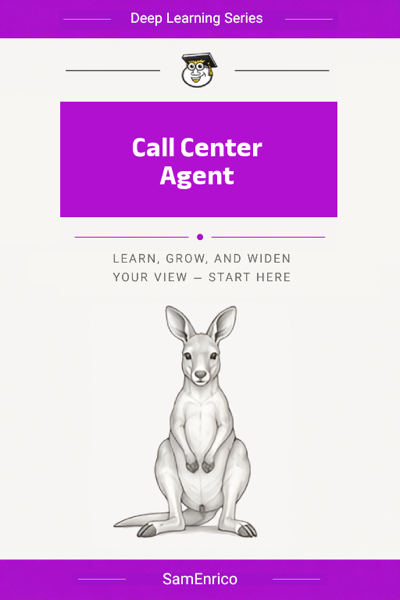
Non-FictionInformativeEducational
Call Center Agent eBook
A Coursebook on Call Center Agent
A Coursebook on Call Center Agent
Formats
Free sample
Chapter 1: The Thousand-Dollar Minute--–- Every time your phone chirps with an incoming call, you are holding a thousand-dollar bill that is on fire. Most agents never realize this. They answer, they solve, they hang up, and the money turns to ash without anyone noticing. But the best agents—the ones who get promoted, who get begged to stay, who get handwritten thank-you notes from customers—they understand a secret that most companies never teach: the first sixty seconds of any interaction determine not just customer satisfaction, but customer loyalty, repeat business, and your own career trajectory.This chapter exists to dismantle a lie. The lie is that your job as a call center agent is a cost to be minimized.
You have heard it in the way managers obsess over Average Handle Time. You have felt it in the way your software counts seconds. You have seen it in the way customers are described as “tickets” or “cases” or “interactions”—never as human beings. The lie whispers that you are replaceable, that your voice is interchangeable, that the only thing that matters is getting to the next call.The truth is the opposite.You are not a cost center. You are a revenue engine wearing a headset.
And the first sixty seconds of every call—the Thousand-Dollar Minute—is where you either ignite loyalty or extinguish it forever.The Myth of the Cost Center Let us begin with history. In the 1980s and 1990s, call centers were exactly what the name suggests: rooms full of people answering phones, reading scripts, and handling complaints. Companies viewed them as necessary evils—like insurance or legal compliance. You invested as little as possible, measured everything in seconds, and celebrated when customers hung up quickly because that meant you had spent less money on them.This philosophy produced metrics like Average Handle Time (AHT), which you will learn about in Chapter 8. AHT measures how long an agent spends on a call.
The shorter the better, according to the cost-center logic. Every second is a penny. Every minute is a dollar. Every hour is a loss.But here is what that logic misses: a customer who hangs up satisfied might come back. A customer who hangs up delighted might tell five friends.
A customer who hangs up angry might tell fifty friends—on social media, where their complaint lives forever. The cost-center model measures only the cost of the call, not the value of the relationship. It is like measuring a marriage by the cost of the wedding invitations.In the early 2000s, a company called Zappos decided to test this assumption. At the time, most shoe retailers treated customer service as a problem to be outsourced. Zappos did something radical: they moved their call center in-house, stopped measuring AHT, and told agents to stay on the phone as long as it took to make the customer happy.
One famous call lasted ten hours and twenty-nine minutes. Another agent sent flowers to a customer who had lost a family member. Another overnighted diapers to a stranded parent at eleven o’clock at night.You might assume that Zappos went bankrupt from all this generosity. Instead, they grew from zero to over a billion dollars in annual sales and were acquired by Amazon for $1.2 billion. Their founder, Tony Hsieh, wrote a book called Delivering Happiness that became a business classic.
His argument was simple: customer service is not a cost. It is the only marketing that remembers.Think about that for a moment. Advertising is a monologue. You shout at people and hope they listen. Customer service is a dialogue.
Someone has already bought from you, or tried to, or wanted to. They are on the line because they care enough to call. That phone ringing is not an interruption. It is a gift. It is a person saying, “I want to keep doing business with you, but something is in my way.
Help me remove it, and I will stay forever.”The Experience Economy and Your Role as Performer The lie of the cost center is not the only misconception this chapter will destroy. There is a second, more subtle misunderstanding: that your job is to solve problems. It is not. Your job is to stage a memorable experience.In 1999, business strategists Joseph Pine and James Gilmore published a book called The Experience Economy. Their argument changed how smart companies think about value.
They explained that there are four stages of economic value, and most businesses stop at the third stage while customers have already moved to the fourth.The first stage is commodities. Think of wheat, coal, or raw data. These are interchangeable. No one cares which coal mine produced the coal in their furnace.The second stage is goods. Think of shoes, phones, or chairs.
These are physical objects. You might prefer Nike over Adidas, but at the end of the day, both shoes cover your feet.The third stage is services. Think of haircuts, car repairs, or call center support. These are activities performed for you. You pay for someone to do something you do not want to do yourself.The fourth stage is experiences.
Think of concerts, vacations, or a meal at a restaurant that you remember for years. These are not things you consume. They are moments that happen to you. They become part of your identity. You tell stories about them.
You post photos. You recommend them without being asked.Here is the revelation for call center agents: every single call, chat, or email is an experience. And you are the performer. The customer is not calling to get a refund. They are calling to feel heard.
They are not calling to reset a password. They are calling to regain control over something that frightened them—the fear of being locked out of their own account. They are not calling to ask about billing. They are calling to feel that someone is on their side.When you understand this, everything changes. The problem on the screen is just the excuse for the call.
The real problem is always emotional. And emotions cannot be solved with a script. They must be performed.The First Sixty Seconds: What Actually Happens Let us slow down time and examine the Thousand-Dollar Minute under a microscope. You are an agent. Your phone rings.
You have between zero and three seconds to answer before the customer’s internal clock starts ticking. You say your greeting. The customer responds. And then, in the next forty-five to sixty seconds, your customer makes a series of unconscious decisions that determine whether they will trust you, whether they will believe you, and whether they will ever call again.Here is what the research says happens in that first minute.Seconds 0 to 5: The Answer. The customer hears your voice before they hear your words.
They are listening for warmth, energy, and competence. If you sound tired, they interpret that as disinterest. If you sound rushed, they interpret that as disrespect. If you sound robotic, they interpret that as indifference. You have not even said “Thank you for calling” yet, and they have already formed an opinion.Seconds 5 to 15…
This is the end of the free sample. Get the eBook to keep going. Buy now
About this book
Details
- Author
- Montalvo Tomasa
- Publisher
- SamEnrico
- Language
- English
- Genre
- Non-Fiction, Informative, Educational
- Released
- 2026-05-09
- Pages (approx.)
- 141
- Available as
- eBook, Audiobook

Read better in the ZLOADR app
Your eBooks on your phone or tablet. Sign in with your SamEnrico account and start reading.
More by Montalvo Tomasa
 Morning Mindfulness RitualMontalvo Tomasa$11.99
 The Complicated Grief JournalMontalvo Tomasa$11.99
 Gluten Digest SupplementMontalvo Tomasa$11.99
 The Blue Zone 80 Rule GuideMontalvo Tomasa$11.99
 Marketing Creative GuideMontalvo Tomasa$11.99
 Shapur the Victor: The Sassanian King Who Defied RomeMontalvo Tomasa$11.99
 Understanding Sternal Malformation Vascular Dysplasia AssociatioMontalvo Tomasa$17.99
 Procurement Data AnalyticsMontalvo Tomasa$12.99
 Spend Analysis AI ToolsMontalvo Tomasa$12.99
 How to Become a Sheeter OperatorMontalvo Tomasa$11.99
You may also like
 Hong Kong Handover 1997Dunn Johnnie$11.99
 Zumba For Postnatal Recovery CourseNeal Christian$11.99
 Zumba for BeginnersLadner Nikia$11.99
 YouTube Comment Mining GuideHumes Pandora$12.99
 Worry Box MeditationCarlin Rudy$11.99
 Workplace Stress MeditationNguyen Lynn$11.99
 Workplace Stress and Sleep RepairHawley Ivory$11.99
 Workplace Perfectionism CureDelaney Jeffry$11.99
 Workplace Injustice Anger GuideWallen Isabelle$11.99
 Work Addiction and Burnout LinkGreenwood Ester$11.99
 Women in Yoga and WellnessBeattie Galina$11.99
 Women in Stand Up ComedyChun Evangeline$11.99