
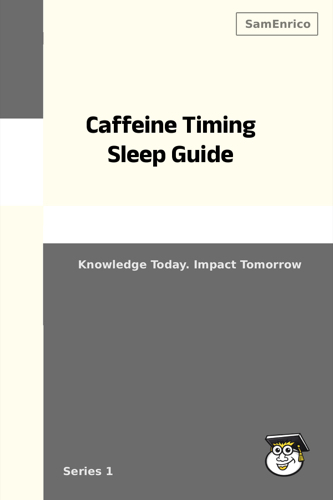
Caffeine Timing Sleep Guide eBook
Avoids afternoon memory harm.
Avoids afternoon memory harm.
Formats
Free sample
Chapter 1: The 3PM Stupids--It happens like clockwork, though you have probably never called it that.You are sitting at your desk around 3:47 in the afternoon. The morning was sharp. You answered emails, solved problems, remembered names. But now someone asks you a simple question—"What did we agree on in the 11 AM meeting?"—and your mind goes blank. Not nervous-blank.
Not tired-blank. A specific, hollow, frustrating emptiness where the memory should be. You know you knew it this morning. You know it is in there somewhere. But right now, at this exact hour, your brain refuses to retrieve it.You blame yourself.
You think: I did not sleep enough. I ate too many carbs at lunch. I am getting older. I am just not a "afternoon person."You are wrong about all of it.What you are experiencing is not a character flaw, a dietary mistake, or a sign of cognitive decline. It is a predictable, biology-driven phenomenon that has been measured in dozens of peer-reviewed studies.
Researchers call it the "circadian time-of-day effect on memory encoding." But you do not need the jargon. You need a name for the enemy.Let us call it the 3PM Stupids.And here is the first bombshell of this book: Your morning coffee is making it worse.Not by accident. Not because coffee is bad. But because you have been lied to by every caffeine habit you were ever taught. You drink coffee when your brain does not need it—and you skip it when your brain is begging for help.
The result is an afternoon memory collapse that feels inevitable but is entirely preventable. By the end of this chapter, you will understand why the 3PM Stupids happen, why 80 percent of people are vulnerable to it, and why your morning ritual is actively harming your ability to remember anything after lunch.Let us begin with the brain's dirty secret: it was not designed for the 2 PM meeting.The Clock You Never Knew You Had Every cell in your body contains a tiny molecular clock. These clocks are synchronized by a master pacemaker in your brain called the suprachiasmatic nucleus, a cluster of roughly 20,000 neurons located just above the optic nerve. This master clock does not care about your deadlines, your caffeine intake, or your willpower. It runs on a cycle of approximately 24 hours and 15 minutes, reset daily by morning sunlight.What most people do not realize is that this clock does not just control sleep and wakefulness.
It controls virtually every cognitive function, including memory. And memory, unlike simple alertness, follows a very specific and counterintuitive pattern.For the majority of people, memory encoding—the brain's ability to take new information and store it for later retrieval—peaks in the late morning and then crashes in the mid-to-late afternoon. This is not a linear decline. It is a cliff. One hour you are sharp.
The next hour you are not.A 2011 study published in the journal Psychological Science tested this directly. Researchers asked participants to memorize word pairs at different times of day, then tested recall later. The results showed that information learned in the afternoon was remembered significantly worse than information learned in the morning, even when participants reported feeling equally alert. The researchers concluded that memory encoding has its own circadian rhythm, independent of subjective alertness.This means you can feel wide awake at 3 PM and still have the memory of a goldfish.The problem is not tiredness. The problem is timing.Larks, Owls, and the 80 Percent Problem Here is where it gets personal.
Not everyone experiences the 3PM Stupids at the same time—or at all. Your chronotype, or your natural sleep-wake preference, determines when your memory cliff occurs.Morning Types, or Larks, wake early, peak in the late morning, and crash in the afternoon. Approximately 80 percent of the population falls into this category, though many do not know it because modern life forces everyone into the same schedule.Evening Types, or Owls, wake late, peak in the afternoon or early evening, and crash late at night. Only about 20 percent of people are true Owls, though the number increases among teenagers and young adults.Intermediate Types fall somewhere in between, with a smaller peak and a less dramatic cliff.If you are a Morning Type—and statistically, you probably are—your memory encoding ability follows this daily curve: sharp at 9 AM, excellent at 11 AM, beginning to fade at 1 PM, significantly impaired by 3 PM, and nearly useless by 5 PM. By dinner time, you could watch a documentary and remember almost nothing from it the next day.If you are an Evening Type, your curve is shifted roughly six hours later: useless at 9 AM, sharp at 3 PM, and excellent at 7 PM.
You have probably noticed that you do your best thinking after the office has emptied.The key insight—and the one that every other caffeine book gets wrong—is that caffeine only improves memory during your non-optimal time of day. During your optimal time, your brain is already firing on all cylinders, and caffeine adds nothing. During your non-optimal time, caffeine can rescue up to 30 percent of your lost memory function.This asymmetry is the foundation of everything that follows. If you are a Morning Type, your morning coffee is worthless for memory. Your afternoon coffee is a miracle.
And if you are an Evening Type, the opposite is true: your morning coffee is the rescue dose, and your evening coffee is useless.Most people have been drinking caffeine exactly backward for their entire lives.The Decaf Discovery The most convincing evidence for this asymmetry comes from a study that was not even designed to find it. Researchers at the University of Arizona were investigating the effects of caffeine on memory across the workday. They recruited healthy adults who were regular coffee drinkers and asked them to perform memory tests at three time points: 9 AM, 1 PM, and 4 PM.Half the participants drank their usual caffeinated coffee. The other half were secretly given decaf without their knowledge. The researchers told all participants they were drinking regular coffee.The results were shocking.
The decaf group showed a steady decline in memory performance from morning to afternoon. By 4 PM, their recall scores had dropped by nearly 30 percent relative to their 9 AM baseline. They felt fine—they reported normal alertness levels—but their memory was silently collapsing.The caffeinated group, in contrast, remained stable all day. Their 9 AM and 4 PM scores were virtually identical.Here is what makes this study so important: the caffeinated group did not improve their memory. They simply prevented the afternoon decline.
Their 4 PM memory was no better than their 9 AM memory. The decaf group got worse. The caffeine group stayed the same.This means that skipping afternoon caffeine does not just fail to help you. It actively harms you relative to your own morning baseline. If you drink coffee only in the morning—as most people do—you are protecting nothing.
By 4 PM, you are operating with a memory deficit that you do not even feel.The researchers calculated the magnitude of this effect as roughly 30 percent. A 30 percent drop in memory encoding means that for every…
This is the end of the free sample. Get the eBook to keep going. Buy now
About this book
Details
- Author
- Springer Douglass
- Publisher
- SamEnrico
- Language
- English
- Genre
- Non-Fiction, Self-Help, Caffeine
- Released
- 2026-06-07
- Pages (approx.)
- 138
- Available as
- eBook, Audiobook

Read better in the ZLOADR app
Your eBooks on your phone or tablet. Sign in with your SamEnrico account and start reading.
More by Springer Douglass
 The Nap Chair Selection GuideSpringer Douglass$11.99
 Small Talk Made Easy GuideSpringer Douglass$11.99
 Peer Review ProductivitySpringer Douglass$11.99
 Merger Integration CrisisSpringer Douglass$11.99
 Thyroid Success StoriesSpringer Douglass$11.99
 The Financial Visualization GuideSpringer Douglass$11.99
 Shopify Store ComparisonSpringer Douglass$11.99
 Jumia Pricing Strategy BriefSpringer Douglass$11.99
 The Siege of Colchester: Blood and Steel in a Divided KingdomSpringer Douglass$11.99
 The Great Emu War: When Birds Outsmarted SoldiersSpringer Douglass$11.99
 The Alchemist's Heart: Lavoisier and the Birth of Modern ChemistrySpringer Douglass$11.99
 The Mineral Guide to HarmotomeSpringer Douglass$11.99
You may also like
 Hong Kong Handover 1997Dunn Johnnie$11.99
 Zumba For Postnatal Recovery CourseNeal Christian$11.99
 Zumba for BeginnersLadner Nikia$11.99
 YouTube Comment Mining GuideHumes Pandora$12.99
 Worry Box MeditationCarlin Rudy$11.99
 Workplace Stress MeditationNguyen Lynn$11.99
 Workplace Stress and Sleep RepairHawley Ivory$11.99
 Workplace Perfectionism CureDelaney Jeffry$11.99
 Workplace Injustice Anger GuideWallen Isabelle$11.99
 Work Addiction and Burnout LinkGreenwood Ester$11.99
 Women in Yoga and WellnessBeattie Galina$11.99
 Women in Stand Up ComedyChun Evangeline$11.99