
Non-FictionMental WealthNutrition
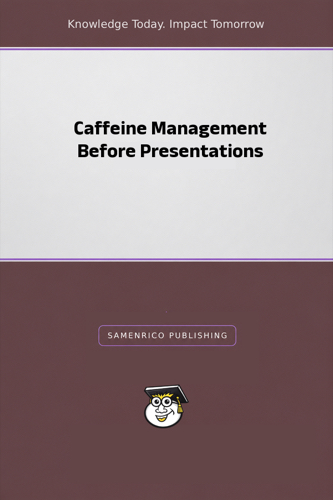
Caffeine Management Before Presentations eBook
Reduce coffee and energy drinks to prevent jitter
Reduce coffee and energy drinks to prevent jitter induced panic.
Formats
Free sample
Chapter 1: The 45-Minute Trap--– You are standing backstage. Your hands are trembling. Not the gentle tremor of nerves—the violent shake that makes your note cards rattle like a rattlesnake’s tail. Your heart is slamming against your ribs so hard you’re certain the audience can see your shirt moving. Your mouth feels like someone stuffed it with cotton balls an hour ago.
Your thoughts are racing so fast that you cannot catch a single one long enough to form a sentence. The person standing next to you whispers, “You’ve got this,” and you want to laugh, or cry, or both. Because you do not “have this.” You are one minute away from walking onto a stage, and your body is acting like you just stepped in front of a moving train.Here is the cruelest irony of all: you drank three cups of coffee this morning specifically to prevent this feeling. You thought caffeine would make you sharp. You thought it would make you alert.
You thought it would give you the energy to command the room. Instead, it has turned your own body into a traitor.This is the 45-Minute Trap.And until you understand it, every presentation you give will be a gamble with your own neurochemistry.The Story of Sarah Chen Let me tell you about Sarah Chen. Sarah was a regional sales director for a mid-sized software company. She had been in her role for six years. She knew her product better than anyone in the room.
She had closed deals worth millions of dollars over the phone, over email, and over lunch. But public speaking had always been her hidden fear.Not the kind of fear that stops you from doing the thing. Sarah did the thing. She said yes to every major presentation. She volunteered for the annual sales kickoff.
She never backed down. But every single time, twenty minutes before she walked on stage, the same ritual unfolded: three cups of coffee, consumed in a nervous rhythm, each cup supposedly giving her the “energy” to face the crowd.At the company’s biggest client conference of the year, Sarah was scheduled to deliver the keynote. A room of four hundred people. C-suite executives in the front row. A deal worth eight figures hanging on the outcome.
She woke up at 5:00 AM, had her first cup of coffee at 5:30. A second cup at 7:00 during her rehearsal. A third cup at 8:15, thirty minutes before her scheduled start time.At 8:45, she walked on stage.At 8:46, her hands began to shake.At 8:47, her voice cracked on the word “welcome.”At 8:48, she lost her place in her notes because her eyes were darting around the room in a panic, looking for an escape route her body was convinced she needed.At 8:49, she excused herself to get water. Her hands shook so badly she spilled half the glass on the podium.At 8:50, she looked at four hundred people and said, “I’m sorry, I can’t do this,” and walked off stage.Sarah did not lose the deal because she did not know her material. She did not lose the deal because she was unprepared.
She lost the deal because she drank three cups of coffee at the exact wrong time. Her competence was no match for her neurochemistry. And the worst part? She spent the next six months believing she had a panic disorder. She saw a therapist.
She considered medication. She almost quit her job. No one—not her doctor, not her therapist, not her well-meaning colleagues—asked her the one question that would have changed everything: “How much caffeine did you drink before you walked on stage?”Sarah’s story is not rare. It is not extreme. It is the rule, not the exception, for a certain kind of speaker.
You may see yourself in her. Or you may see your future self if you do not make a change.The Central Paradox: Fuel That Burns You Here is what caffeine actually does inside your body. Caffeine is a stimulant. That much everyone knows. But the word “stimulant” sounds helpful, does it not?
It sounds like something that wakes you up, that sharpens your senses, that prepares you for battle. And in many contexts, caffeine does exactly that. A long drive. A late night of studying. A morning workout.
These are situations where increased heart rate, heightened arousal, and delayed fatigue are assets.Public speaking is not one of those situations.Public speaking requires, above all else, control. Control of your voice. Control of your hands. Control of your pacing. Control of your breathing.
And most importantly, control of the gap between how you feel internally and how you appear externally. You can be terrified on the inside. The audience will never know—if your hands are steady, your voice is even, and your eyes are calm. But caffeine erases that gap. It takes the internal terror and makes it external.
It puts your panic on display for everyone to see.The paradox is this: you drink caffeine to feel more alert, but alertness is not the same as composure. Alertness is a private experience. Composure is a public one. Caffeine gives you the first and destroys the second.Think about the physical symptoms of a panic attack. Racing heart.
Sweaty palms. Shortness of breath. Trembling hands. Dry mouth. Now think about the physical effects of caffeine.
Racing heart. Sweaty palms. Shortness of breath. Trembling hands. Dry mouth.
They are the same list. Caffeine does not cause anxiety in the way a scary movie causes fear. Caffeine mimics the symptoms of a panic attack so precisely that your brain cannot tell the difference. And your brain, being a pattern-matching machine, assumes the worst: if my body feels like I am having a panic attack, I must be having a panic attack.This is not a metaphor. This is your biology.The Three Numbers That Will Save Your Career Before we go any further, I need you to write down three numbers.
Not in your head. On paper. Or in a note on your phone. Three numbers that will become the foundation of every presentation you give from this day forward.Number one: fifteen to twenty minutes.This is how long it takes for caffeine to enter your bloodstream and for you to feel its initial effects. That first sip of coffee?
You will notice a difference within a quarter of an hour. Your heart rate will tick up. Your alertness will increase. You will feel more awake. This is the onset of effects.
It is also the beginning of the trap.Number two: forty-five to sixty minutes.This is how long it takes for caffeine to reach its peak concentration in your blood. At the forty-five minute mark, the effects of that coffee are not just present. They are maximized. Your heart rate is as high as it is going to go. Your adrenaline is surging.
Your cortisol is elevated. This is the peak. And here is the thing about the peak: it is the worst possible moment to be standing on stage. Your jitters are not just bad at the peak. They…
This is the end of the free sample. Get the eBook to keep going. Buy now
About this book
Details
- Author
- Jameson Shirlene
- Publisher
- SamEnrico
- Language
- English
- Genre
- Non-Fiction, Mental Wealth, Nutrition
- Released
- 2026-06-11
- Pages (approx.)
- 133
- Available as
- eBook, Audiobook

Read better in the ZLOADR app
Your eBooks on your phone or tablet. Sign in with your SamEnrico account and start reading.
More by Jameson Shirlene
 Prioritization During CrisisJameson Shirlene$11.99
 Pandemic Parental Anger LegacyJameson Shirlene$11.99
 Patty Hearst Kidnapping SagaJameson Shirlene$11.99
 Meth Skin Recovery GuideJameson Shirlene$11.99
 The Last Broadcast: The Mysterious Final Transmission of S.O.S. TitanicJameson Shirlene$11.99
 The Last Stand of the Minoan Bull-LeapersJameson Shirlene$11.99
 Warehouse StackerJameson Shirlene$11.99
 Understanding Bone Dysplasia Azouz TypeJameson Shirlene$17.99
 How to Become a Insulation-power-unit TenderJameson Shirlene$11.99
 Kenyan Remote Team CommunicationJameson Shirlene$12.99
 Alibaba Order Protection ClaimsJameson Shirlene$12.99
You may also like
 Hong Kong Handover 1997Dunn Johnnie$11.99
 Zumba For Postnatal Recovery CourseNeal Christian$11.99
 Zumba for BeginnersLadner Nikia$11.99
 YouTube Comment Mining GuideHumes Pandora$12.99
 Worry Box MeditationCarlin Rudy$11.99
 Workplace Stress MeditationNguyen Lynn$11.99
 Workplace Stress and Sleep RepairHawley Ivory$11.99
 Workplace Perfectionism CureDelaney Jeffry$11.99
 Workplace Injustice Anger GuideWallen Isabelle$11.99
 Work Addiction and Burnout LinkGreenwood Ester$11.99
 Women in Yoga and WellnessBeattie Galina$11.99
 Women in Stand Up ComedyChun Evangeline$11.99