
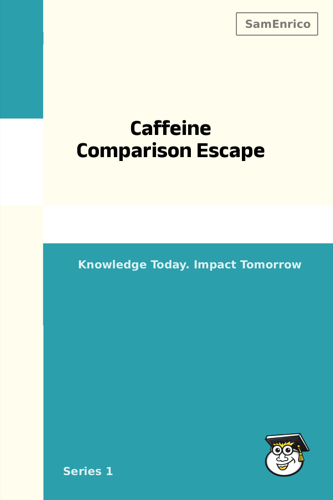
Caffeine Comparison Escape eBook
Reduces status anxiety in short-form video app.
by Morin Brinda
Reduces status anxiety in short-form video app.
Formats
Free sample
Chapter 1: The 11 PM Feeling--It is 11:00 PM. You are tired. The kind of tired that sits behind your eyes, a dull ache that says your body is ready for rest. You have brushed your teeth, changed into comfortable clothes, and perhaps even pulled back the covers. Tomorrow has its demands—a meeting, a deadline, a school run, an early alarm you already dread.
You tell yourself a small lie, the same lie you have told yourself a thousand times before: Just five minutes. Just to unwind. Then I will sleep.Forty-five minutes later, you put the phone down. Your thumb is sore. Your eyes are dry.
The room is dark, but your mind is not quiet. You are not relaxed. You are not informed. You are not entertained in any meaningful sense of that word. You are, quite simply, worse than you were before you picked up the device.
Anxious. Restless. Vaguely ashamed. You scroll through the last few minutes of your memory and find nothing you can name—no single video worth recalling, no insight gained, no laughter that lingers. But you can name the feeling.
It is a low, humming dread that sits in your chest like indigestion. Everyone is doing better than me.Someone got engaged. Someone bought a house. Someone your age just became a CEO. Someone lost twenty pounds.
Someone is traveling through a country you cannot pronounce. Someone has a morning routine so perfect that even their "messy" moments look like cinematography. Someone is happy in a way that seems effortless, and you are here, in the dark, holding a rectangle of glass and aluminum, feeling like a ghost watching a party you were never invited to.This is the 11 PM feeling. And if you are reading this book, you know it intimately.The Question Beneath the Feeling What is actually happening in that forty-five minutes? Not the surface-level explanation—not "I was scrolling" or "I was bored" or "I couldn't sleep." Those are descriptions of behavior, not explanations of cause.
The real question is deeper: Why does scrolling make us feel worse? Not tired—tired is fine. Not bored—boredom passes. But worse. Anxious.
Inadequate. As though something has been taken from you rather than added.Most people answer this question with character assessments. I am weak. I have no willpower. I am addicted.
I am lazy. I am jealous. I am a bad person. These are the stories we tell ourselves in the dark, and they are almost certainly wrong. Not because you are a paragon of virtue, but because these explanations ignore the machinery.
They mistake the user for the system. They blame the fish for not noticing the water.This entire book rests on a single proposition, and we will state it only once, here, at the beginning, so that we never have to repeat it: You are not weak. You are being manipulated. Not by a shadowy cabal of evil engineers rubbing their hands together in a dark room. That is a cartoon.
Manipulation in the twenty-first century is not malicious in the way we imagine. It is efficient. It is the optimization of engagement metrics. It is the natural outcome of a business model that converts your attention into revenue and your insecurity into time on screen. The people who designed the systems you interact with every day are not monsters.
They are engineers, product managers, and data scientists who are very good at their jobs. And their job is to keep you scrolling.Your job—if you choose to accept it—is to understand how they do it.The Caffeine Comparison Complex: A New Metaphor This book introduces a new way of thinking about short-form video apps. They are not just social media. They are not just entertainment. They are a Caffeine Comparison Complex—a stimulant for social insecurity.Consider caffeine.
A cup of coffee in the morning makes you feel alert, focused, capable. But if you drink coffee all day, every day, your baseline shifts. You need caffeine just to feel normal. Without it, you experience withdrawal: headache, fatigue, irritability. The substance has not made you stronger.
It has made you dependent. And the dependency masquerades as a benefit.Short-form video works the same way, but instead of stimulating your adenosine receptors (the biological target of caffeine), it stimulates two psychological systems simultaneously. The first is the dopamine reward system—the ancient neural circuitry that drives you toward unpredictable rewards. The second is the status anxiety system—the social fear that you are nobody in a world of somebodies. Together, they create a loop that is almost perfectly designed to keep you scrolling while eroding your sense of self.Let us examine each system separately, then watch how they combine.The Dopamine Injector: Why You Cannot Stop Swiping The first system comes from the work of Jonathan Haidt, whose book The Anxious Generation documented the catastrophic effects of phone-based social media on adolescent mental health.
Haidt describes the smartphone as a "dopamine injector"—a device that delivers small, unpredictable hits of the neurotransmitter associated with reward, motivation, and craving.Here is how it works. When you swipe to the next video, you do not know what you will see. It might be funny. It might be beautiful. It might be shocking.
It might be boring. That uncertainty is the key. The brain's reward system is far more sensitive to unpredictable rewards than to predictable ones. A slot machine that pays out every third pull is boring. A slot machine that pays out randomly—sometimes after one pull, sometimes after fifty, sometimes not at all—is addictive.
This is called a variable-ratio reinforcement schedule, and it is the most powerful behavioral conditioning mechanism known to psychology.Short-form video apps are slot machines. Each swipe is a pull of the lever. Most pulls deliver nothing memorable. But every so often, one delivers a video so perfectly tailored to your interests, your humor, or your insecurities that you feel a jolt of pleasure or recognition. Your brain releases a small burst of dopamine.
Not the dopamine of enjoyment—that is a common misconception. Dopamine is not the pleasure molecule. It is the motivation molecule. It says: Do that again. The next one might be even better.And so you swipe again.
And again. And again.This is not a failure of will. It is a feature of your nervous system, exploited with exquisite precision by algorithms that have learned, over billions of swipes, exactly how to keep you engaged. The app does not need to know what you like. It only needs to know that you like something, and then find more of it, slightly different, just enough to keep the uncertainty alive.But dopamine alone does not explain the 11 PM feeling.
Dopamine explains why you keep scrolling. It does not explain why you feel worse after scrolling. For that, we need the second system.Status Anxiety: The Fear of Being Nobody The second system comes from the philosopher Alain de Botton, whose book Status Anxiety diagnosed a peculiarly modern form of suffering. De Botton argues that humans have always cared about status—our place in the social hierarchy—because status was a…
This is the end of the free sample. Get the eBook to keep going. Buy now
About this book
Details
- Author
- Morin Brinda
- Publisher
- SamEnrico
- Language
- English
- Genre
- Non-Fiction, Self-Help
- Released
- 2026-06-06
- Pages (approx.)
- 122
- Available as
- eBook, Audiobook

Read better in the ZLOADR app
Your eBooks on your phone or tablet. Sign in with your SamEnrico account and start reading.
More by Morin Brinda
 Disability Benefits for MDDMorin Brinda$11.99
 Omega 3 Insulin Resistance GuideMorin Brinda$11.99
 The Cancer Fundraising Fraud GuideMorin Brinda$11.99
 The Last Whisper of the Bees: Decoding the Ancient Maya Apiculture SecretsMorin Brinda$11.99
 Learn to Play the InciMorin Brinda$11.99
 Clinical Project ManagerMorin Brinda$11.99
 How to Become a Pony EdgerMorin Brinda$11.99
 Community Radio GuideMorin Brinda$12.99
You may also like
 Hong Kong Handover 1997Dunn Johnnie$11.99
 Zumba For Postnatal Recovery CourseNeal Christian$11.99
 Zumba for BeginnersLadner Nikia$11.99
 YouTube Comment Mining GuideHumes Pandora$12.99
 Worry Box MeditationCarlin Rudy$11.99
 Workplace Stress MeditationNguyen Lynn$11.99
 Workplace Stress and Sleep RepairHawley Ivory$11.99
 Workplace Perfectionism CureDelaney Jeffry$11.99
 Workplace Injustice Anger GuideWallen Isabelle$11.99
 Work Addiction and Burnout LinkGreenwood Ester$11.99
 Women in Yoga and WellnessBeattie Galina$11.99
 Women in Stand Up ComedyChun Evangeline$11.99