
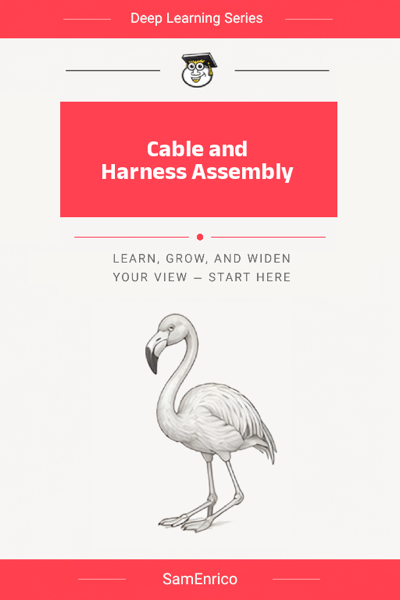
Non-FictionInformativeEducational
Cable and Harness Assembly eBook
A Coursebook on Cable and Harness Assembly
A Coursebook on Cable and Harness Assembly
Formats
Free sample
Chapter 1: The Seven Billion Dollar Nick--The most expensive wire in the world is not made of gold, platinum, or any exotic alloy. It is an ordinary copper wire, twenty-two American Wire Gauge, stripped with a dull blade that left a nick fifteen percent of the way through the conductor. That wire was installed in a commercial airliner’s fuel quantity indicating system. After eighteen months of vibration, the nick grew into a crack. The crack became a break.
The break caused an intermittent open that showed itself only when the wings flexed during takeoff. The pilots saw fuel readings that jumped from full to empty and back again. They rejected the takeoff at 120 knots. The subsequent investigation found not one but seventeen similar nicks in the same harness, each one a potential disaster waiting to happen.That particular wire did not start a fire. It did not crash an airplane.
But it cost the airline $2.3 million in canceled flights, inspections, rework, and lost passenger revenue. All from a nick smaller than the width of a human hair.This chapter exists because of that nick. It exists because the difference between a reliable harness and a future failure is measured in microscopic margins that most people never see. And it exists because cable and harness assembly is one of the few manufacturing disciplines where a single mistake can remain hidden for years before revealing itself at the worst possible moment.The Scale of the Problem The global wire harness market is worth approximately $70 billion annually. That number includes everything from the simple two-wire connector in your toaster to the massive bundles of over one thousand wires found in a modern airliner.
Each year, manufacturers around the world produce and install enough harnesses to circle the planet dozens of times. And each year, a percentage of those harnesses fail.The best available data, drawn from warranty claims and field failure analysis across automotive, aerospace, industrial, and consumer sectors, suggests that between three and six percent of electrical failures originate in harnesses or their terminations. That percentage sounds small until you apply it to the billions of connections made each year. In absolute terms, hundreds of thousands of harnesses fail annually.Some of those failures are nuisances. A car’s window stops working.
A washing machine displays an error code. A television’s backlight flickers. But many failures are catastrophic. The National Fire Protection Association attributes approximately fifteen percent of electrical fires in commercial buildings to wiring and harness failures. The Federal Aviation Administration tracks wiring-related incidents as a specific category, and their data shows that electrical system malfunctions remain among the top ten causes of in-flight diversions and aborted takeoffs.The automotive industry publishes no single aggregated failure statistic, but conversations with quality managers at three major manufacturers revealed a consistent pattern: roughly one percent of all warranty claims relate directly to harness assembly defects.
That number multiplies across millions of vehicles into billions of dollars in recalls, repairs, and reputation damage.Behind each of these statistics is a specific failure mechanism. A crimp that looked perfect but pulled out at six pounds instead of the required twelve. A solder joint that passed visual inspection but was cold, its crystalline structure ready to crack under the first thermal cycle. A stripped wire whose nicked conductor would flex exactly four hundred twenty-seven times before snapping. A shield termination whose pigtail turned a shielded cable into an antenna radiating noise throughout a sensitive analog system.This book is the antidote to each of those failures.Who This Chapter Is For If you have opened this book, you belong to one of several tribes.
It is worth identifying which one, because each tribe brings different assumptions and needs different emphasis.The first tribe is the professional harness builder. You work in a shop that produces harnesses for aerospace, defense, automotive, medical, or industrial customers. You may be new to the field, having come from general electronics or mechanical assembly. Or you may be experienced but seeking formal certification. For you, this chapter and those that follow serve as both a foundation and a reference.
You need to know not just how to perform a task but why the task matters, what standards apply, and how to document your work for audit compliance.The second tribe is the engineer, designer, or quality professional who specifies, reviews, or inspects harnesses but does not build them daily. You design the From-To list, select the connectors, or audit the assembly process. For you, understanding the physical realities of wire preparation, crimping, and bundling is essential to creating designs that can actually be built reliably. The most beautiful CAD model in the world means nothing if a technician cannot physically access a connector pin or if the specified wire gauge is too large for the terminal.The third tribe is the serious hobbyist, the maker, the electric vehicle converter, the drone racer, the home solar installer. You are not bound by IPC certifications or aerospace standards.
But you care about reliability because your projects matter to you. A failed harness on a racing drone means a crashed two-thousand-dollar camera payload. A failed harness on an EV conversion means pushing a non-running car across a busy intersection. A failed harness on a solar installation means a fire risk concealed inside a wall. For you, this book provides professional-grade knowledge without the overhead of production-scale requirements that do not apply.The fourth tribe is the student.
You are enrolled in a community college or technical school program in electrical technology, industrial maintenance, or avionics. You need to pass the IPC/WHMA-A-620 certification exam and demonstrate hands-on competence to future employers. This book was designed with your curriculum in mind. Each chapter maps to specific learning objectives and skill requirements.Identify your tribe now, because the way you use this book will differ. Professionals and students should read sequentially, mastering foundation before technique.
Engineers may skip ahead to the design and documentation chapters but should return to the fabrication chapters to understand why their specifications matter. Hobbyists should treat the certification-focused sections as optional extras but pay close attention to the failure forensics and testing chapters, which are where home-built harnesses most often go wrong.The Three Tiers of Assembly Quality Before assembling a single wire, you must understand a concept that will appear throughout this book: the three tiers of assembly quality. Every harness belongs to one of these tiers, whether the builder intended it or not. Understanding the tiers allows you to make conscious choices about what level of reliability you need and what effort you must invest to achieve it.Tier One: Household and Consumer The lowest tier, but not necessarily bad. A Tier One harness is acceptable for applications where failure has low consequences.
A lamp in a living room. A holiday light string. A small appliance that sits stationary on a counter. In Tier One, wire nuts are acceptable. Electrical tape is acceptable.
Plier-style crimp tools are common. Solder joints may be rough but functional. The standards are implicit, not documented. A Tier One harness should not fail under normal use, but it is not designed to survive…
This is the end of the free sample. Get the eBook to keep going. Buy now
About this book
Details
- Author
- Lebron Timika
- Publisher
- SamEnrico
- Language
- English
- Genre
- Non-Fiction, Informative, Educational
- Released
- 2026-05-06
- Pages (approx.)
- 141
- Available as
- eBook, Audiobook

Read better in the ZLOADR app
Your eBooks on your phone or tablet. Sign in with your SamEnrico account and start reading.
More by Lebron Timika
 Cognitive Restructuring for DepressionLebron Timika$11.99
 Step One Admission of PowerlessnessLebron Timika$11.99
 Ransom Note To Patsy ComparisonLebron Timika$11.99
 Parenting Without AlcoholLebron Timika$11.99
 The Cape Town Fire Conspiracy: A 19th-Century Arson for RansomLebron Timika$11.99
 How to Start a Caravans (touring) Rental Business (Beginners Guide)Lebron Timika$11.99
 Learn to Play the DulcianLebron Timika$11.99
 Equity for Investor FoundersLebron Timika$12.99
You may also like
 Hong Kong Handover 1997Dunn Johnnie$11.99
 Zumba For Postnatal Recovery CourseNeal Christian$11.99
 Zumba for BeginnersLadner Nikia$11.99
 YouTube Comment Mining GuideHumes Pandora$12.99
 Worry Box MeditationCarlin Rudy$11.99
 Workplace Stress MeditationNguyen Lynn$11.99
 Workplace Stress and Sleep RepairHawley Ivory$11.99
 Workplace Perfectionism CureDelaney Jeffry$11.99
 Workplace Injustice Anger GuideWallen Isabelle$11.99
 Work Addiction and Burnout LinkGreenwood Ester$11.99
 Women in Yoga and WellnessBeattie Galina$11.99
 Women in Stand Up ComedyChun Evangeline$11.99