
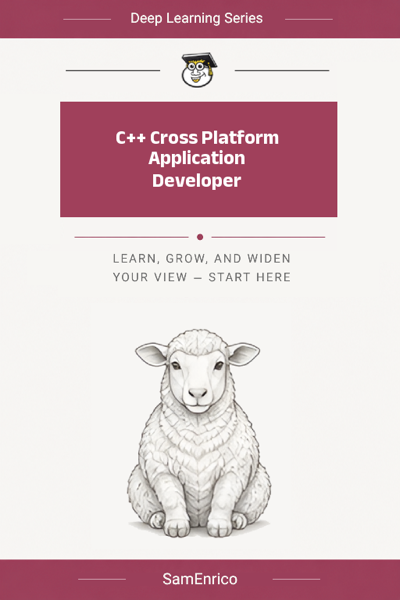
Non-FictionInformativeEducational
C++ Cross Platform Application Developer eBook
A Coursebook on C++ Cross Platform Application Dev
by Chan Karan
A Coursebook on C++ Cross Platform Application Developer
Formats
Free sample
Chapter 1: The Policy Paradox–- On a Tuesday morning in March 2022, a senior engineer named Elena watched her team’s sixteen-week project implode in under four hours. The application—a real-time trading dashboard for a mid-sized hedge fund—had run flawlessly on every Windows machine in the office for three straight months. The client’s due diligence team, however, ran Linux. At 9:47 AM, Elena’s phone buzzed with a screenshot: a terminal window filled with file not found errors, followed by a segmentation fault. The application had crashed before it could even authenticate a user.The root cause took six developers and two full days to isolate. Somewhere in the codebase, a junior engineer had written a file path as Config/Settings.ini instead of config/settings.ini. On Windows, where the file system is case-insensitive, the code worked perfectly. On Linux, where Config and config are entirely different directories, the file simply did not exist. The crash was clean, immediate, and entirely preventable. The client walked away. The startup lost $1.2 million in projected annual recurring revenue.The post-mortem revealed something uncomfortable: every single developer on the team knew, in theory, that Linux was case-sensitive. Each of them had said “we should test on Linux” at least once during the project. But no policy required it. No automated check enforced it. No ticket system demanded it. The knowledge existed, but the discipline did not.This book exists to ensure that never happens to you.The Great Misconception: Portability Is Not a Technical Problem For twenty years, the software industry has treated cross-platform development as a technical challenge. The argument goes something like this: if we just find the right abstraction layer, the right build system, the right set of compiler flags, then our code will run anywhere. Engineers chase the mythical “write once, compile anywhere” silver bullet, convinced that the perfect tool exists just over the horizon.It does not.The deepest truth of cross-platform development—the one that separates successful teams from failed ones—is brutally simple: portability is a management problem disguised as a technical problem. You can have the cleanest OS abstraction layer in the world (and Chapter 5 will teach you how to build one), but without policies that enforce its use, developers will bypass it. You can have a gorgeous CMake configuration (Chapter 2 and 3 will make you a master), but without a mandate to build on all platforms before merging, that configuration becomes documentation rather than discipline.Elena’s team had the technical knowledge. What they lacked was what this chapter calls the Policy Paradox: the uncomfortable reality that adding process feels slow and bureaucratic in the short term, but chaos without process is infinitely slower. Teams that embrace portability policies early ship faster in the long run. Teams that reject policies in the name of “agility” discover too late that they have built a house of cards.The Cost of “We’ll Do It Later”Before we build solutions, we must fully understand the problem. Let me be precise about what happens when a team postpones cross-platform policies.Phase One: The Happy Path (Weeks 1-4) – The team builds exclusively on the primary platform, typically Windows or mac OS. Code compiles quickly. Features ship rapidly. Managers are happy. Developers feel productive. A quiet assumption takes root: “We’ll port it later.”Phase Two: The First Port (Weeks 5-8) – Someone attempts to compile on the secondary platform. The build fails immediately, often with hundreds of errors. Most are trivial: case sensitivity, path separators, missing POSIX equivalents of Windows APIs. The team fixes these and declares victory.Phase Three: The Invisible Rot (Weeks 9-12) – New features continue to be developed and tested only on the primary platform. Every few weeks, someone runs a build on the secondary platform and fixes the newly introduced breaks. The team develops a rhythm: break, discover, fix, repeat. The cost of porting each feature doubles because it is never tested at development time.Phase Four: The Inevitable Fracture (Week 13 onward) – A feature lands that depends deeply on a platform-specific API that has no direct equivalent elsewhere. The team faces a choice: rewrite the feature from scratch for the secondary platform, or declare that feature “Windows only.” Scope creep multiplies. Technical debt accumulates. The team begins to whisper about splitting the codebase into platform-specific forks.I have watched this exact sequence play out at five different companies, ranging from three-person startups to engineering teams of over two hundred. The pattern is so consistent that it might as well be a law of software development: without policies enforced from day one, cross-platform codebases inevitably decay into platform-specific messes.The solution is not more technical brilliance. The solution is adopting a small set of enforceable, lightweight policies that make portability automatic rather than aspirational.Policy One: The First-Class Citizen Rule The most damaging habit in cross-platform development is the designation of a “primary” platform. Teams almost always intend for all platforms to be equal, but human nature—and the convenience of a single development environment—conspires against them. The developer who works on Windows will inevitably write Windows-isms. The developer who loves mac OS will accidentally rely on Cocoa behaviors.The First-Class Citizen Rule is absolute: at the beginning of every project, list every platform you intend to support. Remove the phrase “primary platform” from your vocabulary. All supported platforms are first-class citizens from day zero.What does this look like in practice? It means that when you write a new feature, you do not consider it “done” until it has been compiled and passed a smoke test on all supported platforms. It means that your definition of “working software” is intersectional: a feature works when it works everywhere, not when it works on your machine.Consider two teams building the same application. Team A designates Windows as primary, planning to port to Linux and mac OS “later.” Team B treats all three platforms as equal from the first commit. Here is what their timelines actually look like:Team A (Primary/Secondary Model):Month 1-2: Windows-only development. Feature velocity high.Month 3: First Linux port. Discover 40 breaking issues. Spend 3 weeks fixing.Month 4: First mac OS port. Discover 25 new issues (some overlapping, some unique).Month 5: Windows feature work continues, breaking Linux/mac OS again.Month 6: The team spends 50% of its time fixing portability breaks.Cumulative feature output (6 months): 60% of planned features, heavily Windows-optimized.Team B (All First-Class):Month 1-2: Develop on all three platforms simultaneously. Each feature is tested on all platforms before merge. Initial velocity is approximately 70% of Team A’s.Month 3-4: Velocity increases as patterns become routine. Portability breaks are caught within hours, not weeks.Month 5-6: Velocity matches or exceeds Team A’s Windows-only pace, but every feature works everywhere.Cumulative feature output (6 months): 90% of planned features, fully portable.The numbers tell a clear story: the “slower” approach of testing everywhere from the beginning produces more working software in less calendar time after the two-month mark. The break-even point is consistently between weeks 8 and 10. After that, the team that invested in policies pulls ahead and never looks back.Policy Two: The Pre-Commit Compilation Mandate The most powerful technical policy you can implement requires no changes to your code at all. It simply requires that before any code is merged into your main branch, it must compile successfully on all target platforms.Modern…
This is the end of the free sample. Get the eBook to keep going. Buy now
About this book
Details
- Author
- Chan Karan
- Publisher
- SamEnrico
- Language
- English
- Genre
- Non-Fiction, Informative, Educational
- Released
- 2026-05-04
- Pages (approx.)
- 141
- Available as
- eBook, Audiobook

Read better in the ZLOADR app
Your eBooks on your phone or tablet. Sign in with your SamEnrico account and start reading.
More by Chan Karan
 Mindfulness for Stress WorkbookChan Karan$11.99
 Food Intolerance and EosinophilicChan Karan$11.99
 The Blue Zone Moderate DrinkingChan Karan$11.99
 The Prolonged Grief Disorder GuideChan Karan$11.99
 Process Improvement CreativityChan Karan$11.99
 Gold & Ghosts: The Rothschilds' Secret War in the Napoleonic WarsChan Karan$11.99
 How to Start a Pet Scanners Business (Beginners Guide)Chan Karan$11.99
 Early Payment Discount CaptureChan Karan$12.99
 Anomaly Detection AccountingChan Karan$12.99
 Understanding Sternal CleftChan Karan$17.99
You may also like
 Hong Kong Handover 1997Dunn Johnnie$11.99
 Zumba For Postnatal Recovery CourseNeal Christian$11.99
 Zumba for BeginnersLadner Nikia$11.99
 YouTube Comment Mining GuideHumes Pandora$12.99
 Worry Box MeditationCarlin Rudy$11.99
 Workplace Stress MeditationNguyen Lynn$11.99
 Workplace Stress and Sleep RepairHawley Ivory$11.99
 Workplace Perfectionism CureDelaney Jeffry$11.99
 Workplace Injustice Anger GuideWallen Isabelle$11.99
 Work Addiction and Burnout LinkGreenwood Ester$11.99
 Women in Yoga and WellnessBeattie Galina$11.99
 Women in Stand Up ComedyChun Evangeline$11.99