
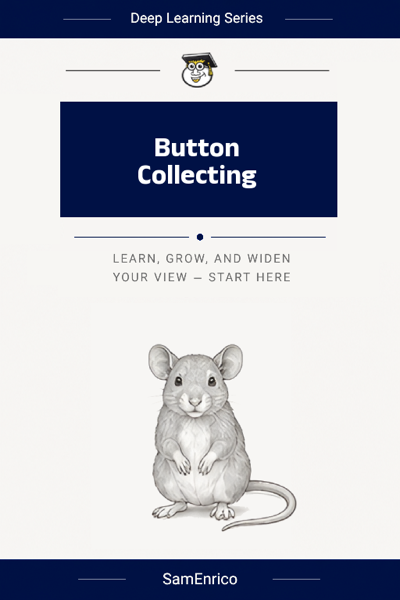
Button Collecting eBook
A Coursebook on Button Collecting
by Gaines Lacy
A Coursebook on Button Collecting
Formats
Free sample
Chapter 1: The Object You've Ignored--You have touched a button today. Perhaps several. You buttoned a shirt, fastened a coat, or adjusted a pair of trousers. In that fleeting moment—a second, maybe two—your fingers performed an action so familiar, so automatic, that your conscious mind did not register it at all. The button served its purpose.
It held two pieces of fabric together. It closed an opening. It did its job invisibly, and then you forgot about it.That forgetting is exactly what this book intends to undo.The button is the most successful failure in the history of human design. Consider this paradox: a button's highest achievement is to go completely unnoticed. When a button functions perfectly, it disappears into the background of daily life.
No one has ever exclaimed, "What a magnificent button!" while fastening their cuffs in the morning. The button's excellence is measured by its absence from thought. And yet, hidden within that tiny disk of shell, metal, glass, or plastic lies an entire universe of human history—wars fought, fortunes made, fashions born, technologies revolutionized, and lives quietly documented in miniature.This chapter makes a simple but profound argument: the button is not a fastener. It is a historical document. It is a miniature sculpture.
It is a time capsule no larger than a quarter. And once you learn to see buttons instead of merely using them, you will never look at your clothing—or your world—the same way again.The Archaeology of the Everyday Every object we touch carries traces of its origin. A ceramic mug holds the fingerprint of the potter who threw it. A wooden chair bears the grain pattern of the tree it came from. But buttons are special because they are simultaneously ubiquitous and ignored.
They exist at the intersection of mass production and personal expression, of industrial efficiency and decorative excess. To collect buttons is to practice a peculiar form of archaeology—not of buried cities, but of the buried moments in ordinary lives.Consider the button that closes your shirt. Where was it made? In what country, in what factory, by whose hands? What material is it—plastic, shell, metal?
If plastic, what kind? If shell, from what species? When was it manufactured? What does its design say about the era that produced it? These questions are not merely academic.
They are the same questions an archaeologist asks when excavating a shard of pottery or a bronze coin. The button is smaller, yes. But it is no less revealing.The earliest known buttons—discovered at the archaeological site of Mohenjo-Daro in the Indus Valley, dating to approximately 2000 BCE—were not used for fastening at all. They were decorative disks carved from shell or stone, with two small holes drilled through the center. Thread passed through these holes to attach the button to clothing as an ornament, not a closure.
The function of fastening would not arrive for another three thousand years. Think about that timeline. For three millennia, buttons existed purely as jewelry—as status displays, as spiritual talismans, as markers of identity. Only when someone, somewhere in 13th-century Germany, had the simple but revolutionary idea of cutting a slit in fabric to receive a button did the button's modern function emerge.The buttonhole changed everything. Suddenly, a button could do two things: decorate AND fasten.
The Renaissance nobility of Europe seized upon this dual function with characteristic excess. Chronicles from the 16th century describe coats so heavy with buttons—hundreds, sometimes thousands—that the wearer could barely walk. These were not practical closures. They were displays of wealth. A single gold button, encrusted with rubies and crafted by a master goldsmith, might cost more than a skilled laborer earned in a year.
To wear such a button was to announce, without a word, that you belonged to a class of people who could afford to turn functional objects into portable treasuries.The Button as Historical Witness Buttons do not merely reflect history. They participated in it. Consider the role of uniform buttons in warfare. Before the 18th century, armies were chaotic assemblies of soldiers wearing whatever clothing they brought from home. Identifying friend from foe in the smoke of battle was nearly impossible.
The introduction of standardized uniform buttons—each bearing the insignia of a specific regiment—changed military logistics forever. A general could look across a field and know, by the glint of brass buttons in the sunlight, where his regiments stood. The button became a tool of command.During the American Civil War, Union and Confederate soldiers wore buttons that identified their branch of service: eagles for infantry, crossed cannons for artillery, anchors for navy. These buttons were so symbolically charged that soldiers sometimes cut them from the coats of fallen enemies as trophies. Today, those same buttons are archaeological evidence.
A brass button found in a farmer's field in Virginia can tell a historian which regiment passed through, in which year, on which campaign. No written record could be more precise.Buttons also witness civilian history in ways that formal records miss. The Victorian era (1837–1901) produced the most elaborate and emotionally expressive buttons in history. Following the death of her beloved husband Prince Albert in 1861, Queen Victoria entered a period of mourning that lasted forty years. She wore only black.
Her court followed suit. The fashion industry responded with an explosion of "mourning jewelry," including buttons made of black glass, jet (fossilized coal), and black enamel. Millions of Victorian women, none of whom had ever met Prince Albert, wore black buttons as a gesture of sympathetic grief. A button became a political statement, a social signal, and an emotional outlet all at once.The chapter on Victorian symbolism (Chapter 6) will decode the intricate language of floral and animal motifs that appeared on these mourning buttons. But for now, understand this: a small black glass button from 1870 is not merely old.
It is a witness to a culture's collective processing of death, a tiny artifact of an entire society's prolonged encounter with grief.The Psychology of Collecting Small Things Why do people collect buttons? The question seems simple, but the answer reaches deep into human psychology. Button collectors are not outliers or eccentrics. They are participants in one of the oldest and most universal human behaviors: the gathering of small, beautiful, meaningful objects into organized assemblages.Psychologists who study collecting behavior have identified several motivations that drive collectors across all domains. The "treasure instinct" is perhaps the most fundamental.
Human beings evolved as foragers. For millions of years, our ancestors survived by scanning their environments for useful objects—edible plants, workable stones, sharp flakes of flint. The brain's reward system, which releases dopamine when we find something valuable, is exquisitely tuned to the experience of discovery. When a collector spots a rare button in a bin of common ones, the same neural circuits activate as when an ancient hominid spotted a ripe fruit on a distant branch. The pleasure of the find is biological, not merely social.The "completion drive" is another powerful motivation.
Many collectors feel an almost physical need to finish sets: all the buttons from a particular manufacturer, all the designs…
This is the end of the free sample. Get the eBook to keep going. Buy now
About this book
Details
- Author
- Gaines Lacy
- Publisher
- SamEnrico
- Language
- English
- Genre
- Non-Fiction, Informative, Educational
- Released
- 2026-05-25
- Pages (approx.)
- 158
- Available as
- eBook, Audiobook

Read better in the ZLOADR app
Your eBooks on your phone or tablet. Sign in with your SamEnrico account and start reading.
More by Gaines Lacy
 Wandering Mind Acceptance CourseGaines Lacy$11.99
 Food Intolerance and HistamineGaines Lacy$11.99
 Complicated Grief Self Help GuideGaines Lacy$11.99
 Product Manager Creative GuideGaines Lacy$11.99
 The Four Days' Battle: The Naval War That Shattered a Sea EmpireGaines Lacy$11.99
 The Blue Zone Purpose FactorGaines Lacy$11.99
 Understanding Sterility Due to Immotile FlagellaGaines Lacy$17.99
 Supplier Portal Self ServiceGaines Lacy$12.99
 Cash Flow AI PredictionGaines Lacy$12.99
 How to Become a Sheet-metal-pattern CutterGaines Lacy$11.99