
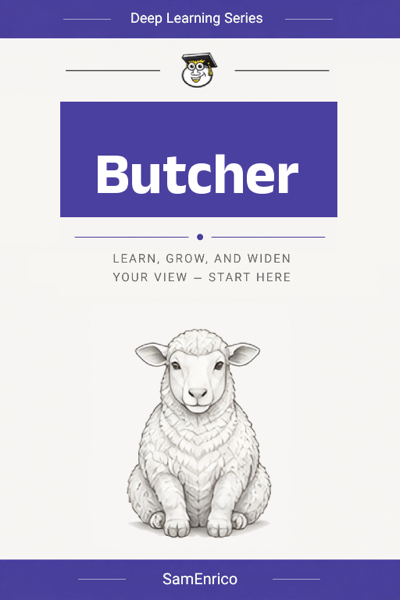
Non-FictionInformativeEducational
Butcher eBook
A Coursebook on Butcher
A Coursebook on Butcher
Formats
Free sample
Chapter 1: The Lost Knife...–- I remember the exact moment I realized I had been lied to about meat. It wasn’t in a slaughterhouse or a butcher shop. It was in a grocery store aisle, staring at a package of “boneless skinless chicken breasts” that cost more per pound than the whole chicken sitting two feet away. I stood there for a full minute, doing the math in my head. The whole bird was cheaper.
But I didn’t know how to break it down. So I paid the premium for ignorance. That day, I spent 8.99ontwobreaststhatcamefroma8.99 on two breasts that came from a 8.99ontwobreaststhatcamefroma5.99 bird. The butcher—whoever had cut it—had made money. The grocery store had made money.
I had lost money and learned nothing. That was the day I bought my first whole chicken, took it home, and made a mess of my kitchen counter. Blood on the cutting board, feathers still attached near the spine, and a vague sense that I had crossed some invisible line between consumer and participant. That chicken taught me my first lesson in butchery: the cost of not knowing is always higher than the cost of learning.The Grocery Store Lie Let me tell you a harder truth. The modern meat industry doesn’t want you to know how to butcher.
They want you dependent. They want you walking past those whole birds and grabbing the tray of pre-cut filets with the oversized label and the premium price tag. Every step removed from the whole animal is a step where someone takes a cut of your money. The slaughterhouse takes a cut. The processor takes a cut.
The distributor takes a cut. The butcher at the grocery store takes a cut. And by the time that shrink-wrapped package hits your hand, you’ve paid four or five different people for a job you could have done yourself in twenty minutes with a sharp knife and a little courage.I’m not saying this to make you angry. I’m saying it because anger is a terrible teacher, but clarity is not. The clarity is this: when you buy a whole animal or even a whole primal cut, you are buying meat at its wholesale price.
When you buy pre-cut steaks, pre-ground beef, pre-trimmed roasts, you are paying retail for labor you already possess the capacity to perform. The average American family spends 3,000to3,000 to 3,000to5,000 on meat every year. A family that learns basic butchery can cut that bill by thirty to fifty percent. That’s not a coupon. That’s a skill that pays you back every single time you cook.The Chicken That Changed Everything Back to that first chicken.
I didn’t know what I was doing. I had watched a three-minute You Tube video hosted by a man with a thick Southern accent and a knife that looked like a sword. He made it look easy. He slid his blade along the breastbone like he was unzipping a jacket. The meat fell away in perfect white slabs.
He separated the thigh from the hip with a twist and a cut that took less than two seconds. By the time the video ended, he had eight perfect pieces and a carcass that looked like an anatomical model.My chicken looked like a crime scene.I cut my thumb on the wishbone. I tore the breast meat trying to follow the rib cage. I confused the oyster (that delicious nugget of dark meat on the back) with a piece of gristle and threw it in the trash. The thighs came off with ragged edges and bits of backbone still attached.
When I finally finished, I had seven irregular pieces, a pile of bone shards, and a deep respect for anyone who did this for a living. But I also had dinner. I cooked those ragged thighs in a cast iron pan with butter and thyme. My wife, who had watched the entire fiasco from the kitchen table, took one bite and said something I have never forgotten: “This is the best chicken you’ve ever made.”It wasn’t magic. It wasn’t a secret recipe.
It was the simple fact that I had cut the meat myself, minutes before cooking it. The breasts hadn’t been sitting on a foam tray for three days. The thighs hadn’t been shocked by refrigeration and shipping. The meat was fresh, unprocessed, and exactly as the animal had grown it. That chicken taught me the second lesson of butchery: fresh meat, properly handled, tastes better than anything that comes in a package.What This Book Is—And What It Is Not Before we go any further, let me be clear about what you are holding.
This is not a coffee table book of pretty photographs. It is not a theoretical treatise on meat science. It is not a collection of recipes disguised as a butchery guide. This is a coursebook. It is designed to be used with your hands dirty, your knife sharp, and your counter covered in meat.
You will spill blood on these pages. You will write notes in the margins. You will dog-ear the chapters that matter to you and return to them when you forget the difference between a Boston butt and a picnic shoulder.This book is also not a substitute for experience. I can describe the feel of a knife sliding along a femur until I run out of words. You will not understand it until you do it.
So this book is structured around action. Each chapter builds on the last. You will start with poultry because chickens are small, cheap, and forgiving. You will move to pork because pigs are built like us—their anatomy makes intuitive sense. You will tackle beef only when you have the confidence and the skill, because a half-cow costs a thousand dollars and mistakes are expensive.
And throughout, you will learn not just the techniques but the philosophy: respect for the animal, efficiency of movement, and the quiet satisfaction of self-reliance.The American Amnesia We have forgotten something important. For most of human history, butchery was not a specialty. It was a chore. It was what you did on Tuesday because the pig had been slaughtered on Monday and you needed to eat on Wednesday. Every homestead had a smokehouse.
Every farm wife knew how to render lard. Every hunter could field-dress a deer before the blood cooled. These were not marks of expertise. They were marks of survival.The twentieth century changed that. Refrigeration meant you could store meat without salt or smoke.
Supermarkets meant you could buy meat without seeing the animal. Food safety regulations, for all their benefits, created a culture of fear around raw meat. We started treating butchery as something dangerous and disgusting, best left to professionals with stainless steel tables and high-pressure hoses. We outsourced our food and, in doing so, outsourced our competence.I am not romanticizing the past. I do not want to live without antibiotics or indoor plumbing.
But I refuse to accept that the only way to eat meat is to buy it in anonymous packages from…
This is the end of the free sample. Get the eBook to keep going. Buy now
About this book
Details
- Author
- Clemmons Belkis
- Publisher
- SamEnrico
- Language
- English
- Genre
- Non-Fiction, Informative, Educational
- Released
- 2026-05-04
- Pages (approx.)
- 145
- Available as
- eBook, Audiobook

Read better in the ZLOADR app
Your eBooks on your phone or tablet. Sign in with your SamEnrico account and start reading.
More by Clemmons Belkis
 Spin Class Sprint Interval GuideClemmons Belkis$11.99
 Phobia Cognitive Behavioral TherapyClemmons Belkis$11.99
 Social Confidence Building GuideClemmons Belkis$11.99
 Cyberstalking Law Enforcement FailuresClemmons Belkis$11.99
 Antwerp Diamond Heist Daring DisguisesClemmons Belkis$11.99
 Velvet and Steel: The Unlikely Rise of Yoko OnoClemmons Belkis$11.99
 Mapping the Abyss: The Deep-Sea Pioneers of the Coral SeaClemmons Belkis$11.99
 Understanding Dopamine Beta Hydroxylase DeficiencyClemmons Belkis$17.99
 Retail Worker DemandsClemmons Belkis$12.99
 AI SEO Tools GuideClemmons Belkis$12.99
 How to Start a Sewing Store BusinessClemmons Belkis$11.99
You may also like
 Hong Kong Handover 1997Dunn Johnnie$11.99
 Zumba For Postnatal Recovery CourseNeal Christian$11.99
 Zumba for BeginnersLadner Nikia$11.99
 YouTube Comment Mining GuideHumes Pandora$12.99
 Worry Box MeditationCarlin Rudy$11.99
 Workplace Stress MeditationNguyen Lynn$11.99
 Workplace Stress and Sleep RepairHawley Ivory$11.99
 Workplace Perfectionism CureDelaney Jeffry$11.99
 Workplace Injustice Anger GuideWallen Isabelle$11.99
 Work Addiction and Burnout LinkGreenwood Ester$11.99
 Women in Yoga and WellnessBeattie Galina$11.99
 Women in Stand Up ComedyChun Evangeline$11.99