
Non-FictionInformativeEducational
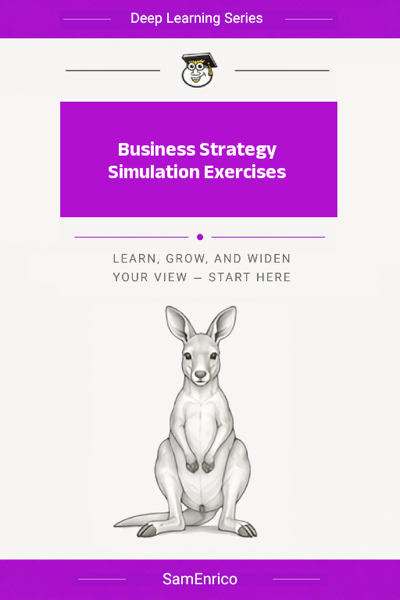
Business Strategy Simulation Exercises eBook
A Coursebook on Business Strategy Simulation Exerc
by Gilbert Mack
A Coursebook on Business Strategy Simulation Exercises
Formats
Free sample
Chapter 1: The Judgment Crucible--Every year, thousands of business students across the world will enter a simulation with the same misguided belief. They believe that victory belongs to the team that masters the spreadsheet. They spend hours building elaborate Excel models, calculating optimal R&D spend to three decimal places, and reverse-engineering the demand algorithm. They treat the simulation like an equation to be solved. And then, when the final round ends and they finish in third place, they are genuinely confused.
"Our numbers were perfect," they say. "The math said we should have won."The math lied. Not because the math was wrong, but because the math was never the point.The purpose of a business strategy simulation is not to teach you arithmetic. It is to teach you judgment. And judgment, unlike a formula, cannot be reverse-engineered.
It cannot be downloaded. It cannot be copied from the team that won last semester. Judgment is the ability to make a high-quality decision when the data is incomplete, the future is uncertain, and the consequences matter. It is the skill that separates the CFO who saves the company from the CFO who bankrupts it, even though both had access to the same spreadsheets. It is what the top 10 percent of managers possess and the bottom 90 percent spend their careers chasing.This chapter is called The Judgment Crucible because a crucible is a container used to heat substances to extremely high temperatures, purifying them by burning away impurities.
That is what this book and your simulation experience will do to you. You will make decisions under pressure. You will watch some of those decisions fail. You will feel the heat of competition, the sting of a lost round, the humiliation of being outmaneuvered by a rival team. And slowly, painfully, the impurities in your thinking will burn away.
What remains will be judgment.Why Business Schools Are Finally Embracing Simulations For decades, the case study was the undisputed king of business education. Harvard Business School perfected the format in the 1920s, and by the 1980s, nearly every reputable MBA program had followed suit. The logic was sound: students learn by analyzing real companies facing real problems. They debate alternatives, commit to a recommendation, and defend their reasoning. It is active learning, not passive listening.
What could be better?The problem, as research has increasingly shown, is that case studies train students to analyze the past, not navigate the future. When you read a case study about Apple's decision to remove the headphone jack, you already know that the i Phone survived and thrived. You already know that consumers eventually adapted to wireless earbuds. Your analysis is inevitably colored by this knowledge, even if you try to bracket it. More fundamentally, you face no personal consequence for being wrong.
If you argue that Apple should have kept the headphone jack, the professor will simply ask a follow-up question. No profits evaporate. No customers defect. No board asks for your resignation. The stakes are purely social — and social stakes are not the same as economic stakes.Simulations solve both problems simultaneously.
First, they strip away hindsight bias because the future is genuinely unknown. When you submit your pricing decision for Quarter 3, you have no idea what your competitors will do. You have no idea whether demand will shift. You have no idea if the macro-economic indicators in the simulation will turn against you. You are making a genuine bet, not analyzing a foregone conclusion.
Second, simulations impose real consequences. Not financial consequences, but psychological ones. When your team's stock price plummets because you misjudged capacity requirements, you feel it. Your teammates look at you differently. You look at yourself differently.
That discomfort is the crucible heating up.Leading business schools have recognized this. Stanford's MBA program now requires a multi-week simulation in its core strategy course. MIT Sloan uses simulations to teach supply chain management. INSEAD has integrated simulation-based exercises into executive education programs for companies like L'Oréal and Siemens. Even Harvard Business School, the cathedral of the case method, has incorporated simulations into its first-year curriculum.
The shift represents a fundamental recognition: analysis is necessary but insufficient. Judgment is the missing ingredient, and judgment cannot be taught through cases alone.The Four Pillars of Simulation Judgment What exactly is judgment in the context of a business simulation? After analyzing dozens of simulations and interviewing hundreds of successful participants, I have identified four distinct pillars that support every winning strategy. These pillars run throughout this book, and they will appear in every chapter. Understanding them now will orient you for what follows.Pillar One: Tolerance for Uncertainty.
Most students enter simulations desperate for certainty. They want to know exactly how much to spend on advertising. They want a formula that converts R&D spending into market share. They want the simulation to be predictable. But simulations — like real markets — are not predictable.
They are probabilistic. The best decision can produce a bad outcome if a competitor acts irrationally or if random variation turns against you. Judgment requires the ability to make a decision without knowing the outcome, and then to evaluate that decision based on the information you had at the time, not the outcome that occurred. This is counterintuitive, and most students never master it. They confuse a lucky win with a smart decision, and an unlucky loss with a stupid one.
The best simulation participants learn to separate process from outcome.Pillar Two: Integrated Thinking. Most business courses teach functions in isolation. You take marketing, then finance, then operations, then strategy. Each course has its own textbook, its own professor, its own vocabulary. This creates a dangerous mental habit: students learn to think about problems through a single functional lens.
A marketing student sees every problem as a branding problem. A finance student sees every problem as a capital allocation problem. A simulation destroys this luxury because decisions cannot be made in isolation. When marketing cuts price, finance must fund the lower margins. When operations reduces inventory, marketing loses buffer stock.
When R&D changes a product's specifications, production must retool the factory. Judgment requires seeing the whole system, not just your favorite piece of it.Pillar Three: Emotional Regulation. Simulations are emotionally intense. The public ranking of teams, the visible stock price, the weekly leaderboard — all of this triggers competitive anxiety. Students respond to this anxiety in predictable but self-destructive ways.
Some freeze, making minimal changes each round to avoid the risk of a big loss. Others panic, thrashing wildly from one strategy to another, never allowing any approach time to work. Still others become overconfident after a single good round, doubling down on what worked once without considering whether it will work again. Judgment requires the ability to feel the anxiety, acknowledge it, and then set it aside while you analyze data and evaluate options. This is not easy.
It requires practice. But it is essential.Pillar Four: Probabilistic Reasoning. The world is not deterministic. Neither are simulations. When you cut price, demand usually increases, but not always.
When you increase advertising, market share usually rises, but not always. When you invest in R&D, your product usually improves, but…
This is the end of the free sample. Get the eBook to keep going. Buy now
About this book
Details
- Author
- Gilbert Mack
- Publisher
- SamEnrico
- Language
- English
- Genre
- Non-Fiction, Informative, Educational
- Released
- 2026-05-06
- Pages (approx.)
- 156
- Available as
- eBook, Audiobook

Read better in the ZLOADR app
Your eBooks on your phone or tablet. Sign in with your SamEnrico account and start reading.
More by Gilbert Mack
 Market Sizing Early Idea GuideGilbert Mack$11.99
 Living at Home Student StressGilbert Mack$11.99
 Intermittent Fasting for AthletesGilbert Mack$11.99
 Nicotine Free Workplace InitiativeGilbert Mack$11.99
 John McCain MaverickGilbert Mack$11.99
 HGH Black Market DangersGilbert Mack$11.99
 TM for MathematiciansGilbert Mack$11.99
 The Team Creative TriggersGilbert Mack$11.99
 Teen Body Positivity GuideGilbert Mack$11.99
 Pets.com: The Dot-Com Puppy That Never BarkedGilbert Mack$11.99
 Frozen Shadows: The X-Ray Expedition That Lit Up AntarcticaGilbert Mack$11.99
 The Sky’s Silent Witness: How Weather Balloons Uncovered a Cold War ConspiracyGilbert Mack$11.99
You may also like
 Hong Kong Handover 1997Dunn Johnnie$11.99
 Zumba For Postnatal Recovery CourseNeal Christian$11.99
 Zumba for BeginnersLadner Nikia$11.99
 YouTube Comment Mining GuideHumes Pandora$12.99
 Worry Box MeditationCarlin Rudy$11.99
 Workplace Stress MeditationNguyen Lynn$11.99
 Workplace Stress and Sleep RepairHawley Ivory$11.99
 Workplace Perfectionism CureDelaney Jeffry$11.99
 Workplace Injustice Anger GuideWallen Isabelle$11.99
 Work Addiction and Burnout LinkGreenwood Ester$11.99
 Women in Yoga and WellnessBeattie Galina$11.99
 Women in Stand Up ComedyChun Evangeline$11.99